
Translated material
Billion
FIFA has a good championship income
Despite the fact that the Russian team in South Africa did not break through, the Russian state is now fighting in Johannesburg for the right to hold the 2018 World Cup. And there is a very serious financial reson in this: the World Cup-a colossal business project with a budget of $ 3.6 billion. Who will go and how much it will get-the New Times found out
Who will win the world championship in South Africa: Brazil? Spain? Argentina? Italy? Do not guess: the main triumph is already known - this is the International Football Federation (FIFA). Moreover, her gain was predetermined even before the first blow to the ball. According to the calculations of the Secretary General of the Federation, Jerome Valka, the net profit from the 2010 World Cup will be $ 1 billion. At the same time, FIFA will receive the main income from the sale of rights to broadcast matches and from sponsor companies.
Dear broadcasts
Over the past 20 years, the International Football Federation has learned to fully use the technological and marketing potential of the global economy, experts of the Times newspaper say. In fact, FIFA - for nothing that has the status of a non -profit organization
* * According to the Law of the Swiss Confederation, where the FIFA headquarters are based, this organization is exempted from paying taxes to the state treasury. -It earns so that any business corporation would not be ashamed to learn. Even in the “quiet” years - without world championships - the federation makes a profit of about $ 700 million. And during the years of world championships, this figure increases by 2-3 times. The secret of such commercial success is simple and understandable: at the disposal of FIFA is a “product” that television and sponsors consider one of the most attractive in the world - a game of football.
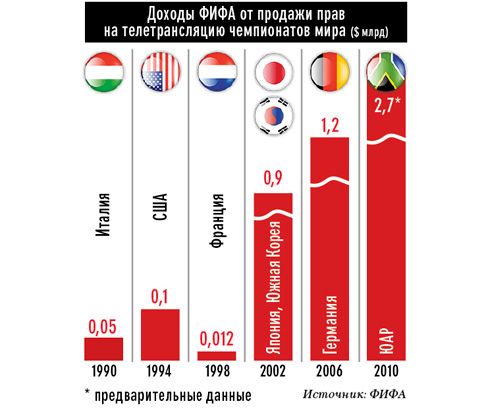
Television ratings are evidenced by: the world championship in football is traditionally one of the most “watcable” events in the world. The previous championship in Germany in 2006 broke all records in this sense: then during the month of broadcasting matches they were watched by 50.4 billion people (that is, on average, every resident of the land, including infants, 7.5 times). Is it worth it to be surprised that FIFA sells the rights to television on television at all higher prices from the championship to the championship. For example, for the right to show matches from Germany in 2006, the Federation received $ 1.2 billion, and the sale of rights to the television of the championship from South Africa has already brought FIFA $ 2.7 billion.
As the New Times explained at the Telezport sports marketing agency, FIFA can afford to increase the prices at times: the rights to show the matches of the World Cup are still sold out by national television channels. Due to the highest broadcast ratings and, as a result, they “beat off” all costs. In Russia, the broadcast of all matches of the championship was divided among themselves Channel One and VGTRK. The amount for which they bought rights is not called there, but independent experts estimate the deal at $ 1–1.5 million. At the same time, experts of Telesport say, advertising prices during the show of matches on the First Channel, Russia 1 and Russia 2 were approximately 30% lower than those on which Euro 2008 was “sold”. The reason is the absence of the Russian team at the current mundial. However, television people will still not remain in the same way: the basic value of one minute of advertising in matches on Channel One and Russia 1 was estimated at 3.5 million rubles with VAT, at Russia 2 - 350 thousand rubles with VAT. It should be borne in mind that advertising is sold by packages that suggest discounts: the larger the package, the higher the discounts. The maximum discount is for companies that bought advertisements for all 192 championship matches. * * On the first and “Russia 1” - 32 broadcasts, on “Russia 2” - 128, taking into account repetitions. According to television experts, each football match of the World Cup “framed” 8-10 advertising minutes (before the match, in the break and immediately after the end). Accordingly, even taking into account discounts, Russian television channels can count on $ 2.5-3 million advertisers.
Competition of brands
The second most important article FIFA at the World Cups are sponsorship contracts. This year, the Federation plans to receive about $ 3 billion from companies. Now Adidas, Coca-Cola, Emirates Airline, Hyundai, Sony, Visa are general sponsors of the championship.
Why did these companies have the choice of football authorities? The Moscow representative office explained: their company three years ago won an open competition for the right to be a sponsor of the World Cup. To get around it, such serious competitors as Nike and Puma, Adidas paid $ 350 million for a seven-year contract (the term of which expires after the 2014 World Cup in Brazil). And now the company is the main official partner of FIFA, supplying balls and equipment for officials and referee. Of the 32 teams in South Africa, Adidas is an official partner of 17.
“Adidas is beneficial for a sponsorship contract with FIFA, not only because the products of this brand receives exclusive conditions for the sale of South Africa on sports arenas,” explains Andrei Rumyantsev, an expert at the sports marketing agency. “They launch entire lines of new products under the advertisement of the World Cup.” Examples of this are the official ball of the Jabulani World Cup and Superly F50adizero sneakers, the sales of which Adidas began around the world just a few days before the start of the championship in South Africa.
According to the agreement with FIFA, sponsors receive exclusive rights to use the symbols of the championship in their product categories (soft drinks, photo and computer equipment, electronic payment equipment, etc.), as well as the right to supply their goods and services to ensure the championship. So the Powarade drink, which produces Coca-Cola, has become an official sports drink of the championship.
Everyone wants to get into the number of selected sponsor brands, and everyone wants to earn extra money (even in doubtful ways). Say, Nike, which is not one of the official sponsors, uses the advertising topic of self -improvement of the athlete to some “superhuman” heights. As advertisements - all football stars. The official sponsor of the 2010 ADIDAS championship has already complained to FIFA Nike.
However, the struggle for the "purity" of the sponsorship rows is by no means South African specifics. During the 2006 World Cup, 3300 violations of sponsorship in 84 countries were registered in Germany. Interestingly, the companies received perhaps the best PR than the officially paid. The initiative of the German airline Lufthansa, which placed football balls on the nose of their aircraft, had a wide resonance. Considering that the championship was held in Germany, the fans were sure that they were flying on the cars of the official carrier of the competition. Meanwhile, the Arab airline Emirates paid for this right. And today, some companies show remarkable ingenuity to use the advertising capabilities of the World Cup for free. The South African airline Kulula received a warning from FIFA, which tried to advertise itself as a "unofficial national airline of the Sami-Know-to-do." At the moment, according to FIFA manager for copyright protection MPUMI MAZibuko, the Federation filed 2500 claims to stop the illegal use of her brands and brands - of which 450 in only one South Africa.
Hope for profit
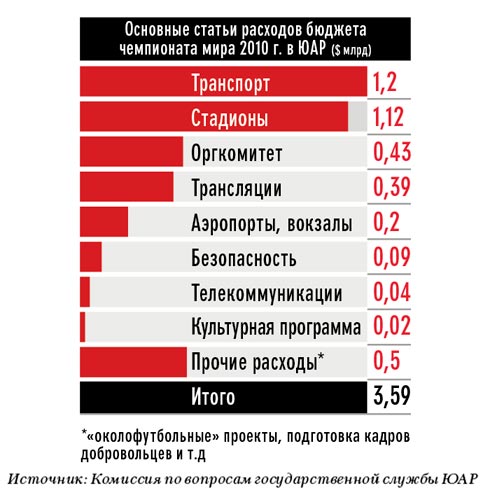
It was in South Africa that Russia presented its application book for the right to accept the 2018 World Cup. The enthusiasm of the authors of this initiative can be understood: the owners of the championships, with all their solid costs, as a rule, remain according to the results of the championships with profit, albeit not as significant as FIFA. South Africa is no exception. And this despite the fact that the World Cup in South Africa cost a penny: direct expenses for organizing and promoting the tournament amounted to about $ 3.6 billion. The most costly article of such competitions for organizing countries is always the construction and reconstruction of sports facilities. After all, most often they are either completely absent or do not comply with FIFA standards. South Africa was lucky: although 5 new stadiums were built for the championship, and 5 more were reconstructed, due to the relative cheapness of materials and labor, it cost only $ 1 billion. For comparison: South Korea and Japan, which took the 2002 championship, spent $ 5 billion on stadiums. The holding of the tournament will cost South Africa $ 1.6 billion, And another $ 1 billion was aimed at promoting the championship. "
Despite the fact that every year the cost of the sponsorship contract of the world championships is growing, the number of firms who want to participate in the financing of the mundial is constantly increasing
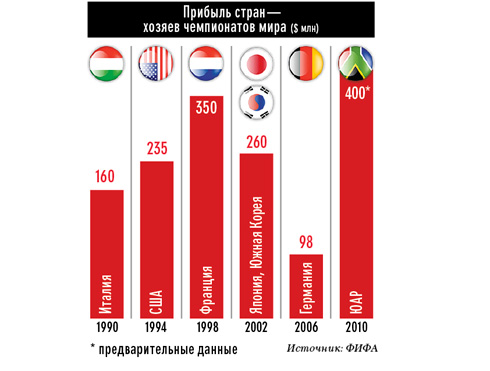
“However, despite the billions of billion costs, the South African authorities have no doubt that the profit will be able to get as a result. The fact that the World Cup is a very profitable enterprise, its organizers understood back in 1930, during the first world championship in Uruguay. Then the amount of $ 255 thousand was earned at that time. In subsequent years, the profit of the countries from the World Cup was calculated by billion. Germany earned about $ 98 million at the championship. And despite the fact that the Germans laid out for the construction of several ultra -modern arenas and other infrastructure about $ 6 billion. France held its championship in 1998 with lower costs, which brought it $ 350 million.
South Africa plans to beat this achievement: according to preliminary calculations, the revenue from the championship will be at least $ 4 billion, which will bring about $ 400 million profits to the organizing country (taking into account the above costs).
However, there are many skeptics among football marketers who call not to rush into euphoria: the mundial is first held on the African continent, and the business model that made profit to such organizational countries as Germany, France, Japan and the United States should also prove its effectiveness for South Africa.