
Translated material
June nightmare
Interethnic clashes in Kyrgyzstan
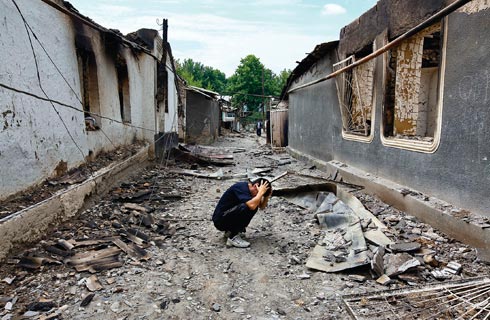
Kyrgyzstan suffered grief, from which the country would not recover soon. The massacre between the Uzbeks and the Kyrgyz in the south of the country, according to official figures, took away the lives of 200 people, according to unofficial, much more believable, who died more than 2 thousand UN counted 275 thousand refugees, of which 80 thousand went to the territory of Uzbekistan, independent observers - almost twice as much. There was no drama of this scale in Central Asia. The New Times was versed in its reasons and lessons
What is interethnic conflict, they know well in Osha: exactly 20 years ago, there was already something similar in the neighboring Uzgen region. But everyone who survived 1990 admits: this time the actions of the pogroms were coordinated much better. Then the clashes began spontaneously, now the Kyrgyz and Uzbeks skillfully pulled the provocateurs. Then the city itself was not injured. Now in Osh, the “southern capital” of Kyrgyzstan, there are practically no shops and bazaarov, catering enterprises - everything has been destroyed. What are the shops - everything that is somehow connected with the Uzbeks is turned into ruins. The regional administration remained untouched, some other state institutions. So they are framed by almost completely empty quarters: the Uzbeks went to the border with Uzbekistan, the Kyrgyz - in mountain villages. The surviving houses and apartments are looted by looters: even if the former owners return, they will have to start life from scratch.
How to live?
“In our entire entrance, I was left alone, in the neighboring one - only one family. The rest everyone ran away, ”says Osh lawyer Arsen Ambaryan. He lives in the Cheremushka microdistrict, which became the epicenter of the conflict: “Today he decided to leave the house. I walked a little. A terrible sight. Ghost city. " Things are a little better in Jalal-Abad: the objects of trade, catering, entertainment were almost completely destroyed, the buildings of the regional state company, customs, and some schools were burned. The University of Friendship of Peoples, belonging to the leader of the local Uzbek community, and one of the corps of the State University, suffered from the fire. The Ministry of Finance of Kyrgyzstan has already allocated 50 million soms (approximately $ 1 million 100 thousand) for the restoration of Osh and 10 million-Jalal-Abad. Obviously, this money is not enough. Most of the problems with the construction of new houses to the Oshtsy and Jalalabads decide for themselves. Meanwhile, the south of Kyrgyzstan was always poorer than the North. In fact, it is this factor that is based on disagreements between the two parts of the country. Now the south has become even poorer and very far from its reconciliation with the north.
I don't understand mine
In 1990, unrest in Osh was suppressed with the help of the internal troops of the USSR and almost the total replacement of party and police leaders from among the Kyrgyz on Russian-speaking. Now there are almost no Russian -speaking personnel in the police and the authorities, and the Big Brother refused to send the troops. So quickly suppressing the conflict and drive it underground will not work.
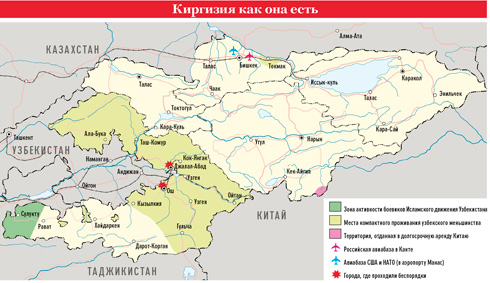
“In the past 20 years, the problems of interethnic relations in the Kyrgyz south did not resolve at all,” the head of the public fund “For International Tolerance” of Raya Kadyrov, complains in a conversation with The New Times. “The calls of the provocateurs lay on fertile ground.” Uzbeks in Kyrgyzstan - 1 million 200 thousand people, almost 20% of the population of the republic. Most live in Jalal-Abad and Osh regions. At the same time, the Uzbeks are in no way represented in the authorities of the supreme power. They have not a single more or less significant post in state administrations of regions, districts, cities. There are, however, frail exceptions. After the “Revolution of the Tulips” of 2005, the Governor of the Osh region was not long stayed by the Uzbek, the fiery oppositionist Anvar Artykov. And in the current government, Uzbek Bakhtiyar Fattakhov heads the local government agency. But Uzbeks always had a good representative office in the Jogorku Kenesh (parliament): their candidates were elected here in single -mandate districts and on party lists.
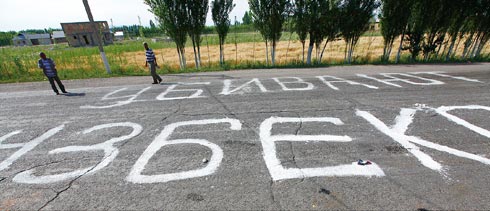
The Uzbeks neatly hinted: it would be nice to give a national minority at least one ministerial post. What did you always receive one answer: can you imagine that Kyrgyz will receive the post of minister in Uzbekistan? The same argument was used by the Kyrgyz authorities and, in response to the request of the Uzbeks, make their language the second official. In fairness, it should be noted: in Uzbekistan, really the representative office of the Kyrgyz in the supreme power is impossible. But after all, the Kyrgyz in Uzbekistan is much smaller. In recent years, the number of Uzbeks in Kyrgyzstan grew, the Kyrgyz in the Osh and Jalal-Abad regions declining. The young generation of Kyrgyz is leaving the south in search of earnings either to the north of the country or to Kazakhstan or Russia. Uzbeks rarely leave. If this goes on, sooner or later Uzbeks in the south will become larger than the Kyrgyz. And then their political and social requirements will become even more stringent. Meanwhile, now the Kyrgyz population is annoyed every time it comes to the concessions of the Uzbeks. On the Kyrgyz nationwide television channels there are no programs in the Uzbek language? You, you might think, in Uzbekistan will be allowed by Kyrgyz -speaking broadcasting ...
Third forces
The conflict was provoked by the “third forces”, namely, the overthrown President of Bakiev and his environment, the Provisional Government assures. Many in the republic agree with this. Raya Kadyrov says: “The representatives of our organization at the very beginning of the conflict heard scraps of conversations in Osh: in one part of the city, a person in the crowd tells his interlocutor on a cell phone:“ When will you bring the promised cargo? We are tired of throwing stones! " The conversation was probably about weapons. And in another part of the city they recorded such a conversation: “You said that Tokmak will rise (a city in the north of Kyrgyzstan, 60 kilometers from Bishkek, where many Uzbeks live. - The New Times)?” So, it was planned to provoke clashes in the north. ” But what, for example, says the nameless eyewitness of the Osh pogroms, whose letter diverged on the Internet: “I was convinced that most pogromers were organized into groups from 500 to 2000 bastards armed to the teeth. All mostly visitors from remote villages and areas. Ahead of large groups was usually a combat vehicle of infantry (BMP), followed by people armed with machine guns, and then a crowd with knives, sticks and reinforcement. Mahali (areas of compact residence of the Uzbeks), such as, for example, Shahit Tepa, took large groups. Small attacked smaller areas. Yesterday (June 13. - Approx. Aut.) ICC had to come, when these crowds would have agreed in one place, capturing the city, destroying or expelling almost the entire local population. Following Osh, Jalal-Abad had to fall. ”
Literally the next day, June 14, after the arrest in the UK, Maxim Bakiev, the youngest son of the former head of the state, the conflict in the south went to decline, the process of stabilization began. From this fact, many made a definite conclusion: the provocateurs lost their brain center. And this is what is indicative: the problems of relations between the Kyrgyz and Uzbek peoples immediately faded into the background.
The myth of peacekeepers
Will the Kyrgyz and Uzbeks be able to forget the June nightmare? After all, even now, the Uzbek population of Osh is afraid to leave his Mahalley for humanitarian aid. The Uzbeks categorically refuse to receive medical care from the Kyrgyz doctors. And the inhabitants of Nariman, one of the suburban Osh villages mainly with the Uzbek population, still do not allow government representatives and shoot at all moving objects. Will people forgive each other with all the evil that reigned in two cities of the Kyrgyz south for almost a week? Question. Now in the republic there are many supporters of the input of peacekeeping forces, which often mean Russian troops. A week ago it seemed that this was the only way out of the situation. When information appeared on the Internet, they say, paratroopers from Ulyanovsk fly in Bishkek, many have hope: thank God, they will soon put things in order, as in 1990. But the peacekeepers never appeared. Kyrgyzstan was left alone with its problems.
“Russia was ready to send troops to the Kyrgyz South, but with the condition that the Provisional Government will cancel the referendum planned on June 27 on the project of the new Constitution, which provides for the transition to the parliamentary form of the board,” the New Times said on anonymity, a high -ranking official source in Bishkek. - After which the government was supposed to rewrite the draft constitution and preserve the presidential republic in Kyrgyzstan. Our leadership refused. "
If only the order was
Now in anxious expectation there is already the Kyrgyz North. Rumors of the preparatory riots in the capital crawled along Bishkek and his suburbs. In the Bishkek of the Uzbeks itself, there are few more, there are much more of them in Tokmak, which is 60 kilometers from the Kyrgyz capital. The interim government does not hide: the danger of riots in the north really exists. Talks are heard everywhere: unknown people on cars without numbers go through Bishkek and ask at passers -by, where the Uzbeks live. And the longer the alarm lasts, the more Bishkek people advocate entering foreign troops. Not necessarily with "peacekeeping" - with any mission. If only they would put things in order.
From one bondage and to another
The Ferghana Valley of Uzbekistan presents an outside observer quite unusual for these places a picture: refugee camps, each of which is surrounded by an iron lattice. Now, according to the Ministry of Internal Affairs of Uzbekistan, the number of refugees - ethnic Uzbeks from neighboring Kyrgyzstan reached 100 thousand, and the line from the Kyrgyz side of the border does not decrease, although the pogroms have practically stopped. Uzbekistan officially accepted 45 thousand people, after which he closed the border to the castle, and he actually placed in the Uzbek territory missed by the “line of sedimentation”. 57-year-old Fatima Adylova (the surname was changed at her request), he was able to move to a far family to Andijan. “We were saved from beating, we thought they would give us shelter and bread, but it turns out, we came to jail,” she complains. According to her, the relatives of many of her friends do not want to accept their relatives from Kyrgyzstan out of fear of violating the order of the authorities who have forbidden the new Uzbeks free movement around the country. Meetings of relatives, says Adylov, are now taking place “chastely” - hug through a bars in the refugee camps.
“The local authorities are afraid to“ lose us ”because he is going to send him back soon. But we have nowhere else to return, ”says Adylova. Many refugees who managed to find shelter with Rodney catch the police and puts in special receivers-distributors for homeless people. “They say that there is worse than in Osh - one dirt and illnesses,” Adylova laments.
Even more local "homeless" refugees from Kyrgyzstan are scared by rumors that the Uzbek authorities will soon begin sending aliens to their homeland "organized, in large parties." But many of them hoped, if not for political asylum in the historical homeland, then at least the opportunity to stay here as long as possible, until there was complete confidence in the safety of the return.
Ivan Safranchuk,
Associate Professor of the Department of World Political Processes MGIMO (U):
Nobody will send troops to Kyrgyzstan. The input of the Uzbek troops is unacceptable for Bishkek. Kazakhstan now does not need this either: the attitude of Nazarbayev, who was closely connected with Bakiev, is not completely clear and positive to the new Kyrgyz authorities. Despite the fact that a significant part of the banking business, real estate sales, and the recreational sector on Issyk-Kul belongs to Kazakhs. There are a lot of Kazakh investments in Kyrgyzstan.
And if Russia had introduced the peacekeeping contingent, it doesn’t matter, by a bilateral agreement or under the CSTO flag, China would look at this with a very great suspicion. He will not say no. But he will have a question: is this for a long time? And who will be guarded by the Kyrgyz-Chinese border? And whether all this will lead to the creation of the Kyrgyz-Russian Confederation-such proposals in Kyrgyzstan sounded. Moreover, Russia has serious economic interests in Kyrgyzstan: we are building hydroelectric power stations there, we invest in engineering, and mining industry. There is another aspect: no one in Moscow to the end certainly knows the essence of those mechanisms that lead to riots on the post -Soviet periphery. Remember, the military was sent to Sumgait in the late 1980s. And they did not understand what was happening there, for which the Azerbaijanis cut the Armenians, and vice versa. The military also received there on the first number of both from those and others, beast and began to do something indecent, and for this they were even more beaten.
As far as I can judge, in the Russian leadership, in power structures there are those who believe: it would be great to strengthen in Kyrgyzstan due to “restoring order”. Well, we send a hundred or thousand people: what if they kill any of them or they will kill someone? Or will a thousands of crowds go to them? The situation is not at all victorious. From my point of view, people who were controlled by Ramzan Kadyrov would have been best coped with the situation. They would have figured out on the spot there and protect themselves, and they would have brought the order to a certain one. But the uncertainty of the internal Kyrgyz situation will probably restrain Moscow.
The Chinese will not introduce troops into Kyrgyzstan, even if they are asked about it. They have no experience of this kind of operations in this territory, although the Chinese interests in Kyrgyzstan are both economic and political quite extensive. In addition, Kyrgyzstan became a “hub” for the transfer of Chinese goods to Uzbekistan. On the territory of Kyrgyzstan there are two very large clothing markets, which in their volumes are unofficial data - exceed the GDP of Kyrgyzstan itself. The Kyrgyz and Chinese nomenclature in the quantity and cost of goods that cross the Chinese-Cyrgist border do not coincide very much. After the “Tulip Revolution”, Prime Minister Felix Kulov tried to fight this, but to no avail. Maybe for all of China, this is a slight trading stream, but for the Xinjiang region - quite significant. It is unlikely that they will take an active part in this conflict and the USA. Everyone is ready to help Kyrgyzstan - materials, money, weapons, equipment ... But all this should be applied to the local authorities. And one who will help her with military force risks spoiling relations with other major players in the region.
Nobody needs Kyrgyzstan except those who are now fighting for power there. This is a political conflict between the old and the new government. Criminal authorities do not obey only Bakiev, they interact with many politicians and live on their own. Therefore, events in Kyrgyzstan cannot be explained by one conflict. For crime, some stability is still more profitable, but in order to establish stability on favorable conditions for itself, first you need to shake it. The role of some thieves in law in the economic, political, social life of Kyrgyzstan is huge. Among them are Uzbeks and Kyrgyz. And while these people do not agree among themselves and the authorities, there will be no order.
It is impossible to underestimate the important political decision of the new authorities - constitutional reform and the transition to the parliamentary republic. While we are dealing with the stage, when the different forces that participate in political and economic life declare their positions. A little later they will begin to negotiate on certain conditions. It is not the fact that the current government will remain in the current composition and there will be no changes in it.