
Translated material
Carnival instead of shooting and scammers
Better to play than fight
For a political journalist, the World Cup is, on the one hand, on the one hand, the opportunity to see how the planet was evolved for an insignificant period of time - 40-50 years. On the other hand, what is happening these days at the stadiums of the South African Republic-this is utopia, the dream of a world that could well be. Understand why there is no one yet
It remains only to guess why almost 3000 years ago the Chinese emperor came up with this entertainment for his soldiers on the day of the glorious birthday of the ruler. Tsu Chu - this is the name of this ancient type of football. But even in ancient Kyoto, they played something similar to the ball, and in Greece, when it was still a “childhood of mankind”, and in great Rome. There was no pragmatic meaning in the game - in comparison with the same running or throwing a spear, even rather the opposite. In ancient Rome, there were 27 people in each team, and two -thirds of them turned out to be as a result of this exercise with the ball (it was smaller and fired than the present).
* * From Benoit Emonet. Revisting Statistical Applications in Soccer. 2000. But for some reason they played and continued to play?
Sublimation of the animal
Man is bad by nature. This given is recorded in the Bible and then many times interpreted by political philosophy until Kant formulated its imperative: "The republic may consist of devils - if there is a law over them." For football, general rules were formulated in 1863 - since then they, with variations, have been playing. On a rectangular field, more than a dozen men (and since some time and women), using the ball, strength techniques, footboards, subpoins, head, arms, legs - everything except weapons, under the thorough supervision of the referee, win the war -lost states, affirm their national, racial, religious equality, resolve social and caste conflicts. Hardly, sometimes to frank cruelty, they can get something enemy in a fever, but no, do not kill, do not explode, do not make a control shot in the head-they realize their animal: rage, aggression, resentment, complexes, but at the same time remain people, that is, creatures who accept the established rules of the game.
* One of the rare examples of the opposite, when a war followed the football match, is an armed conflict between Honduras and Salvador in 1969, which happened after the defeat of the Honduras team in the match for the right to participate in the World Cup. So, in 1988, 9 million Dutch (60% of the country's population) celebrated their victory over the Germans in the semifinals of the European Championship, admitting to journalists: “As if we won that war”;
* From the book of Simon Cooper "Football and his enemies." St. Petersburg, 2009. The Poles victory over the metropolis, the USSR, at the Olympics in 1972, and Ireland over England in 1988 (in the first round of the European Cup) after Olister’s long-term struggle for the department: in June, they won, and in November the Great British government could not be defeated by the separatists, and sat down at a table of negotiations.
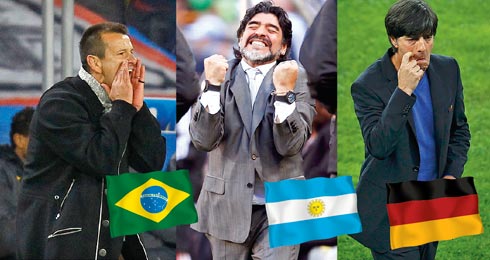
Emotions of coaches. Dunga (Brazil), Diego Maradona (Argentina) and Joachim Leo (Germany) reacted differently to the actions of their wards on the field
So Senegal said goodbye to the colonial complexes, defeating the French at the opening of the 2002 World Cup, Black Africa rejoiced in 2006, when the cat-d'Ivoire beat Serbia, and a week ago, when Ghana did the same, fans of the Protestant Celtic and the Catholic Rangers in the annual mode using the football-not bullets! - allow their religious contradictions in Scottish Glasgow; And Russian skinheads are rooting for black, yellow and other football migrant workers playing for our clubs and protecting the honor of their national teams now in South Africa (read on page 20).
And there were how many examples when the support of a particular football team became a form of protest against the dictatorship: the Catalan Barcelona - during the years of Franco in Spain; The West German "Herta", for which they had and suffered behind the wall in Berlin East; The “folk” “Spartak” of Zek Starostin, when he beat clubs in the “uniform” - CSKA and “Dynamo” on the field; Iran’s teams in the qualifying tournaments for the current world championship (did not hit)-what was poured out in the demonstration of the opposition “green movement” against the Ahmadinejad regime and the rejection of the hijabs of women-brown people in clerical Iran.
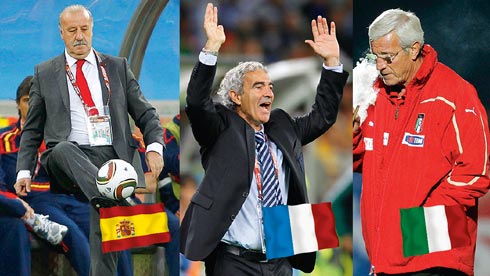
Spaniard Vicente del Bosk continues to believe in success; Frenchman Raymond Domenec is preparing to leave the coaching bridge; Italian Marcello Lippi reflects on how to defeat the next opponent
Recognizing the obvious
The 90s of the last century and especially the decade of the current century put an end to many myths that existed in football and even more in politics around it. For example, that authoritarian or even totalitarian regimes favors the development of this sport: there are only two cups in the assets of their victories at the world championships-Italy from Mussolini (in 1934 and 1938) and Argentina from the reign of the military (1978). That in corrupt modes with the poor population, command sports are flourished-the poor de has a powerful stimulus: Brazil is the only exception. That the presence of functioning democratic institutions and success in football are in no way related: everything is exactly the opposite, research in the field of football political economy prove. * * Simon Kuper & Stepan Szymanski, Soccernomics. London, 2009. That nationalism is the driving force of football: it is enough to look at the French national team, which is played by immigrants from Algeria, West Africa, Eastern Europe, at clubs of world football powers - England, Germany, Holland, to say goodbye to this myth. And how many talks about the dangers of globalization were - her most ardent opponents are also now sitting in front of TV screens. * * Franklin Foer, How Soccer Explans The World: An Unlikely Theory of Globalization. NEW York, 2004. Of course, of course, it doesn’t do without costs: the Brazilians did not allow American pension funds and German media corporations to invest in their football, and in the USA they will still resist the invitation of European coaches to their clubs, but this bastion will fall soon, the football researcher Simon Cooper said in an interview with The New Times.
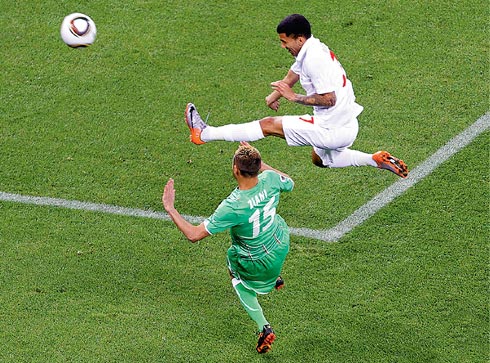
Having stumbled with Slovenia, the British (in white) could not achieve victory in the game with Algeria - the second draw in a row
Of course, there are all the sins of the modern world in football - and corruption, the mafia, bribery, and contract matches, including at the world championships, which Canadian journalist Declan Hil writes in his book, But football changes the world, and the world changes football. And for millions of fans on the planet, the world championship is something like a city of happiness, a utopia that may not be realized, but which creates a role model confirms that a person-if it becomes generally accurate and is protected by law and rules-is able to overcome the low and animal.