
Translated material
A specific story
Textbook as a manual on xenophobia
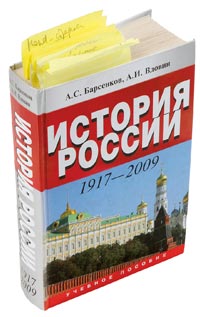
Textbook for the elite. At the historical faculties of Russian universities, future historians are taught by a textbook, the authors of which do not hide their Xenophobic views and dress in the white clothes of Stalin. The odious textbook, which has recently been released by the third edition, studied The New Times
The textbook "History of Russia. 1917–2009 ”, written by the professors of the Department of Russian History of the XX-XXI centuries of the Historical Faculty of Moscow State University Alexander Vdovin and Alexander Barsenkov (Barsenkov gives lectures to students of the 3rd year and conducts special seminars, and Vdovin conducts special training courses on the history of Russia 1917-1991), for the third time is recommended for the educational and methodological unification According to classical university education (UMO) as a textbook for students of higher education in the specialty "History". According to the head of the History of the Institute for Retraining and Advanced Education of Moscow State University, Professor Anatoly Utkin, this textbook is in demand in “elite universities” - the Academies of the FSB and the Ministry of Internal Affairs and others.
The justification of Stalin
In the introduction, the authors turn to the “Education standards” declared by Vladimir Putin at a meeting with participants in the All -Russian Conference of Teachers of Public Sciences in June 2007. “There should be no excesses in history that insulting historical memory and national feeling. The tragic pages of history should not be forgotten, but they should not be used to impose guilt, ”the authors write, retelling the installation of the then president of Russia in their own words.
“Like Alexander Filippov, in the textbook“ History of Russia ”for high school teachers, Barsenkov and Vdovin, they try to justify Stalinist repressions with historical necessity by introducing Stalin to one of the effective rulers of the 20th century,” historian Nikita Sokolov told The New Times. -The following statement by Molotov is given: “If we take into account that after the revolution we chopped right-naul, we won, but the remnants of enemies of different directions existed and in the face of the threatening danger of fascist aggression, they could unite. We owe the 37th year by the fact that during the war we did not have the fifth column. ” No commentary on this opinion is given by the authors. It turns out that this is the only assessment. ” 
The historian draws attention to the fact that, despite the documents previously published and well -known to historians, the authors of the textbook are trying to prove that "the Greater Terror was initiated by the NKVD." “The textbook mentioned that after the murder of Kirov, Stalin personally signed the directive, which later received the name of the Law of December 1, 1934,” says Sokolov. - But the essence of the law is not disclosed. But it was precisely by this law that the hasty order of military field proceedings was introduced, according to which cases were heard without the participation of the parties, the indictment was attached a day before consideration, cassation complaints were not allowed, the sentence was carried out immediately. It is not clear from the textbook whether Comrade Stalin has an attitude towards the NKVD, whether he signed execution lists, it is not clear what the famous “triples” are. Responsibility for a large terror personally with Comrade Stalin is removed by the authors of the manual, although we know who signed these lists and to whom they were sent ”(see the certificate on page 27).
As the most balanced assessment of the historical role of Stalin, the textbook is given the characteristic of the Generalissimo, supposedly given to him by the Prime Minister of Great Britain Winston Churchill: “He accepted Russia with Sohu, and left the atomic weapons equipped with atomic weapons. No! No matter what they say about him, such history and peoples do not forget. ”
“Churchill never said anything like this,” the graduate of the 1979 Moscow State University, sociologist Anatoly Golubovsky, explained to The New Times. “It has long been known that this quote belongs to an English historian.” * * On March 6, 1953, a necrologist was published in the Manchester Gardian newspaper, signed by Isaac Doech, which said: “The essence of Stalin’s historical achievements is that he received Russia, plowing with wooden plows, and leaves it equipped with atomic reactors.” This statement entered the British Encyclopedia. But this is not the only blunder of this kind in the textbook. There, for example, Stalin’s speech is quoted on August 19, 1939, explaining the need for a contract with Hitler, although several years ago it was proved that this is a fake. * * See the article by the historian Sergey Cases in the journal "Patriotic History" No. 1, 2004
Jewish threat
According to the critics of the textbook, its most important drawback is the "concern of the authors of the Jewish threat." “This is one of the widespread nationalist versions that have not yet been included in the textbooks: that the Bolshevik power is a Jewish dictatorship and that it is something similar to an external occupation,” says Nikita Sokolov. And Anatoly Golubovsky found several quotes in the textbook, each of which, in his opinion, should be studied from the point of view of the criminal liability of the authors, since they may fall under Article 282 of the Criminal Code of the Russian Federation (“arousal of hatred, or enmity, as well as humiliation of human dignity”).
“This is the first textbook in our country, where the share of Jews in power, among science and culture figures, are carefully calculated, as well as their proportional ratio with the total population of Russia,” says Anatoly Golubovsky. -The authors pay too much attention to the national issue in the 30s: then in the state apparatus, in the NKVD, there were suddenly many Jews in the press. This is how this is said in the textbook: “... such an actual inequality has become perceived as an abnormal position. The authorities were forced to reckon with this. Stalin called Mehlis, at that time the chief world of Pravda, and offered to give Russian pseudonyms to Jewish journalists, and also said to Molotov: “Take the Jews from the People’s Commissariat of Jews.” The leaders of the USSR openly demonstrated their readiness to eliminate "irregularities". In certain circles, these actions were perceived as manifestations of the policy of state anti -Semitism ... However, according to statistics (during repressions. - The NEW Times), the losses of the Jewish population in relative calculus did not exceed the losses of other peoples of the USSR ... With the policy of state anti -Semitism, these ratios would be obviously different. ” 
Not a harmful textbook
“I believe that a patriotic, condo look at the Jewish question has the right to exist, although the authors may be fond of,” said Anatoly Utkin, one of the reviewers of the textbook in an interview with The New Times. - It is too much about the Jews, the authors follow Solzhenitsyn, who raised this issue in the famous work of Two Together Together. In general, this is a manual where the idea of patriotism passes in a red thread. The textbook is imbued with love for the homeland, patriotism, and it is important that the continuity between the Soviet and post -Soviet era is traced there. ”
According to The New Times, the textbook of Barsenkov and Vdovin was recommended at a meeting of UMO * * The association includes 60 deans of the Histresses from different regions of Russia, which are gathered twice a year. Back in 2005, when his first edition was released, the subsequent vultures were renewed automatically, since the textbook was “run -in” and did not cause much complaints. When discussing in 2005, there seemed to be critical comments on the authors of the textbook, but the majority spoke in order to recommend it for higher education. As one of the members of UMO said, the new Times, the critics were confused by the assessment of the role of Stalin, which is given by the authors: “From the point of view of statehood, Stalin is a great hero, from the point of view of human rights - the murderer and the villain.”
The dean of the Faculty of History of Moscow State University and the chairman of UMU, Sergei Karpov, in an interview with The New Times, said that he sees nothing “harmful” in the manual discussed. “This is an author’s textbook, it is purely factual, the authors are not too theorist. It is recommended by us because it meets the standards. But it is rather written for other universities. At Moscow State University, the main emphasis is not on textbooks, but on sources, on scientific literature. ” The historian and journalist Nikolai Svanidze told The New Times that Barsenkov and Vdovin were not familiar with the textbook, although he heard about him. Having promised to carefully study the textbook, he did not exclude that if there really is chauvinistic and anti -Semitic statements, he can become the subject of study on the Commission of the Commission on Interethnic Relations and Freedom of Conscience of the Public Chamber. As for the commission on countering the falsification of history under the administration of the President of the Russian Federation, it, according to The New Times, does not engage in textbooks.
In 2002, the so -called “Stalin's shooting lists” were published for the first time, the names of people convicted by personal sanction I.V. Stalin and his closest associates under the Politburo of the Central Committee of the All -Union Communist Party of Bolsheviks (b) to different measures of punishment - the vast majority of execution. They were prepared by the Memorial Society and the Archive of the President of the Russian Federation. In the archive of the President of the Russian Federation, 383 lists of 44.5 thousand people were preserved, executed only for 1936–1938. According to other “lists”, from 1940 to 1950, at least 1160 people were shot.
Alexander Vdovin, Doctor of Historical Sciences, Author of the Textbook:
“I lead to Moscow State University a laboratory on the history of national relations and therefore I have a professional interest in national plots, and in particular, in the Jewish question. All the materials that I managed to identify on this topic were included in the textbook for enriching students of students about our history. There is a book by Kostyrschenko “The Secret Policy of Stalin. Power and anti -Semitism. " Working on a textbook, I used facts and numbers from this book.
The Jewish factor had a significant impact on the historical process. For example, the 30s, information is given which of the Jews was in the Politburo, some in the Gulag, in our repressive bodies, their number among prisoners. And there are not only Jews, different nationalities. Or: there is a struggle against cosmopolitans, can you do without this plot? If you write about it, then it is clear that Jewish surnames and other facts will appear. This is just the fullness of the information.
... There was no state anti -Semitism in the USSR. If there were state anti -Semitism, then we would not have Jews. All of them would be deported, like other punished peoples, or destroyed.
In addition to the theme of national relations, another sphere of my professional interests is the topic of dissident. Therefore, the textbook is written about this. And in particular, there are a lot about the movements of a national character that occupied a significant place in the dissident movement. ”
From an interview with The New Times