
Translated material
Mozarella Russian endurance
Pietro Macza came to Russia for several weeks - and remained for life. What is the Italian farmer business in Russia - found out The New Times
Another tourist bus, having incut to the village of Mednoy, stops in front of a long concrete fence. “Comrades! - The indelible epochal inscription flaunts on a gray background. - We increase the efficiency of production and the quality of work in the name of further growth of the economy and popular welfare! ”
Behind this fence for 10 years now, the Italian farmer Pietro Macza and his Russian wife Jeanne have been implementing the slogan of the past era. But they do it exclusively in their interests: Matsza is one of the pioneers of Russian agrotourism.
Behind a gloomy fence is a completely different reality. Two ostriches inquiringly shaking the eyes of the aliens, and the Arabic horseman hetman stands on his hind legs, demonstrating character. Take a walk with the guide on the farm, taste Italian cheeses, lunch in Italian, ride horses-for these pleasures to the Macza farm per month come to a thousand tourists. Agriturism is a new fun for Russian travel lovers, the opportunity to escape from the city to the village, live the life of a farmer for several hours. But in “Little Italy” (the so -called Pietro Farm) come not only for this: I really want to understand why this eccentric left his homeland.
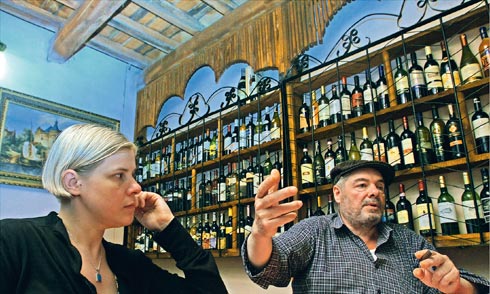
To establish his own business in Russia, Pietro and Jeanne needed a lot of excerpts by Andrei Smirnov’s photographs of the Nadranget
... In the excerptor of cheeses in the autumn, it is cold-the temperature is +10 degrees. Mozarella, Ricotta, Equal, Burrata, Kachyutt - so that they gain a truly Italian taste, you need to take care of them, as for capricious girls. The most whimsical is Mozarella: the enzyme in the cheese mass must be put at a temperature of exactly 36 degrees - no more and no less. And the hard cheese of Kachiotta must be kept in the chamber for a month and a half - at a temperature of exactly +10.
In a month, the Pietro Mazza family produces 1.5–2 tons of cheeses. It is also made for sale (a kilogram costs from 600 to 1.5 thousand rubles), but more for tasting. She - along with the above entertainment - costs guests of 1000-1600 rubles per person. This is for those who agree directly. They go in groups: tourists bring about 1–1.5 million rubles per month. Due to this money, the whole economy is contained: 20 employees, 100 cows, 15 horses, 30 pigs, 20 goats and 2 ostriches.
“Why did I leave Italy? - Pietro, dragging on a fragrant cigar, lets a ring of smoke into the air. - Then, why do hundreds of my fellow countrymen leave Calabria. In Italy, it is very difficult to conduct its business, and especially in Calabria. ” Pietro was born in the south, in the poorest and most dysfunctional region in the country, where the famous Calabrian mafia is hosted by the Ndranget. He does not very willingly talks on this subject, it is too sick and dangerous: in his homeland, near Katanzaro, relatives and family farm remained. “From the age of four I helped my mother bake bread and make cheeses,” says Pietro. “But no matter how you love your land, you have to choose: either get into dubious connections, or leave.” That is why the fourth -generation farmer Pietro Mazza in his youth went to Rome and went to the police, and having passed the earthly life to half, he found himself in Russia. However, there was one more circumstance: Pietro fell in love. They met in Rome: Jeanne was 19, he was 41. Two hours after acquaintance, he made her an offer. When in the summer of 1999 they flew to visit Jeanne's relatives in Russia, there was a terrible heat in Calabria. And here, in the suburbs, birch coolness rustled. And Pietro suddenly gave out: “We stay. We will cook cheeses here. ”
Get on the stranger
However, having leaving away from the Calabrian mafia, Macza ran into Russia with an equally strict reality. When 10 years ago he and his wife bought from the local authorities a forgotten clipstick of the regional consumer union in the Tver region, only local “nesuns” rushed to him, dragging bricks from dilapidated buildings. But the years have passed - and thanks to the efforts of the Italian, the ruins behind a concrete fence gained decent outlines. On the farm there was its own substation, three artesian wells, a hangar, and the sausage workshop turned into a beautiful tasting room for 350 people. It was then that people in uniform appeared on Mazza farm. Pietro and Jeanne were accused of bankruptcy of the food plant. “When our 16 hectares became attractive, we became interested in organized crime management,” says Jeanne. “It became clear that serious people“ ordered ”us.”
"
Leaving away from the Calabrian mafia,
Mazza collided in Russia with at least
Hard reality
"In 2005, the criminal case was brought up on Jeanne and" hung up "eight articles. During the searches, they searched for weapons and drugs. Naturally, they did not find anything, but the pressure lasted four years. What forces it cost all this time!" When the state is fighting against you, it only says Jeanne. Last year, Macza won all the time. If the presumption of innocence is in Calabria, why is the presumption of guilt in Russia? He had to give bribes, Pietro answers: “I don’t understand about it: they do not correspond to my mentality.
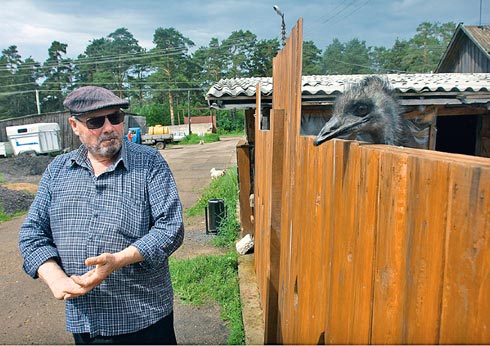
Ostriches on the farm "Little Italy" - more for exotic
Mazza was close to leaving, but remained. “In Italy, about 18 thousand companies engaged in agritourism,” says Pietro. “And here I am the only Italian who develops this business.” In addition, the Apennins are a very large tax burden, Mazza explains, and the cost of labor is too high: if in Italy the average salary of a farm worker is € 1200, then in Russia three times less: 15 thousand rubles. The cheap labor in the vicinity is really more than enough. But ... "It is impossible to work with the Russians! - boils Pietro. - The next morning you wait for 15 people, only two come. They work day, then they are not visible for a week: they drink. ” That is why Mazza preferred to hire citizens of Uzbekistan: unlike the locals, they are nonsense and hardworking. But the trouble is: from this year, the Russian authorities have banned that foreigners have been arbitrarily recruited to work - from now on, it is necessary to ask the state a quota. So far, for 2010 they did not give it to anyone, they considered that they should take “their own” during the crisis for work. And the law -abiding Pietro had to send workers home. Those who stayed are working on their contracts. But they will leave the farm soon: they are a fine for an illegal migrant worker - 1 million rubles.
The capitalist is damned
Pietro, by local standards, is generally strange. It feeds the cows not by silage, as is customary in Russia, but by hay and a mixture of grain, which itself is shaking at its mill. Only then, milk turns out suitable for the production of cheeses - does not smell like a “cow”. And he bought up old tractors from local collective farms for a penny and turned them into new ones: now in pretty red cars to not recognize the former scrap metal. “These are these beds,” Pietro shows metal beds standing in the courtyard with elegant backs, designed for the night of tourists, “we make ourselves, from ordinary pipes, according to our sketches. Such in Ikea costs 15 thousand, and we get it almost for nothing. ”
The Italian gets. And this is not pleasing. “For local residents, I was and remain a capitalist who came to exploit their lands,” Pietro states sadly. Local psychology is incomprehensible to him: “While you are going from Moscow to Tver - continuous abandoned collective farms! He exclaims. - Why not make them the centers of agriturism? In Russia, it would be correct to develop Russian agrotourism, not Italian, to revive local traditions. ” Pietro recalls: it was agriturism that allowed the Italian farmers to get to his feet after the war, he was born in the 50s, when agricultural enterprises were lying face down without money. People began to bake bread, make cheese, sold them - and survived.
But so far in Russia agrotourism is in its infancy. “In the Tver region there are farmers developing this direction,” says Svetlana Maksimova, chairman of the Union of Farmers of the Tver region. “One has ostriches, the other has a bee, the third has fishing and a bathhouse ... But Pietro is easier, he came here with money, and our farmers have to pay loans with interest that ruin many.” However, Pietro insists: it is not about money, but in desire. He tried to talk with the directors of the agricultural facilities whose huge areas are idle idle: remember the grandmother's recipes, put two or three workers on the line, this is inexpensive, and bake bread according to the ancient recipe, sculpt dumplings, make milk that you sell for a penny, except for cottage cheese, because the world has invented 4 thousand types of cheese! “But no one has a will or desire to try something new,” he concludes. “Everyone is sitting and waiting for help from the state.”
The Italian is not able to understand this: in Kalabrian villages, every piece of land is conquered from the mountains, water is brought in fire tanks, and in Russia unpaid fields, and water to pour. In Calabria there is a proverb: "Help yourself, and God will help you." Every day, the 60-year-old Calabrian gets up at 8 in the morning and works until late in the evening: he says that he did not even make the twentieth part of the plan. Pietro hopes that the daughter of Jessica, who is already 16, will continue his business. In the meantime, the Mazza family has not been able to go to Italy for 10 years - there is no one to leave the household: Pietro could not explain to the Russians that the enzyme should be put in the cheese mass at a temperature of exactly 36 degrees, and not 35 or 37 ...
Agrotourism is a vacation in rural areas. It includes a tasting of farm products, acquaintance with the life and life of farmers, often - accommodation in peasant houses, ancient estates. First appeared in Europe at the beginning of the 19th century, there is about 500 thousand farms there today. The most developed in Italy, France, Holland, Germany. About 35% of the population prefer such a vacation in Europe: agrotourism brings 10–20% of the total income of the tourism industry. According to the Russian Union of Trade, the annual increase in rural tourism in the world is 10%. In Russia, agrotourism is only emerging: it is most developed in Karelia, the Krasnodar Territory, in the Tver, Leningrad, Kaliningrad, Pskov regions, in Buryatia, Altai and the North Caucasus. According to the Association for the Development of Agriturism, less than 100 agricultural enterprises operate throughout the Russian Federation. The industry prevents the passivity and economic illiteracy of the rural population, the loss of traditions and craft skills, limited opportunities for teaching the population, developing their own business, lack of infrastructure - road network, gas station and service.