
Translated material
Black-black sea
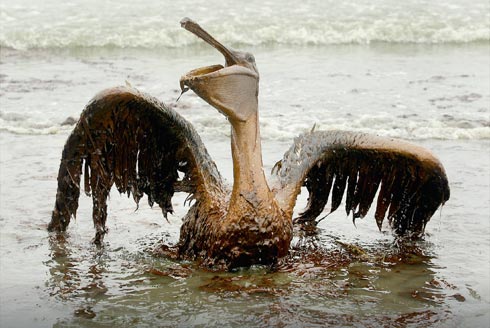
Black-black sea. US President Barack Obama secured from the management of British Petroleum (BP) a package of large-scale compensation measures for the accident on a drilling platform in the Gulf of Mexico, which became the largest environmental disaster in US history. For 57 days, BP rubbished the US government over the scale of the disaster, claiming that a thousand barrels of oil per day were leaking into the ocean. In fact, from 25 thousand to 60 thousand. Total, if we take the upper limit, more than 2 million barrels! In addition to environmental disasters, economic ones can be added: the costs of damage compensation alone are estimated in the range from $37 billion to $70 billion. An important detail: on June 15, Barack Obama addressed the nation with a statement about the accident from the Oval Office of the White House - from here American presidents speak only on extremely serious occasions. What conclusions will America draw from the tragedy, what BP now expects and how much money will it cost - The New Times found out
The spectacle would be funny if it weren’t so sad: Lamar McKay, head of the American division of BP, sat in front of members of the US Congressional commission investigating the causes of the accident, with a confused look and repeated the same phrase, as if he had learned it by heart: “We are not to blame. These are not our calculations." The hint is that the Deepwater Horizon partners, who supplied BP with the ill-fated floating platform, are to blame. Republican Congressman Cliff Stearns suggested that McKay resign and, in the meantime, publicly apologize to the Americans. But he again: “These are not our calculations.” Then Louisiana congressman Anh “Joseph” Cao, who has Vietnamese roots, took the floor: “In Asian culture, there was another option for retirement... In medieval Japan, you would simply be given a short sword and asked to make yourself hara-kiri.” After which McKay finally mumbled: “There is a good chance that by mid-August we will have the situation completely under control.” “Mid-August”?!
Carpet challenge
The next day, June 16, President Obama met in Washington with the top of BP: Chairman of the Board of Directors Karl-Henrik Svanberg, company President Tony Hayward and Lamar McKay. Result of the meeting: BP is creating a compensation fund of $20 billion. To do this, the company will cut dividend payments by three-quarters, cut investment programs and sell its assets for $10 billion. The fund will be managed by a lawyer independent from the US government, Kenneth Feinberg, who administered a similar fund that pays compensation to victims of the September 11 terrorist attacks. And another $100 million will go to another fund - to support US oil industry workers laid off due to the government's six-month moratorium on underwater oil production.
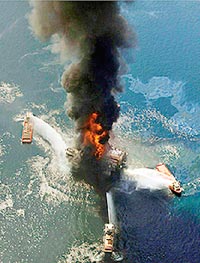 |
| American photographer Charlie Riedel has been keeping a photo diary of the environmental disaster since the accident. |
This news came in handy. America has been waiting for decisive steps from its leader: according to the latest opinion poll conducted on June 15, 52% of Americans found the president’s actions at that time unsatisfactory. Bush had the same rating after Hurricane Katrina in 2005, which marked the beginning of both his political decline and the US Republican Party. And the Democrats, now led by Obama, are on the verge of elections to Congress: they are in danger of losing their majority in the Senate and, possibly, even in the House of Representatives. And the Gulf of Mexico oil spill could hit the Democrats headlong.
Stomp on balls
After the meeting between BP management and Obama, the company's shares on world exchanges began to rise again. But many experts believe that this will not last long. The burden of inevitable costs is too great. In addition, oil continues to leak into the ocean. 10 days ago, BP engineers installed a special cap over the well, which keeps about 15 thousand barrels per day from leaking. But last week, a floating platform that pumps out captured oil was struck by lightning and started a fire. This time there were no casualties, but the pumping was suspended. On June 14, the greenest American politician, former vice president and Nobel laureate Al Gore, erupted in an angry rebuke against BP, which does not allow journalists into the accident zone, on his blog. But for the sake of truth, let us note: the US Coast Guard, local police, and government officials are preventing the access of press representatives. But BP installed an Internet camera near the leak site so that everyone could admire the black clouds of oil escaping from the rupture in the pipe. In addition, the company recruited teams of rescuers - specifically for clearing the coast of Louisiana. But, to be honest, it would be better not to hire. As the CNN television company reported, citing local residents, these would-be rescuers “only trampled on pelican eggs, despite the fact that the unfortunate birds were already stuck together with oil.” BP, of course, was lucky that the “stomping” was not filmed by a CNN film crew, otherwise the top of the company would have been lynched on the way to the White House.
Claims, claims...
The probability of default on BP's debts over the next five years is estimated, judging by CDS,1 quotes, at 35% (a month ago - 28%). Only Greece is doing worse: the probability of its default over five years is estimated by CDS at 48.5%. The Fitch rating agency lowered BP's rating by six notches at once - to a level close to junk.
The fate of the company is impossible to predict - the scale of the disaster in the Gulf of Mexico is not fully understood. At the end of April, BP claimed that the exploded platform was leaking about 1,000 barrels of oil a day into the sea. This estimate has been increased five times and today has reached its maximum of 60 thousand barrels per day. BP has already spent $1.6 billion on attempts to plug the oil gusher, gushing at a depth of 1.7 km, and to collect the spilled oil. And in total, the disaster will cost BP, according to Credit Suisse, $37 billion. Skeptics believe that the costs will exceed $40 billion. This is 1.5 times more than BP’s last year’s revenue and more than twice its profit (see charts on page 41). Moreover, the Obama administration is determined not to allow BP to minimize the costs of eliminating the consequences of the accident.

In the coming years, BP (if it does not cease to exist as a result of financial losses) will have to sue, sue, and sue again. More than 225 lawsuits have already been filed against her - Americans have very well developed skills to demand compensation for involuntary losses. There are many victims. 11 workers died during the accident. The heaviest damage was suffered in Louisiana, Florida, Alabama, and Mississippi. Until now, the beaches of Alabama and Florida were considered among the cleanest in the world. Now neither fishing nor tourism is possible in coastal areas. BP will also have to pay for the losses of the owners of coastal real estate that has sharply fallen in price. New Orleans has just been restored after Hurricane Katrina, and now there is an environmental disaster that will scare away tourists and organizers of corporate seminars for a long time, hotel and restaurant owners complain, claiming that now they have no future. Not only the affected residents of the Gulf of Mexico intend to sue BP, but also businessmen from states that the oil spill has not yet reached, for example, hotel owners in Georgia and South Carolina: just the news of the accident led to a noticeable decline in tourist flow.
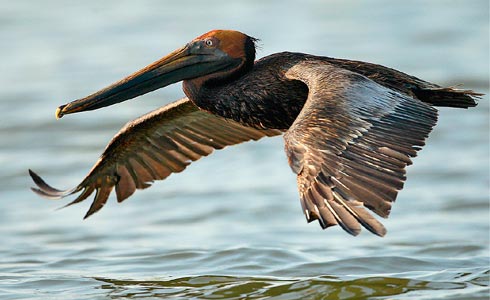
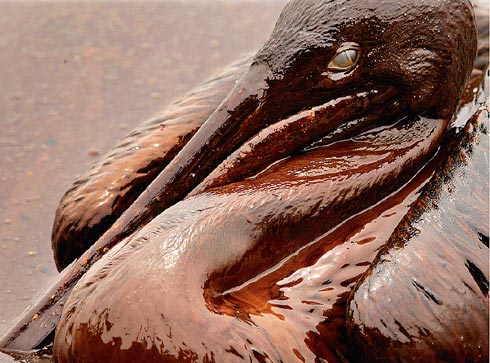
An environmental disaster on the Louisiana coast through the eyes of photographer Charlie Riedel: a series of photographs of pelicans dying in an oil spill has become one of the most discussed topics on green websites on the Internet
Its shareholders are also filing lawsuits against BP. They are unhappy that the company did not pay enough attention to mining safety. Investors have reason to be dissatisfied: shares have fallen by almost half since the accident. “BP has severely wounded the entire country, not just a city, region or state,” Bloomberg quotes Houston lawyer Michael Hall as saying. — Hundreds of thousands of Americans (and soon there will be millions) are seeking compensation for their losses. The lawsuit will spread and spread, just as oil and the harm it causes spreads.” Are you to blame? Of course, few people are capable of feeling sorry for British Petroleum in a situation where it has thoroughly ruined the life of a gigantic region. The harm is so great that it would seem to justify the most flagrant intervention of the American government in the politics of the British giant. Moreover, until recently the company tried to downplay the scale of the accident and exaggerate its successes in eliminating its consequences. And the accident itself is BP’s fault - US Congressional investigation documents speak about this. BP made many decisions aimed at saving time and money at the expense of safety, according to congressmen (for example, the use of casing pipes). Even a month and a half before the accident, according to internal BP correspondence, its employees feared that workers would lose control of the platform.
American market regulators also slept through the disaster. The Minerals Authority granted BP a drilling permit without requiring the company to provide a contingency plan.
Forecasts

Of course, now the United States, and many other countries, will be extremely careful with deep-sea oil production. The Obama administration is likely to increase subsidies for oil production from alternative sources. But the alternatives are far from ideal environmentally. Thus, the production of ethanol, which is popular among American officials, leads to air and water pollution, soil contamination with pesticides, deforestation, the emergence of “dead zones” and rising food prices, states Kenneth Green from the American Enterprise Institute. And if Obama extends the drilling ban and forces oil companies to create disaster insurance funds, energy prices will rise, note Peter Van Doren and Jerry Taylor of the Cato Institute.
A possible lack of funds to eliminate the disaster may force the company to sell a stake in its Russian project - TNK-BP. The most likely contender for this asset is Royal Dutch Shell. But the company will be the last to part with TNK-BP - it accounts for 20% of the reserves and 25% of the production of all BP.
...Famous Nigerian spammers are now sending letters on behalf of BP President Hayward. Like, his money invested in BP shares and options is under threat, writes an imaginary Nigerian attorney: the American authorities are going to nationalize the company. The Nigerian, estimating the cost of his consulting services at 20 British pounds, offers to participate in the transfer of Hayward's funds (£80 million) to Australia, where they are expected to be divided in half with the recipient of the letter. Nigerian financial scammers, no matter how one views their work, have grasped the main thing: BP is in distress...
According to Goldman Sachs, the total cost of the rescue operation in the most pessimistic scenario could be $70 billion. According to a number of forecasts, even with a credit line and dividend cuts, BP is realistically able to spend $5–10 billion a year on rescue operations. At the end of the first quarter of 2010, the company had $6.841 billion in its accounts. BP’s profit for 2010, according to initial forecasts, was expected to be $18.1 billion.