
Translated material
Chronic preceding
Moldova is preparing for the next vote
Moldova is again preparing for mass will. The summer will barely end, the country will be held almost simultaneously and a referendum, and parliamentary and presidential elections. What is the meaning of the beloved national entertainment Moldovan - I tried to understand The New Times
In September, Moldovan citizens will have to answer one question at the referendum: do they want to return to the Presidential Direct National Enforcement System, which they refused 10 years ago to build a parliamentary republic, or are ready to maintain the right to elect the head of state for deputies who have not been able to cope with this task for 15 months. Most sociologists are sure: Moldovans will gladly support the idea of direct elections. And that means that already in November the republic will choose the president, and at the same time a new parliament. After all, its current composition must be dissolved by law.
The term of reason
In the middle of last week, June 16, it was a year since the moment Vladimir Voronin, who was then the President of Moldova, dismissed the parliament and announced the early elections after two unsuccessful attempts of the deputies to coordinate the candidacy of the new head of state. The year has passed, and now, according to the Moldovan Constitution, the parliament should dissolve again: after all, the deputies of the updated parliament have already managed to not choose their president’s country twice (in November and in December 2009).
* * Constitution of the Republic of Moldova: Article 78 p. 5: “If even after repeated elections the president ... is not elected, the current president dissolves the parliament ...”; Article 85 p. 3: "Within one year, the parliament can be dissolved once." But Mikhai Gimpu, for 9 months the acting head of state, said on June 16: “Nothing but the constitution can force me to dissolve the parliament. Even the Constitutional Court. " And he explained: yes, they say, the year has passed, it would be possible to dissolve, but in the main law it is not said when. But the law on the procedure for election of the president states that the next dissolution of the parliament should take place “within a reasonable time” after a year from the moment of his last dissolution. According to GIMPU, an intelligent term is interpreted in its own way: "One counts three, the other-six months or two years." So - first a referendum, and then you can bloom.
The flour of the choice
The idea of a referendum arose for the ruling alliance for European integration immediately. First four democratic parties,
* The Liberal Party, the Democratic Party, the Liberal Democratic Party and the Bloc "Our Moldova". Including in the alliance, I had to make sure that they, like the Communists, are not able to gain three fifth votes necessary for the president’s election. The situation has come to a dead end. Worse, an endless impasse: according to the forecasts of sociological services, none of the warring parties, nor liberal parties that formed the alliance, nor the Communists will again receive the most unlimited parliamentary elections of the majority.
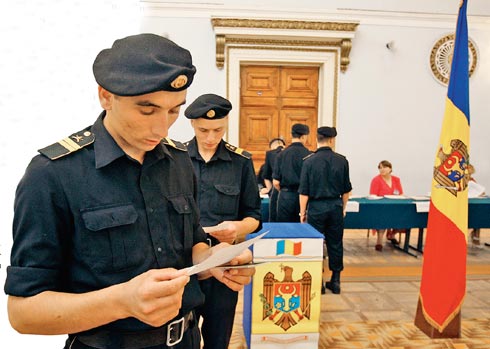
Autumn elections should put an end to a protracted political crisis
The only way out is to change the constitution so that this unfortunate norm about the three -fifths disappears from the Moldovan reality and does not force the republican elite to look for consensus where it is not and cannot be. The Venice Commission of the European Union, led by Gianni Bukikkiio, designed to help young democracies in resolving constitutional crises, recommended that the parliament independently soften this norm and leave the final decision on the presidential candidate for a simple majority. But after all, to change the constitution, all the same consensus is needed! .. And although the Communists assured that they were ready to vote for a change in Article 78 of the Constitution, the liberals did not believe them and stopped at the referendum. The result of it, we repeat, is practically a foregone conclusion: the country will return to the practice of direct presidential elections. But what will happen next is not able to predict either sociologists or political scientists.
The suspended future
So far, the chances of the presidential chair are distributed like this. The leader of the liberal democrats, Prime Minister Vlad Filat is leading in hundred-prose. About 20% of voters are ready to vote for it. In second place is the leader of the Democratic Party, Marian Lupa with 16.3% of the vote, the ex-president of Voronin, who is ready to support 14.9% of Moldavian, closes the top three of the leaders. But the leaders can be suppressed by the former Minister of Defense of the country, ex-adviser Anatoly Chubais according to RAO UES Valery Pasat. He has already announced his intention to create his own party to participate in both parliamentary and presidential elections. During the reign of Vladimir Voronin, Pasat was convicted of damage to the budget of the republic and was in prison from 2005 to 2007. In 2009, all charges were removed from the Pasata, and he began his political career with a proposal to introduce the lessons of Orthodoxy in schools. The idea found support from Metropolitan Chisinau and all of Moldova Vladimir, the church even openly stated that it supports the creation of a party that would protect the interests of Christians in the republic. How many votes can the coalition of the former Minister of Defense and the Metropolitan be received in the election, no one is still predicted. "
The church even openly declared
which supports the creation of the party,
which would protect the interests of Christians
in the republic
“But this is far from the only uncertainty. Firstly, Voronin’s participation in the elections is still in question. On the one hand, the Constitution does not allow the presidential post for more than two consecutive terms. On the other hand, the Constitution will change, and besides, after Voronin’s resignation, Mikhai Gimpu has been led by a country. Only the Constitutional Court can resolve doubts, and he has not yet decided from the position. Secondly, the I.O. Mikhai Himple The full prohibition of both the Party of the Communists and its symbols insisted. The liberal alliance does not approve of the idea of a ban, fearing that persecution of the Communists will only lead to an increase in their popularity.
Thirdly, the popularly elected president will certainly wish to regain part of the powers that migrated in 10 years since the abolition of direct elections of the head of state to the Prime Minister.
The number of uncertainties in the political future of Moldova can increase even more: the Communists after June 16 declared a complete rupture of any relationship with the current government and declared it illegitimate.
According to sociologists, in extraordinary parliamentary elections from 28% to 30.3% of citizens are ready to vote for the Communists. The Liberal Democratic Party, led by Prime Minister Vlad Filat, can get from 14% to 19% of the vote. The Democratic Party of Marian Lupa is promised from 8.6% to 10.7%. The Liberal Party, led by Mikhay Gimpu, should focus on 5–8% of the votes, and the Vice-Spiker Serafim Urefiman Vice-Spiker Urefyan will lose the elections with a high degree of probability will lose: his rating balances on the verge of 2%.