
Translated material
Oilman, sir!
Gref and Khristenko told how our "everything" works
The testimony that Viktor Khristenko and German Gref gave in the court in the “case of Yukos” are interesting not only by the fact that high state men, on a number of positions, refuted the state accusation, that is, poured water to the defense mill of Mikhail Khodorkovsky and Platon Lebedev. They are also notable for the fact that they allow us to judge how our “everything” is arranged - the oil industry of Russia. In any case, how it was arranged in the first term of the presidency of Vladimir Putin and before that. The New Times with the help of experts versed in the court heard in the court
Former Minister of Economic Development and the current head of Sberbank German Gref and former Deputy Prime Minister, and now the Minister of Industry and Trade Viktor Khristenko gave their testimonies for a total of almost 6 hours. Both refused comments from comments, citing the fact that everything they wanted to say said in court. The New Times also turned to their press services for comments, but Sberbank and the Ministry of Industry and Trade left the requests unanswered.
The interrogation of witnesses took place according to the same scenario. Khodorkovsky himself asked questions on behalf of the defense. It is curious that in both cases he apologized for being forced to ask strange questions, the answers to which he is obviously known, but this is required by the interests of the matter.
I chose the most interesting questions and answers (given below in an abbreviated form by the transcript), after which I gave the word to comment experts.
Tax flight
Mikhail Khodorkovsky, in 1997-2004. - The co -owner and head of the Yukos oil company, since 2005, is a prisoner: in the framework of the criminal case, I must ask you a question about some features of the industry management. Did the government realize the economic feasibility at the stage of 1998-2003, which belongs to this criminal case, the existence of vertically integrated companies, in particular, the company of Yukos, uniting activities from the stage of exploration of the gas station deposits into a single technological chain?
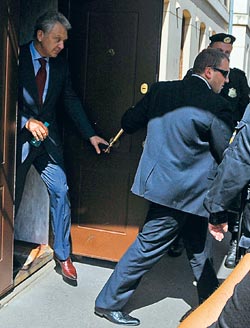
<figure> <img SRC = "https://archivarius-public.s3.us-west-2.amazonaws.com/RIMA/WEB/MEDIA/IMG/047BC1F2F055080CE92C18C6FC3010FA.jpg"/> </figure> June 22. Journalists attack the Minister of Industry and Trade of Viktor Khristenko near the building of the Khamovnichesky Court
Victor Khristenko, Minister of Industry and Trade of the Russian Federation, in 1999–2000 - First Deputy Chairman of the Government, in 2000-2004. - Deputy Chairman of the Government, who oversaw the fuel and energy complex: building integrated structures on the technological principle is the most justified and meaningful practice of building holdings. If we talk about the period of 1998-2004, the main attention of the government to vertically integrated structures was riveted from the point of view of fiscal problems. In these years, legislation was largely formed in relation to the control of the activities of vertically integrated structures, and primarily from the point of view of taxation. 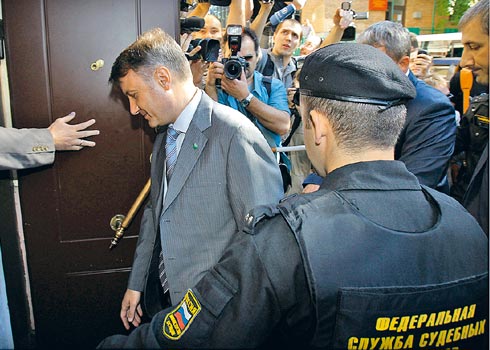
June 21. Sberbank head German Gref came to testify in the case of Yukos
Mikhail Kasyanov, politician, in 2000-2004. -The Prime Minister of the Russian Federation: the vertical integration of oil companies in the Russian Federation is justified. Neither the company nor the state from the tax point of view will benefit from their artificial separation. At the same time, literally all oil companies used the so -called internal offshores - the zones of preferential taxes within the Russian Federation, which existed until the end of 2003. First of all, we are talking about the so-called closed administrative-territorial entities (but) and some regions of the Russian Federation, which legally received the right to reduce taxes for oil or any other companies registered there, sending the received funds not paid to the federal budget, to their development, investment projects. In those years, it was a completely legal system. It took our government three years in order to convince the State Duma to adopt laws that cancel the right of regions to apply preferential taxation. In 2003, all internal offshores were closed. 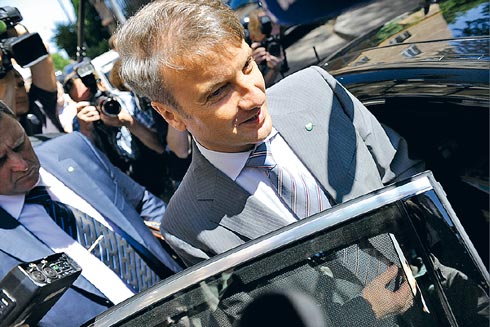
The role of the witness is executed
Boris Nemtsov, Deputy Chairman of the Government of Russia in 1997-1998, from April 24, 1997 to November 20, 1997 - The Minister of Fuel and Energy of Russia: We in the Government (1997–1998) fought offshores, tried to cover them. Local authorities, on the contrary, fought for taxpayers, so there was a conflict. But then we covered something, for example, tightened the rules for opening companies in but. However, we did it with varying success: the lobby from the local authorities was quite strong. And the oil lobby at that time pressed the government, but we still forced them to pay taxes when we had to increase their collection.
Evgeny Yasin, supervisor of the Higher School of Economics, in 1994-1997. - The Minister of Economics of the Russian Federation: In those years, almost all oil companies were registered in the same way to optimize taxation. But they were created in the areas of single -industry towns, where defense enterprises were located. Since the government then could not give them money, and they did not have their income, the appearance of oil plots who at least paid something to the local budget was a way out of the situation. Yukos, in particular, used the “snow”, “forest”, but there were quite a few of them. Assets were displayed into external offshores: transfers were made so that the calculations on internal operations were performed abroad. This was due to the optimization of taxes, but to a greater extent - with fears in the collisions of the state: they tried to keep money away from his native aspen. So not only Yukos worked-the whole business, and in my opinion, still works like that.
Nikita Krichevsky, scientific director of the Institute of National Strategy: but in those years there were quite a lot. Historically internal offshores were Kalmykia and Baikonur. There it was possible to register at least 100 thousand companies. And no one violated anything, the companies left taxation, but did it within the law: they did not steal money, did not conceal taxes. Today we have the whole industry in external offshores - and no one punishes anyone for this.
Maria Orlova, Deputy Head of the Energy Department of the Institute of Energy and Finance: There are many taxes in the oil sector in the oil sector: offshores, black salaries, incomplete registration of oil production at the collection point, oil sent to the refineries for processing, but leaving the refinery for export, already bypassing the Transneft system and, accordingly, often bypassing Customs payments at points: for example, you can produce oil in tanks under the guise of oil products.
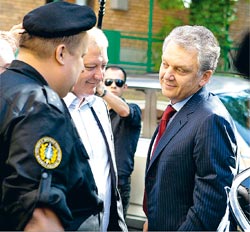 |
| Viktor Khristenko before the interrogation in the Hamovnik court ... |
Prices are internal and external
Khodorkovsky: the prosecutor’s office reproaches me that the domestic prices, at which the ownership of oil was transferred from the production enterprises of the Yukos company in the regions (Samaranneftegaz, Yuganskneftegaz and Tomskneft) of the production of Yukos itself, were lower than the prices of Urals oil in Rotterdam and in the Mediterranean ports. I ask you to explain what costs the vertically integrated oil company incurred on the site from the region of production to the port of the Mediterranean?
Prosecutor Valery Lakhtin: Maybe Khodorkovsky will stop asking questions about pricing?
Khristenko: The intra -Russian price differs from the price of Rotterdam to the amount of export duty and to logistics costs. Actually, the export duty is introduced for this in order to level the conditions of the domestic market and the external. We can say with the confidence that the extracting units of companies at the output cannot have a price equal to the price of oil in Rotterdam.
As for the internal pricing of Wink, their transfer prices (by which oil is transmitted from some divisions of the company to others) are not nothing exotic, or even more illegal. The question is that the transfer pricing within the company does not infringe on the interests of at least three structures: the federal budget of the Russian Federation, regional budgets and shareholders themselves.
German Gref, chairman of the board of Sberbank, in 1998-1999. - The first deputy chairman of the Mingosimatunstarie, in 2000-2007. - The Minister of Economic Development and Trade of the Russian Federation: Yukos legally bought oil from his production companies at prices, which were lower than on European exchanges. The situation that the price in the manufacturer was significantly lower than in Rotterdam was known to me - this is natural, otherwise it cannot be. The price difference was determined by a number of factors, including export taxation and transneft tariffs. If Rosneft, whose board of directors I entered in those years, bought products at prices above European ones, then it would go bankrupt.
 |
| ... and at its end |
Vladimir Milov, politician, in 2002 - Deputy Minister of Energy of the Russian Federation (quoted from an interview with The New Times No. 4, March 2007): It is incorrect to compare the selling prices of oil “in the well” with prices for the sale of oil in European import terminals (Rotterdam, Mediterranean). In order to obtain the correct comparison of the price level, it is necessary to subtract from the prices of the purchase of oil in European import terminals the costs of transporting oil from the well to the port (rude - $ 22–25 per ton), transshipment in the port ($ 2-3 per ton), insurance and freight tankers ($ 5–6). These are not “stolen” funds, but the necessary costs from which the oil producing units of Yukos were exempted and which the maternal company took on.
Yegor Gaidar, before the death in December 2009, is the director of the Institute of Economics of the Transition period (quoted under his article by The New Times No. 4, March 2007 ): according to the estimates of the Ministry of Energy of Russia, in 1999 more than 90% of oil sold by Russian companies was sold at transfer prices. The practice of applying transfer prices * * transfer price is the price that is set inside the corporation for calculations between subsidiaries that are often in different countries. This price almost always deviates from the market in one direction or another, due to which oil companies manage to optimize the distribution of profit between different enterprises. These schemes made it possible to optimize taxes. On January 1, 2002, a new head of the Tax Code was introduced, which excluded the possibility of applying these schemes for tax evasion. - Not at all the Russian invention. Where national legislation allows this, oil companies are trying to minimize taxes. Good or bad is another question. But this was not the case that existed at that time and the state was not disputed.
Mikhail Kasyanov: Since our oil is produced in various regions, in different conditions, with varying degrees of complexity, with a different shoulder of delivery, respectively, this price cannot be the same-not only within the country, but also within one vertically integrated company. If we are talking about the difference in domestic prices and the Rotterdam, we should not distinguish Yukos - this practice is the same for all companies: this is the difference between the price of oil in the country and abroad. By the way, the export duties that are now used to equalize the internal and external price have introduced just our government in 2003 - this was preceded by several years of negotiations with oil workers and a long discussion in the State Duma. This is a simple mechanism that allows you to provide income for the state, as well as to retain domestic oil prices and oil products below European, until the incomes of our population have been equal to the incomes of Europeans.
Maxim Shein, head of the analytical department of the BCS company: internal and external oil prices, of course, differ. For example, if you take prices for the beginning of this quarter, then, roughly speaking, the external price of Urals is $ 75–78, and our internal price is $ 34. It is understandable: even if you want, you will not buy oil from you at world prices, because it is unprofitable.
Maria Orlova: The oil production company sold oil within itself at the internal price, as it gave tax optimization: income tax was formed from the sale price multiplied by volume, respectively, the lower the price, the lower the tax. In those years, income tax was quite high, everyone worked according to this scheme, not just Yukos.
Access to the pipe
Khodorkovsky: export quota restrictions somehow reflected on the difference between oil prices in Rotterdam and within Russia?
Khristenko: You actually ask about access to the pipe - it was at that time limited to oil companies in connection with access abilities. At the same time, quotas were distributed in accordance with the volume of production of oil companies, the quota cost nothing. Therefore, the quotity itself did not belong to the price costs, but limited the physical volumes of export by access abilities of the Russian pipeline system at that time.
Mikhail Kasyanov: There was a government commission, which made decisions on access to the pipe and determined quotas for export deliveries. This was also due to the restrictions on the throughput, the need to direct oil for internal processing, taking into account the State Assembly and the Northern Formation. At the same time, we made sure that the companies in the same proportion were exported and within the country.
Boris Nemtsov: We destroyed corruption in access to an oil pipe. When I became the Minister of Fuel and Energy in 1998, I made it so that the volume of access to the pipe became proportional to the extraction and it became impossible to steal. If the company mined more, it received a major quota for export, and vice versa. And the second: the transit fee was the same for everyone. Before me, there was an institution of special exporters of oil, who received quotas, and there they gave bribes. We destroyed this and created a rather transparent mechanism that is still working.
Evgeny Yasin: The access mechanism to the pipe has not changed since then. There is a state company Transneft and a fairly high cost of pumping oil according to the state pipeline. In accordance with the volumes of production, contracts are concluded and limits for pumping oil of various oil companies are allocated. And Transneft approved and approves its tariffs in a special tariff service. Before the pipe, everyone was in an equal position: Yukos, “Lukoil”, “Rosneft”, TNK-Br. The market, competition work here. There, perhaps, not everything is transparent, but somehow it is impossible to lose more than 300 million tons of oil.
Nikita Krichevsky: The access mechanism for the pipe in those years was corruption: quotas were determined by culuar agreements. The amount of the agreement depended on the volumes that had to be pumped. Of course, the oligarchs with ministers, but their improvised ones agreed. I don’t think, however, that the state “Rosneft” or “Gazpromneft” acted in this way. But the fact that they, too, somehow solved the issue of access to the pipe, administratively or in force, is obvious. Because the pipe is one, but there are many who wish.
How oil stole
Khodorkovsky: The accusation lies in the fact that the organized group, that is, I and Platon Leonidovich Lebedev, removed, that is, physically and free of charge, oil, that is, fluid, on the transnefta accounting node, in an amount of 60 million tons-from 1998 to 2003-a total of 350 million tons. As a member, and then the chairman of the Board of Directors of Transneft, from 2000 to 2008, tell me, some large-about 50-60 million tons per year-deviations from this balance associated with the company Yukos and its subsidiary mining units, can you call the court in the period until 2004?
Lakhtin: Khodorkovsky holds a sheet of incomprehensible content, refers that this sheet corresponds to the text of the criminal case materials. Let Khodorkovsky pick up the materials of the criminal case, refer to a specific volume and a sheet of the case ...
Khodorkovsky: Volume 175 of the indictment, page 92.
Khristenko: Yukos was contracted by Transneft for pumping the corresponding volume of oil to where Yukos considered necessary. Of course, there is no other system in Russia, and therefore Yukos used this system while one of the major customers. The physical theft of oil from the pipeline system is a problem that was, is and, unfortunately, remains. It is associated with illegal inserts, with which regular struggle is being carried out. But physical theft in the volume of millions of tons is unknown to me.
Gref: checking the information that oil was delivered to pipelines and put on export, and not abducted, was not included in my duties as the deputy head of the Mingosimature. However, if the theft of 350 million tons took place, then this fact would be known to me.
Maxim Shein: The theft of oil from pipelines is possible only through illegal sinks. But you will not steal much. Khristenko should know that oil is walking through the pipe under huge pressure, and you begin welding. Any unauthorized access will quickly be known through the oil accounting nodes when a clear amount of oil at the entrance and output is known. You can’t just cling to the pipe and download slowly: you will be found. In addition, the pipe is laid in such a way that it is visible from the helicopter. Существуют нормативы по облету нефтепроводов на вертолете. Вообще нефтяные компании склонны их рьяно охранять. Например, в Западной Сибири практикуют вооруженные посты и колючую проволоку, которая окружает территорию нефтяников. Так что за незаконные врезки можно было даже не от государства, а от самих нефтяников крепко получить. Незаконные врезки обычно происходили и происходят лишь в Чечне.
Мария Орлова: Парадоксально, но до сих пор экспортом нефти в России занимаются не сами нефтяные компании. Они продают свою нефть трейдеру — как правило, это происходит на борту танкера. В этой точке собственность переходит уже трейдеру. Обычно трейдеры — это швейцарские или кипрские компании, например, Gunvor (один из крупнейших в мире, где, по неофициальной информации, есть интерес Путина). Формально вы ни в чем к трейдеру не придиретесь: его танкер приписан к какому-нибудь нероссийскому пароходству. Например, из Новороссийска сейчас возят нефть в Китай. За тот период, пока нефть идет из России через Босфор, Суэцкий канал, Африку, собственник, как правило, меняется несколько раз. Так что таким образом даже сейчас можно украсть нефть, но все же в незначительных объемах. Все-таки сейчас, минуя учет и таможенные платежи, уже нельзя увести какие-то огромные объемы нефти. А в те годы это было сплошь и рядом. И ЮКОС был не хуже и не лучше других: все пользовались любыми дырами в законодательстве и слабостью государства.
Евгений Ясин: В период ЮКОСа государство полностью контролировало потоки нефти. Потому что было известно, сколько транспортируется по трубопроводам, сколько — по железной дороге. Все железнодорожные перевозки проводила государственная компания. Кроме этого, конечно, можно было возить нефть автоцистернами, но понятно, что это уже другие количество и цены. У нас фурами нефть не возят — это нерационально. Иными словами, в обход государства продать нефть было невозможно.