
Translated material
Is Carthage destroyed?
Who allowed senior officials to testify in defense of Yukos leaders
Herman Gref and Viktor Khristenko, and before them Mikhail Kasyanov and Viktor Gerashchenko spoke in the Khamovniki court with testimony in the case of Mikhail Khodorkovsky and Plato Lebedev. High -ranking witnesses unanimously stated: accusations of the theft of 350 million tons of oil, put forward against the former owners of Yukos, is absurd. Judge Viktor Danilkin is cornered in a corner: to bear the indictment verdict after such evidence seems impossible. Justify Khodorkovsky? Will they allow? The New Times followed the sensational performances of witnesses, studied the political background, analyzed the testimony , talked with one of the key witnesses - the chairman of the Russian government in 2000-2004 Mikhail Kasyanov , and tried to find out how this completely Kafkian process could end
The process over Mikhail Khodorkovsky and Plato Lebedev returned to the first lanes of newspapers and the releases of television agencies, after the former Minister of Economics, and now the head of Sberbank, German Gref and the former Deputy Prime Minister in the energy complex, now the Minister of Industry and Trade, Viktor Khristenko, testified in the Khamovnichesky court.
Embarrassed Gref
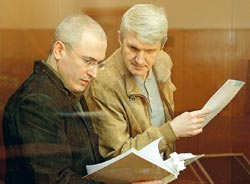
Already in the early morning of June 21, the 7th Rostov lane was forced by the van of television companies that were waiting for the appearance of Gref. Before the meeting in the hall for two minutes, photographers and video operators were launched for two minutes. They surrounded the armored glass aquarium, trying to make a successful shot. Platon Lebedev with an absent look considered the ceiling, Mikhail Khodorkovsky leisurely leafed through the documents. The first twenty minutes were like a nervous expectation before the New Year: everyone is waiting for gifts, but so far we have to eat olivier and listen to stupid toasts. Herman Gref came to the court 10 minutes earlier than 10.30.
Gref took out glasses from the inner pocket of the jacket, put them on, then took off the clock from his left hand, put them in front of him on the tribune and began to answer the formal questions of the judge Viktor Danilkin: he works as the head of Sberbank, lives in Moscow, was born in Kazakhstan in 1964, did not experience hostility to the defendants, there is no reason for their contract. "Hello, German Oskarovich!" - began his interrogation Khodorkovsky. “Good afternoon, Mikhail Borisovich,” Gref answered, as if it were a regular business meeting at large, and not a conversation with a person sitting in a glass cobblem.
Gref sometimes nervously tapped his fingers of his right hand on the rostrum and looked like a schoolboy who did not learn his homework: he crumbled, answered questions uncertainly, emphasized those things that he knew for sure. When he did not know or did not want to remember, he said: “I don’t remember”, “I’m not sure”, “I can neither confirm nor refute”, “I will not say now.”
Answering questions about the theft of 350 million tons of oil in 1998-2003, the head of Sberbank informed the court that the Ministry of Economy used the official documentation of Rosstat to take into account the number of oils extracted, transported and exported in the country. And to the question of Khodorkovsky: “If 20% of Russian oil production (60 million tons per year) were gone on the“ Transneft ”node in some year, such information as the Minister of Economics would have come? Or are you not obliged to check? " - He answered: "It was not my responsibility ... But I think that if it had been discovered, it would probably have come." “But you didn’t receive such information?” - “No” (more here ). Gref at one in the afternoon, and behind him, half of the audience left the hall. Then, however, one of his colleagues returned - German Oscarovich forgot his glasses on the rostrum.
Second blow to prosecutors
The next day, June 22, the entrance to the Khamovniki court in the morning was numbered by the bars of the fence, and several employees of the bailiff service were on duty at the door in anticipation of the arrival of the Minister of Industry and Trade of Viktor Khristenko. The minister was late: “I got into the cork,” Judge Danilkin explained to the audience. At the very beginning of the interrogation, Khristenko noted that he is not familiar with the case file and in itself is not a very experienced witness in court. An interrogation, which lasted 2.5 hours, was often interrupted by dissatisfied remarks, cries and performances of the prosecutor Valery Lakhtin: something constantly did not suit him. Even when Khodorkovsky quoted the indictment, Lakhtin protested: “I ask Khodorkovsky a remark! Quotes some sheet! Let him refer that he reads there? " Lakhtin was clearly nervous: witnesses such as Gref and Khristenko, destroyed the script prepared a month ago.
Khristenko spoke clearly and confidently. In the period from 1998 to 2003, when, according to the prosecution, Khodorkovsky and Lebedev stole 350 million tons of oil, Khristenko worked as the first deputy Minister of Finance and Deputy Prime Minister of Russia, answered just for the "Neftyanka". Like Gref, Khristenko said: “Productive units of companies cannot have a price equal to the price of oil in Rotterdam!” When Minister Khristenko and his bodyguards began to leave the hall, prosecutors and judges, as if schoolchildren who met the teacher who entered the class, jumped up from their places: the boss deigned to leave.
"
When Danilkin looks at the prosecutors, he just has a fright in his eyes. He is intimidated to death
" 
Both during the first and second process, the judges regularly refused the defenders of Khodorkovsky and Lebedev to satisfy the applications for calling senior officials as witnesses. Back in December 2009, Prime Minister Vladimir Putin said that the defendants are related to murders for which the head of the Yukos economic security department Alexei Pichugin was convicted. “In your place, I would turn to the prosecutor and get acquainted with the case. You will receive an absolutely clear answer to your question, ”snapped in a recent conversation with foreign journalists and Deputy Prime Minister Igor Sechin, when he was asked about the political background of Khodorkovsky’s case. The greater surprise was the decision of Judge Viktor Danilkin to call Gref and Khristenko to court. What's happened?
In this regard, experts interviewed by The New Times offer several versions.
The first: the Kremlin and the government decided to distance themselves from the loud process and leave the decision of the fate of the defendants on the conscience of the judge Danilkin, who will have to solve the difficult task of putting the comma in the right place: you cannot have mercy to execute.
Second: Khodorkovsky’s enemies in the White House (primarily the same path
Well, Sechin) The process became uninteresting, and the Kremlin, the Dmitry Medvedev team, on the contrary, takes control of the situation, because the current president is not interested in the accusatory sentence.
Finally, the third: the challenge of Khristenko and Gref is only an imitation of justice, an attempt to put dust into the eyes of foreign investors. In favor of this version, it says that the court granted the defense to call the VIP-seekers on May 19, on the eve of the visit to Russia, adviser to Barack Obama Obama Michael Makfol and a large group of American businessmen, who in the Kremlin were in every possible way to invest in the Skolkovo Project. * * At the same time, however, Danilkin refused to invite lawyers to meet the Prime Minister Vladimir Putin, his deputy Igor Sechin and the head of the Ministry of Finance Alexei Kudrin. It is symptomatic that the interrogations of the head of Sberbank and the head of the Ministry of Industry and Trade occurred on the eve of the visit of Dmitry Medvedev to the United States, where the president continued to knock out investments under the project of the Russian Silicon Valley. “This is the right background for the president’s visit to the United States: they showed that in Russia officials can also appear before the court, where they can be asked acute issues,” says Kirill Kabanov, chairman of the National Anti -Corruption Committee. “Another thing is that most of the specific questions they could answer, there were no answers.”
Government maneuver?
According to most experts, Gref and Khristenko could not appear in the Khamovnican court without the sanction of Prime Minister Vladimir Putin. Former Prime Minister Mikhail Kasyanov, who voluntarily performed in the Khamovnichesky court, claims that at least Khristenko probably discussed his campaign with government chairman Vladimir Putin. According to Kasyanov, if the minister is summoned to the court, he will report to his leadership about this: “This is not some kind of regulatory law, this is the ethics of relations adopted in the government,” the former Prime Minister The New Times said.
“In Russia, people of such a high position in fact cannot but coordinate such decisions,” Andrei Illarionov, former presidential adviser on economic issues. “Formally, no one requires such a coordination, but if the official had committed a similar action without having previously held coordinations or, as they say, a“ prone ”, this would be perceived as an obvious demonstration of non -reducedness that would withdraw this person from the circle of persons related to decision -making.” Actually, exactly this led in 2003 to the resignation of the then head of the administration of President Alexander Voloshin. As a source well acquainted with this story says, Voloshin then informed Mikhail Khodorkovsky that the first person allowed the oligarch to finance the Communist election campaign: these were the last relatively free elections to the State Duma, and Yukos was very active in promoting “its” deputies from various parties - from the Communist Party to the ATP and Yabloko. However, President Putin believed that he did not give such permission or his words were incorrectly understood. The “incomprehensible” Voloshin was forced to leave the Kremlin.
The fact that the issue of their appearance in court Gref and Khristenko was coordinated with a higher leadership, the former State Duma deputy, Major General of the FSB retired, and the former head of the Security Service of Yukos Alexei Kondaurov, is also sure: “I do not believe the independence of judge Danilkin. When he looks at the prosecutors, he just has a fright in his eyes. He is intimidated to death. And he obviously had some teams to call Gref and Khristenko and on the non-devasts of everyone else. ” “They are not obliged to do (coordinate) under the law on civil service, because the subjects of the criminal process are obliged to come to the court, regardless of where they work. This is an informal code of conduct. They agreed on the fact of their appearance there and the content of what they said, ”the political scientist Stanislav Belkovsky is convinced.
VIP Initiative?
However, there are those who believe that the minister and banker made an independent decision to visit the Khamovnican Court. “Khristenko and Gref are quite serious guys. They know well what is possible, and what can not be afforded, ”says the political scientist, a former assistant to President Boris Yeltsin Georgy Satarov. The lawyer Elena Lukyanova agrees with him: “The power is not homogeneous. The power that planted remained with her own. And the one who came, she is not the one who planted. I do not think that Putin will endure from this process, but he now has other weight categories. ” The source close to the Kremlin claims that those who previously closely followed Khodorkovsky’s affair are no longer interested in the process: Judge Danilkin will have to decide how to get out of this situation. At the same time, Alexei Kondaurov believes that the Dmitry Medvedev team is trying to participate more and more actively in the process: “The Kremlin has been withdrawn from the game for obvious reasons. I think it was part of the election agreements. But now the Kremlin is trying to enter the game, because the absurdity of what is happening goes off scale, and the reputation for the country is already very serious risks. ” First of all, they are associated with the “Yukos” cases considered in the Strasbourg and Hague courts, * * On the essence of the claims and their judicial perspective, The New Times wrote in detail in No. 44 of December 7, 2009 and No. 8 of March 8, 2010. For which Russia is threatened with gigantic amounts of payments. But not only this can scare the Kremlin: “speculative capital will come, and direct investments with such a development of the situation will not come in large quantities, and there is nowhere to take money,” Kondaurov believes. - In this situation, the Kremlin, perhaps, began to play more actively. Khristenko and Gref are professionals, they cannot behave, like the prosecutor Lachtin. They also have personal reputational risks associated with the fact that they cannot lie from obvious things. For Lachtin, this is "excusable", for them - no. It is not for nothing that Khodorkovsky all the time apologized for “stupid” questions, the process from the very beginning tries to encroach on common sense. The charges are destroyed by any idea of the rights of private property. Neither Gref nor Khristenko, with all his loyalty, even if they are members of the team, can not allow themselves to go through the line of common sense, therefore they said that they were in reality. ”
“My version is as follows: those people who perform in court on the side of defense, protect themselves, not Khodorkovsky and Lebedev,” Belkovsky agrees. - They thereby want to show that they do not have the slightest attitude to the Yukos case. And no matter how it develops further, they are not involved in this. Thus, they save their own reputation and guarantee themselves a political and professional future, including in the international context. ”
The preparation of the material was attended by: Egor Mostovshchikov (report from the courtroom), Ekaterina Bazanova and Konstantin Novikov