
Translated material
"The main danger is the budget deficit"
The main economist of the World Bank for Russia - The New Times
The World Bank changed the forecast of the main macroeconomic indicators of the Russian economy for 2010. The bank’s report that has just been published says that GDP growth will be 4.5% - in March, the bank predicted an increase of 5–5.5%, and the budget deficit - 4.6% of GDP, while in March - 3%. Why so? - About this The New Times was told by the chief economist of the World Bank in Russia 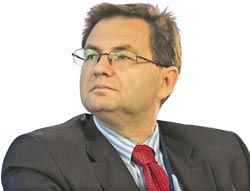
Nefteedollars will not save
But the forecast of the Ministry of Economic Development is 3.4%, that is, less than you show. The department of Elvira Nabiullina knows about the prospects of our economy something that you do not know?
Don't think. Just different teams of analysts give different forecasts based on different methods. Our forecast is based on the latest data on the growth of Russian GDP in April and on some indicators of May. And they demonstrate better dynamics than in the first quarter. Although if you compare these numbers with April-Maj last year, then we must take into account the effect of the “low base”: it was then that your economy failed to the greatest extent. So, now it is easier for her to purely arithmetic to demonstrate the rise. Second: the real level of income of the population has been growing since the beginning of the year - it has already exceeded the pre -crisis. Accordingly, demand and consumption will grow. The unemployment rate in Russia is not as large as expected before. Finally, your country does not have such a high external debt as the countries of Western Europe. All these factors suggest that Russia has the opportunity to grow at a higher rate than the Ministry of Economic Development predicts. How these opportunities will be used is another question.
The World Bank raised its forecast for the average oil price - up to $ 78 per barrel this year and up to $ 74 in the following. If the forecast comes true, then the budget deficit will decrease?
Not a fact. The increase in budget revenues due to increasing oil prices, apparently, will be partially leveled by additional social expenses and pensions indexations. Let me remind you that, according to our March forecast, the Russian budget deficit was supposed to be 3% of GDP for the year. And next year, your budget should have been balanced at all. Now we see the situation more alarming: the budget deficit in 2010 will be 4.6% of GDP, and in 2011-3.8% of GDP. For the Russian economy, risks associated with high volatility of oil prices and global conjuncture remain very sensitive. After all, if oil prices are dropped, then your budget deficit will increase. The government makes sense when forming a budget for 2011 to lay a conservative forecast for oil prices in order to provide the budget with a “pillow of safety” in case of adverse surprises of the global situation.
President Medvedev at a recent St. Petersburg Economic Forum stated that the raw material dependence of the Russian economy after the crisis decreased. Do you agree with such an assessment?
I would say that the diversification of the Russian economy remains the main challenge for your government for the near future. I think that the president understands this and the meaning of his statement is to show that diversification of the economy is one of the main tasks of modernization.
"
The diversification of the Russian economy remains the main challenge for your government for the near future
"
The VB left his forecast for Russian inflation in this year - 7-8%. The Ministry of Economic Development expects the price increase will be even slower and will meet 6–6.5%. If it turns out, it will be a record low result for 20 years of reform. Is he achieving?
In our forecast, we proceeded from the fact that the increase in the money supply in Russia occurs relatively slow pace and restrictions in lending to legal entities and individuals are preserved. Less money in the economy - fewer opportunities for rising prices! At the same time, there are risks of increasing inflation associated with the possible weakening of budget policy, in particular, as a result of the planned indexation of pensions.
With an eye on Europe
Can a debt crisis, which now, from the "presentation" of Greece, is unfolding in Europe in Europe?
Let's just say: the debt crisis in some countries of Western Europe increases the risks associated with the development of the Russian economy. For example, an influx of foreign investment from these countries may be reduced or their demand for your export products decrease. However, we do not expect that the debt crisis in the old world will lead to defaults of the Greek or any other economy. At the same time, Russia has sufficiently limited connections with the countries of the South of Europe, which were under the blow, from the point of view of financial ties and revolutions of foreign trade. Therefore, we think that the influence of the European debt crisis on Russia will be limited.
What needs to be done to make foreign investments to Russia?
It should be borne in mind that the post -crisis world is a world of more expensive capital and a higher level of competition between countries for its involvement. This means that in order to ensure an influx of investment, your government needs to work more actively on structural reforms aimed at improving the investment climate, strengthening the financial sector, improving the quality of infrastructure and institutions, improving the quality of labor.
You called a number of risks that exist for our economy. Which one do you consider the most dangerous?
Budget deficit. You need to prepare for its serious reduction - primarily by cutting unproductive expenses and increasing the efficiency of the entire budget sphere.
Zhelko Bogotich was born in 1960 in Yugoslavia. Citizen of Montenegro. For more than 18 years he worked in various positions in the World Bank and the International Monetary Fund. Including for 10 years he has been engaged in countries with transition economics, such as Bulgaria, Uzbekistan, Belarus and Tajikistan. He owns not only his native Serborvat, but also English, French, Russian and Spanish. He received the degree of Doctor of Philosophy in the Field of Economics at the University of Connecticut (USA).
“We have recovered dependent on oil,” said Finance Minister Alexei Kudrin.
Below - his answers to the questions of journalists given during a briefing, which was also visited by The New Times
About world finances
Today, according to all estimates, humanity has financial resources for $ 3 trillion less than before the crisis. The stock markets lost a quarter of their capitalization - $ 15 trillion. The total amount of budget deficits of the leading 20 countries of the world increased by 7.5%. According to the eurozone, sovereign debt will exceed 100% of GDP by 2015. If the budget deficits are reduced to zero, this threatens to reduce the global GDP by 8–8.5%. Russia must verify its steps in financial policy under the international coordinate system.
About GDP
Today, Russia's GDP is 21% lower than the one that the government counted before the crisis, taking its medium -term programs covering 2010. And next year, this gap with pre -crisis forecasts will grow to 24%. Even if the economic growth continues with the pace that we predict, this year the budget revenues will be a quarter lower than it was in 2008. Moreover, we will lose both oil and gas and Neneftegas income.
About forecasts
We should not proceed from super -optimistic plans - only from conservative forecasts, and we must further take into account the cyclic nature of the development of the economy. Until now, we proceeded from the idea of its continuous growth, and the crisis reminded us that the economy is developing according to another, cyclic rules. So, we need to continue to create a margin of strength in successful times, when there is a surplus and expansion of the tax base.
On the budget deficit
This year, the deficit will be, according to government forecasts, 5.4% of GDP. This is a serious challenge for us. We plan to eliminate the budget deficit by 2015. To do this, each subsequent year we expect to reduce it by somewhere by 1% of GDP. In this regard, we will have to increase borrowings. The Russian external debt, which is now 8% of GDP (the lowest indicator among the “twenty” countries) will increase to 14% of GDP.
On reduction of expenses
We should not succumb to euphoria: they say, at the beginning of the year we planned a deficit of 6.8%, and now already 5.4%. It is necessary to be aware that this does not happen due to the efforts of the government, but by increasing the price of oil (compared with the fact that we predicted at the beginning of the year) and ultimately due to the strengthening of our dependence on the oil conjuncture. It is more correct to measure yourself according to the non -Neneftegaze deficiency (cleansed of oil revenues and borrowing). In 2000, it amounted to 1.7%, in 2003-3.2%, in 2008-6.5%, in 2009 --13.5%. This year it will reach 13.7%. This dynamics indicates that we have become more dependent on oil and should reduce it.
About pension problems
The budget deficit of the Pension Fund of the Russian Federation is 1 trillion rubles, and it will be covered at the expense of the budget (which is 2% of GDP). Strengthening demographic problems are imposed on this. Today we have 128 workers for 100 pensioners (for comparison: in Europe, where there is also an unfavorable demographic situation, 150–160 per 100). By 2020, there will already be 112 employees working for 100 pensioners, and by 2030 - 100 by 100. This is a serious call: no pension system will withstand such a load. So, there must be a reform of social obligations. We will inevitably have to increase the retirement age, especially since we have it lower than in most other countries. If you do not raise age, we will face the fact that the pension will be very low.
The material was prepared by Dmitry Dokuchaev