
Translated material
"Chinese quality" in science
The phrase “Chinese quality” has a clearly negative shade in modern Russian and is synonymous “cheap, but bad”. According to many related to the process of reviewing in international magazines, in recent years, the shaft of Chinese articles also went to these magazines both at the place of residence of the authors and their quality. On the Internet, on the near -scientific forums, you can find a lot of bravura stories that tell about how this or that reviewer chopped off the next “Chinese article”. Nevertheless, over the last decade, the number of articles published by Chinese authors has increased 4 times, and starting in 2006, China has issued more scientific articles to the mountain than any of the developed countries of the world, without catching up with this indicator only in the United States [1]. Naturally, the question arises of what quality these articles. Given the number of researchers in China, one can easily imagine the situation of ensuring this growth exclusively due to articles in second -rate magazines. However, it turns out that this has long been not so. China systematically conquers leadership not only by quantity, but also with high quality.
Of course, in order to evaluate a specific scientific article, you need to read it. But operating on a fairly large array of data, when all articles cannot be read physically, in the first approximation you can evaluate the average quality of articles according to one parameter - in which magazines they are published. The more prestigious the magazine in the scientific society, the more severe review the articles are held. The opposite is true: the tougher the reviewing, the higher the level of published articles and, accordingly, the more prestigious the magazine. The prestige of the magazine, especially for the mass sciences, in turn, can be evaluated by such a simple parameter as an impact factor [2].
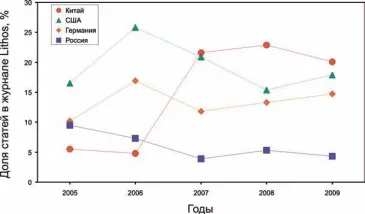
Consider the contribution of Chinese scientists to the most impact geological magazines, for which, in my opinion, the above statement about the connection of a high impact factor and prestige is quite rightful. In table. 1 shows data on the share of articles published in 2009 in the top ten of the most highly impressive geological magazines [3]. For each journal, data on five leaders are given to the leaders who published the most articles in these magazines in 2009, as well as in China (in cases where it is not yet included in the five leaders) and Russia. It can be seen that China is part of the ten most published countries in seven of the ten most prestigious magazines, and in two magazines he is in the five leaders, in one of which (Lithos) he generally took first place, overtaking the United States. Interestingly, back in 2005-2006. According to the number of articles in this journal, China was only on the outskirts of the first ten, but since 2007 it takes first place, slightly ahead of the United States and almost half as much as Germany’s publications (Fig. 1). Russia significantly loses comparison. Positions are surrendered even in magazines such as Lithos, in which the participation of Russian authors was traditionally high. In 2009, Russia was not included in the ten most published countries in any of the top magazines, and in some of them it is in the second twenty. In the Journal of Petrology for 2009, there was not a single article with the Russian address at all. This fact is especially noteworthy in that Journal of Petrology mainly publishes articles with a large amount of its own experimental data.
Table. 1. Five leading countries on publications in ten geological journals with the highest impact factors (JCR-2009) in comparison with China and Russia. ISI database data Web of Science ( www . ISIKNOWLEDGE . COM ). All types of publications are considered, excluding theses of reports.
| Magazine | Impact factor | Publisher | Country | Number of articles | Share of articles, % |
| Geochimica et cosmochimica acta | 4.385 | Elsevier | USA Germany France England Canada China Russia | 1 2 3 4 5 10 21-22 | 53.9 16.2 14.9 13.4 8.2 4.4 1.3 |
| Geology | 4.368 | The Geological Society of America | USA England Canada Germany France China Russia | 1 2 3 4 5 8 27-34 | 59.2 15.4 13.4 10.4 7.4 5.4 0.7 |
| Quaternary Science Review | 4.245 | Elsevier | USA England Germany Australia Canada China Russia | 1 2 3 4 5 14-15 18-26 | 32.5 31.4 12.2 9.4 9.0 2.7 2.0 |
| Earth and Planetary Science Letters | 4.062 | Elsevier | USA France England Germany Japan China Russia | 1 2 3 4 5 9 17-18 | 53.6 20.4 16.8 15.4 10.4 6.2 1.4 |
| Journal of Petrology | 3.738 | Oxford University Press | USA England Germany France Australia China Russia | 1 2 3 4 5-6 13-17 - | 29.2 16.7 13.5 12.5 11.5 3.1 0 |
| Precambrian Research | 3.581 | Elsevier | USA Australia Canada China South Africa Russia | 1 2 3 4 5 11-12 | 26.9 25.5 21.4 16.6 11.7 6.2 |
| Lithos | 3.537 | Elsevier | China USA Canada Germany France Russia | 1 2 3 4 5 11 | 20.1 17.9 15.2 14.7 10.3 4.3 |
| Contributions to Mineralogy and Petrology | 3.497 | Springer | USA Germany Australia France Switzerland China Russia | 1 2 3 4 5 10-11 16-17 | 37.0 27.0 13.0 12.0 11.0 6.0 3.0 |
| Chemical Geology | 3.407 | Elsevier | USA France Germany Australia Canada China Russia | 1 2 3 4 5 7 17-20 | 37.3 22.4 14.8 11.5 10.9 9.7 1.5 |
| Meteoritics & Planetary Science | 3.253 | Wiley-Blackwell | USA England Germany Canada Japan Russia China | 1 2 3 4 5 8 14-15 | 59.8 15.9 14.4 12.9 9.1 6.1 2.3 |
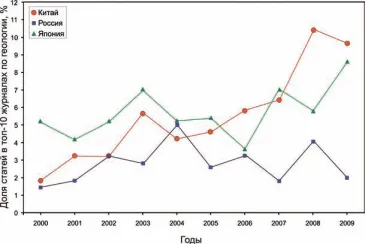
In table. 2 shows the total data on the ten magazines in the ten in the last ten years. The United States remains an unchanged leader in the number of publications. At the top of the first ten years, large European countries have been located - England, France, Germany. In the middle - Canada, Australia and Japan. The ten Switzerland and Italy are closed. China represents an exceptional case. If in the early 2000s he was in the middle of the second dozen, today-in the middle of the first. For ten years, China has gone from the level of Russia to the level of leading countries (Fig. 2). Until 2004, Russia showed coherent growth with China, after which stagnation and a slight decline in productivity occurred. However, it should be noted that this growth of publication activity can be an artifact of the selected database. So, the replacement of the European magazine Contributions to Mineralogy and Petrology (Springer) with the American Geophysical Research Letters (American Geophysical Union) is raising the trend for Russia to average ~ 2.5%.
Thus, today we can say that the phrase “Chinese quality”, at least in the geological sciences, should carry a positive meaning rather. And if the existing trend is preserved, then ten years will not pass, as it will firmly strengthen in the mind that “Chinese quality” means “well done”.
1. Http://thomsonreuters.com/content/corporate/articles/bricreports
2. Www.elsevier.com/framework_editors/pdfs/perspectives1.pdf
3. The table includes only magazines with more than 5 years of history and the number of articles in 2007-2008. more than 100 units. In the first parameter, Nature Geoscience (Nature Publing Group) and BiogeScience (European Union of Geo-Sciences) did not fall into the list, and Annual Review of Earth and Planetary Sciences is on the second (Annual Reviews) and Reviews of Geophysics (American Geophysical Union).
Table. 2. The share of articles (total place) among leading countries in comparison with Russia in dynamics over the past ten years in ten most cited magazines in geology (Table 1). Countries are ranked according to their publication rating in 2009. Data on the ISI Web of Science ( www.isiknowledge .com ) database. All types of publications are considered, excluding theses of reports.
| Country | 2009 | 2008 | 2007 | 2006 | 2005 | 2004 | 2003 | 2002 | 2001 | 2000 |
| USA | 47.2 (1) | 40.4 (1) | 45.2 (1) | 41.8 (1) | 42.0 (1) | 42.8 (1) | 41.2 (1) | 45.1 (1) | 45.6 (1) | 44.6 (1) |
| England | 15.2 (2) | 14.2 (5) | 14.2 (3) | 16.2 (2) | 15.6 (2) | 10.6 (5-6) | 9.6 (5) | 11.2 (4) | 14.4 (2) | 13.2 (2) |
| France | 14.0 (3) | 15.0 (3) | 14.4 (2) | 13.4 (3) | 15.0 (3) | 12.4 (4) | 13.0 (3) | 16.6 (2) | 11.2 (3-4) | 11.4 (3) |
| Germany | 12.8 (4) | 15.6 (2) | 13.8 (5) | 12.8 (4) | 14.6 (4) | 15.4 (3) | 14.2 (2) | 14.0 (3) | 11.2 (3-4) | 8.6 (5) |
| Canada | 10.8 (5) | 7.4 (7) | 9.4 (6) | 10.0 (5) | 6.0 (6) | 17.2 (2) | 8.6 (6) | 9.4 (5) | 8.2 (5) | 8.0 (6) |
| China | 9.6 (6) | 10.4 (6) | 6.4 (8) | 5.8 (7-8) | 4.6 (9) | 4.2 (12) | 5.6 (8) | 3.2 (11-12) | 3.2 (10) | 1.8 (15) |
| Australia | 8.6 (7-8) | 14.6 (4) | 14.0 (4) | 9.8 (6) | 10.2 (5) | 10.6 (5-6) | 11.8 (4) | 6.6 (7) | 7.6 (6) | 9.2 (4) |
| Japan | 8.6 (7-8) | 5.8 (8) | 7.0 (7) | 3.6 (10-11) | 5.4 (7) | 5.2 (8) | 7.0 (7) | 5.2 (8) | 4.2 (9) | 5.2 (7-8) |
| Switzerland | 6.2 (9) | 4.6 (10) | 6.0 (9) | 5.8 (7-8) | 5.2 (8) | 5.4 (7) | 3.4 (11) | 7.0 (6) | 5.4 (8) | 5.2 (7-8) |
| Italy | 4.2 (10) | 5.0 (9) | 5.0 (11) | 3.4 (12) | 3.4 (10) | 4.0 (13) | 4.0 (9) | 5.0 (9) | 6.0 (7) | 4.4 (9) |
| Russia | 2.0 (13-16) | 4.0 (11) | 1.8 (16-18) | 3.2 (13) | 2.6 (12-13) | 5.0 (9) | 2.8 (12-13) | 3.2 (11-12) | 1.8 (17) | 1.4 (18) |