
Translated material
Simulakra
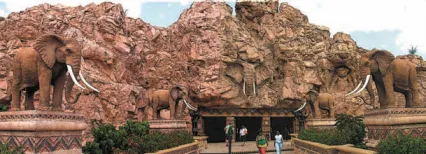
In South Africa, on the territory of Bost -Kostsov, tourists can survey the restored city of ancient African civilization - the luxurious palace of the ruler; "Bridge of time" to him, lined with statues of elephants; impressive stone leopard at the temple of creation; Pools bordered by palm trees. A certain northern people penetrated here 3 thousand years ago and erected all this splendor, then the earthquake destroyed the city, and the surrounding black tribes pulled the remnants. And then the English archaeologist from the generation of Cecil Rogs found and excavated the lost city, and the current technologies allowed him to date him and restore everything as it was ...
Thousands of tourists walk along the streets of the lost city, admire exotic, but the administration does not hide from them that all this is a simulacrum. The international hotel group Sun International built an archaeological monument from scratch, maintained a myth, also constructed, but on the model of existing myths about the Great Zimbabwe, the cops of Tsar Solomon, the wards of Queen Savskaya. The chief architect of the California team of builders, Gerald Ellison, admits that all this is the purest fantasy, but "painted with the legacy of Africa." In the palace, naturally, a hotel was arranged. Martin Hall, an archaeologist from Cape Town, who described this artificial monument in the early 90s (Hall, 1995, etc.), considers it as a colonial creature that affirms the superiority of the northern colonialists over the black population, and at the same time as a typical product of postmodernism with its substitution of realities with a performance, a game.
In the 70s of the twentieth century. Such a stream appeared in archeology ... No, not in archeology, but near archeology - Mock Archaeology (parody, fake, fraudulent archeology).
Either the example was contagious, or the ideas of postmodernism act on archeology equally everywhere, but in the UK, the World Center for Archeology, the same installation broke out. In 1999, Mark Dyon spent the appearance of archaeological excavations on the banks of the Thames, and then imitated archaeological studies with collected garbage: documented, crossed, classified, conducted tests and, finally, made an exhibition in the Tate gallery. The most influential professor of Cambridge Colin Renfre, Lord Camstorn, accompanied this imitation with his qualified lecture.
“All this,” he claims, “clearly looks very similar to archeology, and when you meet the enthusiasm of some volunteers, you also feel like there. But is it archeology? Like this, Mark Dyon calls himself an artist, and the final product is at the exhibition in the Tate Gallery (and then it was purchased by the gallery), but is this art? ... Right, archeology, what are archaeologists do ”(Renfrew 2003: 85-86, 88).
Dyon did everything that archaeologists are doing - digging, gently collected, drew, classified, exhibited. True, he does not have archaeological education and is not an employee of an archaeological institution. But some glorious archaeologists of the past, too. Compared to the classic excavations of Sir Mortimer Wieler in the middle of the last century, the work of Dyon, Renfra noted, looked much more like his own professors Renfra, archaeological excavations than the Cessonian method of Wyler!
Renfra here does not note only one significant difference:
Dyon did not set himself the task of finding antiquity and understanding the past by them, while Wheeler and Renfra pursued this particular goal. Renfra only notes: "We dig the past, is it?" (Renfrew 2003: 88). Renfra does not seem more important to the goal, but the process of archaeological research. Like contemporary art: the same Richard Long, whose works are exalted by Professor Renfra, wanders around the light and does not very laborious, but noticeable changes in the terrain - it smokes, there will shift the stone - and this process is art for him. True, for Dyon, this process is both archaeological research and art - just fun, parody, joke.
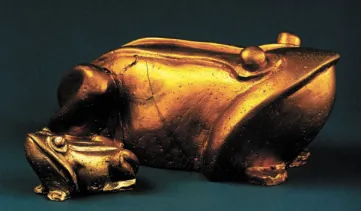
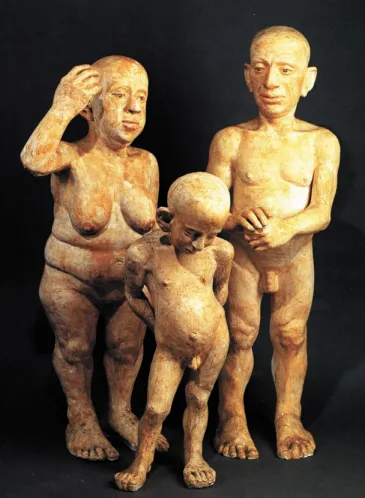
Similar, but a much larger joke was made by journalists of St. Petersburg, and they were supported by the archaeologists of the Hermitage. In 2004, the Hermitage organized the grandiose exhibition “Gold of Swamps”, all the exhibits of which were products of free fantasy of contemporary artists. At the exhibition, a certain tribe of ancient swamp dwarfs, their culture and creativity, gold figurines and jewelry, wooden carved figures, plans for settlements, diaries of archaeologists, allegedly digging these settlements, herbariums and insect collections - samples of fauna and flora of the geographical environment, drawings of burials, drawings of burials were presented. A luxurious volume in Quarto (Anatoly Belkin. Gold of Bolota, 2004), filled with colored illustrations in the best Hermitage style, on glossy paper, good for a scientific publication (1,500 copies), was published to the exhibition. T O MU precedes the preface of the director of the Hermitage of Professor MB Piotrovsky. In the article of a prominent employee of the Hermitage Yu.Yu. Piotrovsky gives a quote from Arturo Perevo-Revert: “In fact, the game is the only truly serious thing.”
When I was young, the section "Physicists joke" was very popular in the magazines. Now, archaeologists are joking.
But Mock Archaeology is translated not only as “parody, comic archeology”, “archeology for the pod”, but also “craft, fake, falsifying archeology”. Meanwhile, in archeology, fakes are only inexperienced employees, beginners, are perceived as innocent jokes. Indeed, in archeology, the excavation of the monument is identical to its destruction. It is impossible to dig up and check the second time and check how things lay there. Therefore, for such jokes (throw up a fake, etc.), I immediately dismissed from the expedition. Moreover, the rules of excavations are included in the criteria of scientific. And the criteria for scientificity, archeology is used to perceiving seriously, and the erosion of these criteria - on the banks of the Thames or on the banks of the Neva - may turn out to be risky jokes for it. Dangerous jokes. Humor is quite accessible to me, but I need to strictly distinguish between jokes and a serious business. And, perhaps, not to get carried away with the cultivation of jokes that are too close to business.
Of course, archeology and Hermitage are only the indicators of the general trend for postmodernism. It concerns all arts and all sciences. What is the planned "silicone valley" in Skolkovo? The same Simulakr. The idea is that investments flow from all countries and world luminaries of science gathered to work there. But it is obviously clear that in order for both to happen, it is necessary to ensure an atmosphere in which investors will be sure that they will not take the work they have started from state security or from the ruler’s friends, and scientists will not be accused of transmitting information in Zimbabwe. And this means that you first need to release Khodorkovsky and Danilov and his comrades and be put on trial of the initiators and executors of these judicial undertakings. Without this, you can, of course, take Vekselberg for Faberge and encourage him to finance Skolkovo, you can attract other home billionaires, you can invest state billions, but you will not get a real silicone valley, but a lost city of BOVENTS.
If it turns out that Vekselberg does not go well, then is it not to appoint Anatoly Belkin by the head of the project? “Gold of Swamps” always turns out to be tinsel, but “dwarfs of swamps” are closer to reality and even know how to dream.
Belkin A. 2004. Gold of swamps. Own version. Exhibition catalog. St. Petersburg, Hermitage.
Hall M. 1995. Great Zimbabwe and the Lost City. - Ucko P. (ed.). Theory in Archaeology. London and New York, Routledge: 28-45.
Renfrew C. 2003. Figuring it out: Whmt Age We? What do we come from? The PARALLEL VISIONS of ARTIS AND Archeologists. London, Thams And Hudson.