
Translated material
He was an intelligent of the highest sample
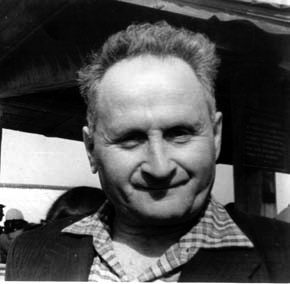
In August 2010, he marks the 100th anniversary of the birth of the famous Soviet physicist, teacher and popularizer of science David Albertovich Frank-Kamenetsky. We publish a biographical essay that was written about his father Maxim Frank-Kamenetsky, professor of Boston University (USA).
My father David Albertovich Frank-Kamenetsky was born on August 3, 1910 in the city of Vilna (now Vilnius, the capital of Lithuania) in an intelligent Jewish family. His father Albert Grigoryevich (Gershonovich) Frank-Kamenetsky (1873-1935) was a professor of chemistry, who was educated in Switzerland. His mother is Anna Abramovna, nee Hannah Arons. His uncle Israel Grigoryevich Frank-Kamenetsky (1880-1937) was a major hebraist and an Egyptologist, a professional in the University of Leningrad. Another uncle Zakhary Grigoryevich Frank-Kamenetsky (1874-1951), a children's ophthalmologist, lived and worked in Irkutsk, where he founded his clinic, which later became famous throughout Siberia. In 19171918 The father’s family also moved to Irkutsk, where Albert Grigoryevich headed the chemistry sympathic in the newly created Admiral Kolchak Irkutsk University. Albert Grigorievich unequilledly led the department until his sudden death in 1935.
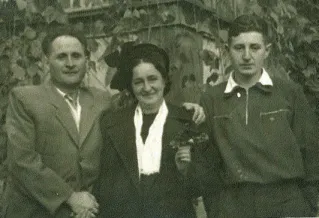
Despite the remoteness from the center, the degree of which is now even difficult to imagine, the father received a very good school education. He studied with such famous people as the designer of helicopters Mikhail Leontyevich Mil and anthropologist Mikhail Mikhailovich Gerasimov, with whom his father continued to be friends until the end of his life (all three died in one year-1970). After school, my father went to study at the Tomsk Technological Institute (now the Tomsk Polytechnic University), which he graduated in 1931, receiving a diploma of the Mining Engineer-Metallurg. He was sent to Chita for gold mines, where he worked for three years as an engineer and at the same time taught at an engineering college.
Obviously, he wanted something more, and his father was intensively engaged in self-education in physics, chemistry and mathematics for all these three years. In 1934, he wrote a letter to Leningrad N.N. Semenov, the future Nobel laureate, director of the newly formed Institute for Chemical Physics of the USSR Academy of Sciences, in which he outlined his thoughts regarding chemical thermodynamics. The result of the letter was the transfer of his father in the same year to Leningrad, where he was enrolled in the Semenov Institute as a graduate student. Here, the father became close to another graduate student of the same institute - Yakov Borisovich Zeldovich, friendship and fruitful work with which did not stop until the end of his life.
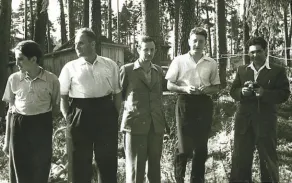
The next years before the start of the war were unusually productive. It was during these years that work on the theory of combustion and thermal explosion was made, based on the idea of a chain reaction, which brought his father world fame. In the same years, a significantly ahead of their work on motor -coaling chemical reactions were made. The works of this period subsequently formed the basis of its famous monograph "diffusion and heat transfer in chemical kinetics."
But the war began. The institute was evacuated to Kazan, where his big family followed his father: wife Elena Efimovna Friedman, mother Anna Abramovna, daughter of Tam, son of Albert and just born in Gorky, on the way to the evacuation, second son Maxim (author of these lines). In Kazan, his father defended his doctoral dissertation and did a job about the diagram of graphite states, including diamond. The work was classified and, as far as I know, was never published, although its results were well known to the Soviet scientist who worked on the problem of artificial diamonds. The father himself highly appreciated this work and was glad that she played an important role in solving the problem of artificial diamonds.
For a short time (1944-1946), the father headed the Department of Technical Chemistry of the Gor-Kov State University, where, according to the recollections of employees of the department, its stay left a deep mark. But the Institute of Chemical Physics was transferred to Moscow, and his father and his family moved to the capital for a short time. In 1947 The first edition of The Main Book of D.A. Frank-Kamenetsky, ”as he called“ diffusion ... ”Ya.B. Zeldovich.
In the postwar years, the father’s interest in the popularization of science was manifested, as evidenced by the publication of the brochure “Energy in nature and technology”. But it was a very difficult time. The anti -Semitic campaign was gaining momentum, which took place under the wake of the “cosmopolitan”. The father was accused of unbelief of the bright future of mankind on the basis that in his book he dared to discuss the theory of thermal death of the Universe. The absurdity of accusations only emphasized their anti -Semitic background. Apparently, the clouds were taken careful: his father was convinced that from very large troubles he was saved only by participation in the atomic project.
Work on the project began back in Moscow, and in 1948 the father and his family moved to Sarov (aka Arzamas-16, “mailbox” or simply “object”). All the years at the facility, he worked under the leadership of Zeldovich. At the facility, he became friends with Julius Borisovich Khariton, Igor Evgenievich Tamm and Andrei Dmitrievich Sakharov. But he was especially close in these years with Lev Vladimirovich Alt-Shuler, Veniamin Aronovich Zuckerman and Matess Mendelevich Agrest.
Obviously, by the family of his work at the facility, the father entered the course of modern nuclear physics, and this fueled his interest in astrophysicism. Subsequently, both Zeldovich and Sakharov made the same path - from the physics of the nuclear bomb to astrophysics, but the father was a pioneer who paved the way to both of them. It is amazing how he had the strength to combine unusually intense work in special tunics with the activities of purely fundamental problems of astrophysics. However, it was not always enough: in 1952 he suffered the most severe heart attack, from which he never completely recovered, although he “reduced the momentum” only relatively briefly. There in Sarov, the last child was born - the daughter of Maria.
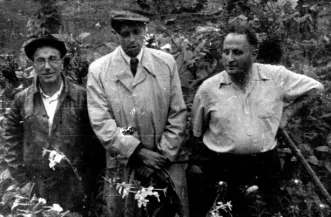
Igor Vasilievich Kurchatov very much appreciated his father and in 1956 he transferred him closer to himself, to Lipan, as the Institute of Atomic Energy, located in the north-west of Moscow, was then called. This was part of the extremely ambitious plan of Kurchatov, which was the genius of the organization of science, both fundamental and applied - to create the best scientific institution in the world. It is enough to mention the names of those who worked in Lipan in the late 1950s: Artsimovich, Leontovich, Kadomtsev, Budker, Kagan, Midal, Larkin, Smorodinsky, Velikhov, Vedenov, Sagdeev, Kikoin, Osovets, Fainberg, Aleksandrov, Lazurkin, Hesin, Shapiro, Gurevich, Spivak, Shafrans and Shafrans and Shafrans and Shafrans and Shafrans and Shafrans and Shafrans and Shafrans and Shafrans and Shafrans and Shafrans, Shafrans and Shafrans, Shafrans and Shafrans, Shafrans and Shafrans, Shafrans and Shafrans, Shafrans and Shafrans, Shafrans and Shafrans and Of course, Frank-Kamenetsky.
The last, Moscow period of his father’s life began. Despite the almost constant health problems, its activity during this period is simply amazing. He becomes one of the founders of the emerging science - plasma physics. In his laboratory at the Kurchatov Institute, he develops both applied directions - controlled thermal unit and plasma chemistry, and fundamental - plasma in space and inside stars. He makes a major discovery in the field of plasma physics-magnetic-sound resonance. Organizes at the physical education a new symbol of Plazma, which he heads until the end of his life. It becomes the deputy editor of the popular science magazine "Nature", actually takes on all the work on the preparation of the numbers and himself publishes many interesting articles there, mainly in astrophysics.
Books are published one after another: “Physical processes inside the stars” (1959); “Plasma is the fourth state of the substance” (1961, it was reprinted several times in Russian and was translated into many languages); “Lectures on plasma physics” (1967); “Diffusion and heat transfer in chemical kinetics” (1967; 2nd Russian publication, radically processed and supplemented; English translation was published in 1969); "Nuclear astrophysics" (1967). And as if all this is not enough: he organizes the biophysics laboratory in the newly founded by I.V. Kurchatov Radiological Department of the Institute of Atomic Energy.
In the spring of 1970, his father suffered another exceptionally heavy heart attack, from which he could no longer recover. He died at home on June 2, 1970
Speaking about the outstanding merits of his father as a scientist, teacher and popularizer of science, one cannot but say about him as a person [1].
The fact is that the scale of his personality impressed everyone who talked with him. Father was primarily an intellectual of the highest sample. Moreover, the intellectual is hereditary, which was an extreme rarity among the Soviet education of his generation.
He was called, Renaissance Man, freely oriented not only in all the areas of physics and chemistry, but also who knew, and, moreover, not firsthand, many other areas of science and art: psychology and psychiatry, the history of different countries and peoples, especially the history of Russia and the history of Jews, classical music, literature, especially Russian, English and German, and image art - from the image of the Russian Antiquities to the present. He knew by heart almost the whole block, Gumilyov, Pasternak, Zabolotsky, not to mention Pushkin.
The scale of the personality made it partly by a white sheep in his environment, which consisted mainly of people, albeit talented, but narrowly educated. From this scale of personality - and complete indifference to external attributes of scientific success, such as rewards (although he received a lot, for special tematics) or membership at the academy (where he was not elected). Father was well aware of the crime of the regime in which he lived. In this regard, he has not had any illusions since the beginning of the 30s, from the Holodomor, who was then called "collectivization." In general, personalities of this scale are not able to hate: hatred is the destiny of the poor in spirit. But the father experienced a strong hatred of one person, here he could not do anything with himself. The object of this hatred was Stalin. Through the Jewish channels, and more often from the “enemy” radio programs (at the head of his bed there was always a short -wave receiver with headphones), his father knew very well about the new eccentricities of the “father of the peoples”: the villainous murder of Mikholes, the acceleration of the Jewish theater (his father helped the poor actors with money), the execution of the Jewish anti -fascist committee, and finally, the “business of doctors” (here is the case of doctors (here. The headphones were not needed -more carefully taps for the ears).
Stubborn rumors about the allegedly preparing mass deportation of Jews in Birobidzhan also reached him. How then could he participate in the creation of the most terrible weapon for a tyrant?! He was absolutely alien to self -justification such as the need for nuclear parity or “nuclear shield”. He clearly realized the unbearable of the choice to which he was put: to refuse to serve the tyrant meant to die himself and destroy his family. And he served a tyrant with one hope - that he would die before he can use the fruits of the efforts of his and his colleagues. It will be “dead”: the father never spoke about Stalin “died”. And he was happy when his hope was justified.
Photos are provided
M. Frank-Kamenetsky
1. In connection with the 100th anniversary of D.A. Frank-Kamenetsky also read the article by Academician of the Russian Academy of Sciences, Professor Meriland University (USA) Roalda Sagdeev “Remembering the Teacher” in the journal “Science and Life”, No. 7 for 2010 ( www.nkj.ru/archive/articles/18311/ ).