
Translated material
In smoke
Experts predict a long fight against fires
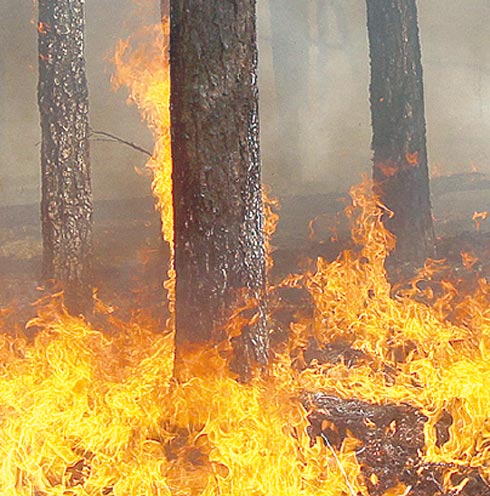
Prime Minister Vladimir Putin, explaining the reason for the fires and the unpreparedness of the authorities to them, said that such heat as this summer was not 140 years old in Russia. This is true. The truth is that, according to the results of a very hot summer, 2002, the Ministry of Emergencies reported: as a result of 37 thousand fires, about 2 million hectares of land were injured, this is the largest disaster over the past 110 years. Now, eight years later, the situation looks much worse. But the fact that the summer would be hot, weather forecasters warned in the spring, the heat sank into central Russia in June. The authorities had at least a month to prepare for fires. But for some reason, the fire still found Russia by surprise. Why and what to expect in the coming weeks, learned The New Times “by the law, the function of extinguishing forest fires at the Ministry of Emergencies is not entitled,” explained The New Times
Deputy Head of the Department of Information of the Ministry Elena Chernova. - It is assigned to the subjects, while the subjects through the Rosleskhoz are given money for preventive measures so that such a huge fire does not arise. As a result of this, apparently, was not done. The functions of the Ministry of Emergencies are salvation from the fire of settlements and potentially dangerous objects. ” One way or another, the Ministry of Emergencies today is the only department in the country with experience in combating large -scale fires. But it turned out to be not ready for what happened: “You ask where the Be-200
* * An amphibian aircraft for extinguishing fires. ,-said irritably on August 5 at a press conference
Head of the Ministry of Emergencies Sergey Shoigu. “How much we managed to buy, we managed to do so much.” We managed - 4 throughout the country.
On July 31, the minister asked the government to replenish the air park with five Mi-26 helicopters and two Be-200 aircraft. Two days later, 8 amphibians already asking for 8 days.
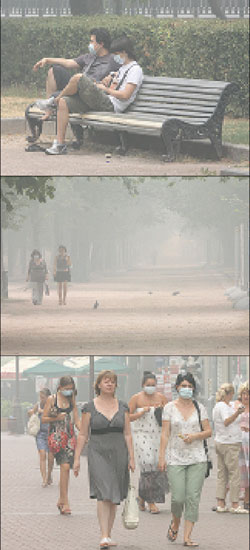 |
| Moscow, on August 6, to the question of whether Yuri Luzhkov will return from vacation in connection with the critical situation in Moscow, his spokeswoman Sergey Tsoi, according to Gazeta.ru, replied: “And what are the problems? Do we have an emergency in Moscow, a critical situation, what is the problem in Moscow? ” |
The conflict of interests to the question of why the Shoigu department did not provide for and did not calculate the threats, as the minister himself admitted (the fire department has been subordinate to the Ministry of Emergencies since 2002), and what budgetary funds have been spent on, writer Andrei Malgin answered in his blog, examining the website of the state order. “Department No. 72 of the Federal Fire Service bought a Jyundai Tucson jeep, the color of black, leather decoration of the salon and steering wheel, automatic gearbox, electric drive and heating of mirrors, audio taxation for six speakers, CD/DVD/MP3, automatic curtains, etc. - Options on three pages. Divine price - 872 thousand rubles ... - Malgin transfers. - The State Fire Service in the Krasnodar Territory - Pajero Sport for 900 thousand rubles and Nissan Teana for 1 million 145 thousand rubles. Are these cars similar to fire extinguishing equipment? Yes, somehow not very. And why did the Toyota Land Cruiser UZJ200L in a very good configuration for 2 million 223 thousand rubles? ”Nizhny Novgorod firefighters?”
No one to extinguish? In the hot 2002, about 200 thousand people of the state forest guards came to fight the elements: 70 thousand foresters-transferring and about 130 thousand other forestry workers, who quickly coped with the task, without turning the problem into a catastrophe. By the way, according to Shoigu, today 162 thousand people who save exclusively settlements and strategic objects are employed in extinguishing fires. Forestry extinguishing is limited to three reserves.
"
The number of strokes registered in Moscow in July increased by 10% compared to the same period last year
"
In 2007, the state guard was abolished, and the issues of forestry were transferred to the regional authorities. “With the introduction of the new Forest Code in 2007, structures serving the forest were simply destroyed,” says
Deputy of the Balashikha Council, former huntsman Alexei Butiev. According to him, the only clearly prominent result of the reform was that in three years the entire infrastructure of forest fire extinguishing - entrances to reservoirs, forest cordons, clearings, flooring for the "jump" of the fire engine became completely unusable. “There is no longer a service in Russia that would be responsible for fires in the forest fund,” states
Expert on environmental law Anton Khlynov . The result is predictable - the record hot summer of 2010 led to disaster. “If in Russia there were a capable and effective state forest guard, damage from a fire disaster in forests could be reduced by five to ten times,” he was convinced
The head of the forest program Greenpeace Russia Alexei Yaroshenko . “And the damage from forest and peat fires in 2010 will be such that these funds would be enough for several decades of existence of a full -fledged state forest guard of 20 thousand people.”
Will it burn for a long time? Experts warn: it will not be possible to quickly cope with the disaster. “If there are no heavy rains, then the situation will develop sadly. There will be repeated fires, - thinks
Head of the Laboratory of Forest Pyrology of the Krasnoyarsk Institute of Forest. V.N. Sukacheva Peter Tsvetkov . - It is necessary to block roads in order to minimize a visit to the forests. In addition, peat burns for a very long time, sometimes for years. Such fires can even winter. It’s hard to extinguish peat not only because it burns at a depth of several meters: with sharp cooling, burning peat is covered with a waterproof crust, which is formed during the oxidation process. And how many are not lei on this crust, it will still smolder under it. ” According to the scientist, even the trunks of trees never completely burn out, only burn. It can burn out a maximum of 25% of wood. “But if hollow trees with a rotten core are burning, then the tree can smolder for a long time and can give new foci of fires,” says Tsvetkov.
The coordinator of the forest policy of the Wildlife Fund, Nikolai Shmatkov, also warns of other dangers: “According to those reports that we come from places, the state does not pay sufficient attention to extinguishing smoldering fires. I am worried that there may be a second wave of fires, when these already burnt forests dry out, they can begin to burn again. ” “The fear is also caused by the fact that so far there were no fires in the territories that were infected in the accident at the Chernobyl nuclear power plant - this is the Lipetsk region, the Bryansk, part of the Kaluga, Tula regions,” Shmatkov lists. “If fires apply to these territories, smoke, Gar and was able to raise radioactive substances into the air, which are located in the upper layer of forest soil, including in peat bogs, in the trees themselves.” According to ecologists, nuclear facilities are well protected from fires, but their infrastructure may suffer.
Ornithologists of the Wildlife Fund report that the birds left Moscow due to smoke, the migration of animals in a number of regions of central Russia is observed.
And finally: who is still to blame for the current situation, in addition to the elements, global warming and the Lord God? “The absence of the state in the last years of forest management, including fire arrangement, to maintain state forest protection,” said Shmatkov. “If strong rains do not begin, the disaster can last a few more weeks,” he is sure. - In the atmosphere, nothing very dangerous is released - carbon dioxide, smoke. Although there is nothing good for health in this. ” Doctors, however, indicate that abnormal heat and smoke most directly affect the health of citizens. According to
Nicholas Podvunov , the number of strokes registered in Moscow in July 2010, increased by 10% compared to the same period last year last. 10% more often Muscovites began to contact an ambulance. And in the reference
Ambulance institute named after Sklifosovsky at The New Times correspondent, how many Muscovites turned to doctors due to smoke of the city, said: “We do not give any comments, we suffocated from smoke.”