
Translated material
The case of the "master" was frightened
The first week of September this year was unusually successful for Russian hunters for space gamma-ray. For this week, the SWIFT orbital apparatus has registered 4 gamuts of the varnish, which is several times more than the average rate of registration gives. The Russian Master Robot Telezcope was the first of all similar attitudes in the world to go to each of these bursts and received unique data on their optical radiation.
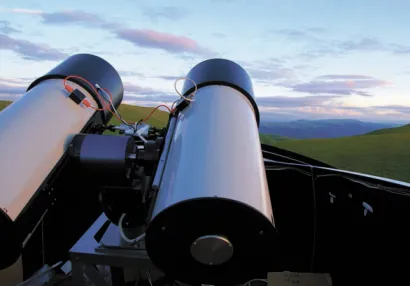
A series of robotic telescopes "Master" (Fig. 1) originates with the Moscow Region near Moscow, where the first of them was installed in 2002. The initiator and project manager Vladimir Lipunov (GAISH MSU) is a rare case of a theoretician who has retrained in the observer. Over time, new telescopes were created and were located already in more suitable places: in the Caucasus, in the Urals, Baikal, in the Far East. Groups from the Pulkovo Observatory, Irkutsk and Ural Universities, the Annunciation Pedament. University. For a long time it was not lucky: either the weather, then the day instead of the night, then something else. Only a couple of times, in 2006 and 2009, bad luck retreated, and the “Master”, entering the gamma-impending first, registered a quenching signal. And suddenly it broke.
On September 1, Swift was registered by GAMMA-VPLIK. A little less than a minute took to process the signal, calculating the coordinates and transfer of data to the Internet. 47 seconds after receiving the notification (103 seconds after the start of the surge), the “master” in Baikal (Tunka) and in Blagoveshchensk entered these coordinates. However, he saw nothing; This is a typical situation: the optical radiation of most bursts are weak, and the gamma radiation has already ended. But it was an unusual surge. After 7 minutes, he resumed with renewed vigor (this was observed before, but rarely). And here the “master” received an excellent signal, which, as it turned out, fell and grew along with Gamma radiation. Then, when the Gamma and X-ray radiation ended, the glow continued at a constant level, with temporary downs (Fig. 2). This is again a very rare, if not a unique case: gamma-rams constantly present surprises.
September 2 - a new surge. The “master”, this time the Urals, again went to the first, but did not see anything. However, a negative result (upper limit) is also a result that will go to the piggy bank.
September 5 is the same story. This time, the Baikal “master” was the first (55 seconds after the start of the surge) set the upper limit.
September 6th. Again, the Baikal and Annunciation Telescopes were the first to hide. This time we saw a bright glow, much exceeding the threshold of sensitivity. According to V. Lipunov, unlike a surge on September 1, here optical radiation did not go synchronously with gamma radiation.
Gamma-pricks are gigantic space disasters that occur in seconds and overshadowing over these seconds in the gamma-band the entire universe. According to modern performances, Gamma-Vaplesk is a collapse of the nucleus of a large star (dozens of solar masses) in a black hole. At the time of the collapse, two jets are emitted along the axis of the rotation in opposite directions, in seconds they break through the thickness of the star, break into space and emit the gamma-quanta ray. We observe a gamma-ray gamma if we get into this ray. The radiation mechanism remains incomprehensible, the spectrum is mysterious. The main energy is emitted in the form of a rigid x-ray and soft gamma quanta. For some, very rare bursts, the direct (which is going simultaneously with the gamma) optical radiation is also registered. By its power, it is much less than gamma radiation, but it is extremely important to clarify the phenomenon.
Another important detail: these bursts were recorded through polarized light filters-it seems that the polarization of the radiation of gamma-implaks will be well measured for the first time. The results in polarization in the telegrams on the basis of which this note is written is not given, they will be presented in an article that is prepared for publication.
B.Sh.