
Translated material
The legendary cruiser Aurora leaves the military crew - only civilian
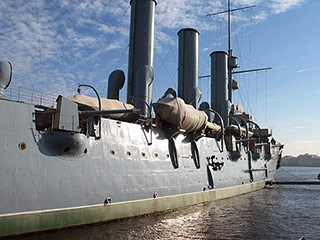
The legendary cruiser Aurora - ship No. 1 of the Russian Navy - will soon leave the naval crew. Only cleaners and civil guards will remain on the ship on the joke at the Petrograd Neva Embankment in St. Petersburg opposite the Winter Palace.
"The cruiser’s military crew will be disbanded by December 1. The corresponding directive was signed by the Commander -in -Chief of the Navy Admiral Vladimir Vysotsky. The cruiser was completed the military biography of the cruiser," the representative of the General Staff of the Russian Navy told Interfax on Friday.
According to him, only maintenance personnel in the person of three cleaners and six guards will remain on the cruiser. The representative of the Commander-in-Chief of the Navy clarified that the cruiser Aurora will become a branch of the Central Naval Museum. “This issue has been resolved,” the agency’s interlocutor said.
Earlier, Deputy Commander-in-Chief of the Navy, Vice Admiral Fedor Smuglin, said that documents were being prepared on the creation of a ship-museum of military glory on the basis of the Aurora cruiser. At the same time, he argued that it is planned to save a military crew on the ship, which, in addition to the officers, will include conscripts and contracting military personnel.
The question of changing the status of the cruiser "Aurora" was raised by the public after the scandalous VIP-witchcraft on board on the night of June 6, 2009 under the curtain of the St. Petersburg Economic Forum. Its "master" was billionaire Mikhail Prokhorov, guests - almost the entire city bomond and business elite, as well as the governor of St. Petersburg Valentina Matvienko and the Minister of Economic Development of the Russian Federation Elvira Nabiullina.
Four months after the scandalous secular party, the main military prosecutor's office reported the results of the check on the cruiser. The prosecutor's office came to the conclusion that officials and businessmen drank illegally there, but who exactly would be punished, she did not report.
As it was established by the check of the GVP, the permission to conduct this event issued by military officials of the fleet contradicted the requirements of the general -Vo -Voinoi charters, as well as legislation on cultural heritage sites and created the prerequisites for the loss (damage) of museum values. "
Later, Prokhorov declared his readiness to take over the finance of the ship if he was transferred to the balance of St. Petersburg.
Reference
Aurora cruiser is a ship No. 1 of the Russian Navy and a branch of the Central Naval Museum. From the gun "Aurora" - the defender of Russia in three wars - in 1917 a single shot was made, which served during the October Revolution a signal by the beginning of the assault on the Winter Palace. Subsequently became a museum.
The cruiser was laid in St. Petersburg at the New Admiralty shipbuilding shipyard on May 23, 1897, launched on May 11, 1900 and the combat ships of the Russian fleet in July 1903 entered.
During the Russo-Japanese War, having made the transition as part of the 2nd Pacific squadron to the Far East (October 1904-May 1905), the Aurora cruiser adopted combat baptism in the Tsushima battle on May 14-15, 1905.
Returning to the Baltic Sea, the Aurora for a long period swam like a training ship on which the ship's practice of the Naval Corps hosted. In 1906-1912 The cruiser visited the ports of many countries of the world, and in November 1911 the Aurovites took part in the celebrations in honor of the coronation of the Siamese king in Bangkok (the kingdom of Thailand).
During the First World War, the Aurora cruiser took an active part in the hostilities at the Baltic Sea as part of the 2nd team of cruisers, and at the end of 1916 he was put for repairs in Petrograd.
In 1917, the Aurora crew actively participated in the February and October Revolutionary events, as well as the civil war and the reflection of foreign intervention.
In 1922-1923, one of the first cruiser Aurora was commissioned and became a training ship, on which, until 1940, a shipyard of naval schools took place. The ship again swam and visited the ports of a number of foreign states. In 1924, the ship was awarded the Red Banner of the CEC of the USSR, and in 1927 - the Order of the Red Banner.
With the beginning of the Great Patriotic War, the cruiser Aurora and its crew defended Leningrad. The entire period of the Leningrad blockade of 1941-1944. "Aurora" stood against the wall in the port of Oranienbaum (G. Lomonosov), subjected to systematic shelling and bombing. The hull of the ship received a lot of holes, took a large amount of water and sat on the ground, but a small crew courageously fought for the life of his ship. In July 1944, the cruiser was raised from the ground and put in repairs.
In 1948, the Aurora cruiser was moored at the Petrograd embankment of Leningrad and was used until 1956 as the training base of the Leningrad Nakhimov school. In 1956, a ship museum was opened at Aurora, as a branch of the Central Naval Museum. In 1968, the Aurora cruiser was awarded the Order of the October Revolution, and in July 1992 the Andreevsky Naval Flag was again raised on it - a symbol of the sea power of Russia.