
Translated material
Antimission of Patriarch Kirill
 It seems that the bill adopted by the State Duma in the first reading “On the transfer of religious property to religious property, which is in state or municipal property” has become the most powerful anti -missionary course of Patriarch Kirill. And the point is not only in a negative reaction to the bill of the cultural community and specialists, in the growth of anticlerical moods, but in the inevitable narrowing of the museum Christian field itself, in the creation of numerous psychological barriers.
The missionary value of the icon, for example, is reduced in the current temple. She no longer admits questioning views, the possibilities of a calm contemplation of lines and colors. In the sacred space, the icon is functional. It provokes a number of ritual actions: supplementation of candles, the sign of the cross, kissing. And the nature of peering into it implies the theological, far from genuine spiritual education format.
Recently I visited the Ferapond Monastery, admired the wonderful frescoes of Dionysius. He looked in the gate church in the community of believers. A paper with a list of mortal sins hung on the door, among which there was a visit to the beach (in the "Blood" section). In the Kirillo-Belozersky monastery, there was also something similar. Such a strange "pilgrimage" context. But will millions of Russians far from the characteristics of modern Orthodoxy agree on it?
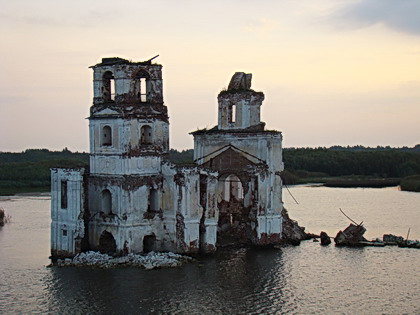
In Ferapontovo, one might end up, making an excursion along the Volga-Baltic Water Way. On the way there are many abandoned temples, some are flooded. It will stand for a few more years - and will die. Of course, they can be saved, organized berths, entrances, so that here the money is dripped from the tourist stream. But this is a hassle. The rural temples of the Russian Orthodox Church are not particularly interested in, even those located on the Torny Railways. Why restore them? It is much more interesting to figure out where expensive land and real estate. Where is it dear? In the historical centers of cities, where most museums are located.
The very nature of the development of the battles around the bill once again shows the peripherality of the museum question for the episcopate. The church leadership is completely calm to the scandal . Reputational losses do not bother him. The other day the next synod took place the other day. And again, not a word was said about the creation of the museum department, about the system of protection of monuments within the church fence. Everything is shifted to the state in the person of Roos -guard culture. It does not matter that this organization does not cope with its duties well. But how convenient! For example, the priest did that the wrong thing nods towards the officials - where did they look?
No, cultural monuments transmitted by the Russian Orthodox Church, of course, will not completely disappear, but the alteration will be dramatic. This is how to drink.
To prevent this from happening, experts offer to tighten the law. They believe that any case of distortion, damage to the monument must be considered in court without fail. The orders should be increased in the orders of no one who does not frighten fines today, and in cases of irreparable damage, especially the death of the monument, criminal liability should be provided.
But this is not the main thing. Museum workers offer to completely exclude monuments of history and culture from the scope of the law, both movable and immovable. To abandon the use of the concept of “religious property” as applied to cultural objects that have received the status of museum monuments and have become a national cultural property.
Many other suggestions sound. For example, make a list of monuments that are not subject to transmission under any conditions. Will the lawmakers hear their? It is not yet clear. But the church lobby clearly does not want to hear them. Here is the last interview with the head of the legal service of the Moscow Patriarchate of Monoini Ksenia (Chernogi) regarding the conclusion of the Public Chamber shows that the issues of preserving the church cultural property do not care at all. Another lobbyist, Archpriest Vsevolod Chaplin, does not tire of repeating that the bill affects the culture institution and concerns property to less. So why doesn't he want to listen to the public’s voice, and the public, by no means a hostile church?
Of course, under the roof of the "museum" different outrages occur. Julia Latynina told Julia Latynina about one of them, in kiji, where the disassembly of the famous Preobrazhenskaya Church began. But if we keep in mind the prospect of preserving the monuments, out of two evils you have to choose the smaller one. Church leadership should honestly approach this issue, show humility.
In relations between museums and church organizations, difficult times are coming. But this does not mean that museums cannot intercept the initiative. We are talking about systematic and solid inclusion of diocesan structures in daily museum activities, as is the case in the Sergius-Posad Museum-Reserve and the Tretyakov Gallery. Significant gestures are not excluded at the same time.
In this sense, the Yaroslavl historical and architectural museum was pleased, which, anticipating a possible conflict, made copies of the icon of the Assumption Cathedral and handed them to the recreated temple, which Patriarch Kirill consecrated on the day of the millennium of Yaroslavl.
And the unfriendly gesture of the “churchmen” who extended the stay of the Toropetsk Icon of the Mother of God in the elite village near Moscow was not at all pleased.
But whatever the costs of “church restitution”, it is positive. Behind the monuments of church architecture, it is necessary to fix the owner, otherwise most of them will simply collapse. But how to recapture the dashing scribes of the clerical to museums in a situation where the state seeks to abandon “non -core assets”? Maybe the State Duma deputies will find the answer to this question when the bill “On the transfer of religious property to religious organizations ...” will again go to them for consideration.
Photo of the author