
Translated material
Boring elections
In the Kremlin
 Boring elections
October 12, 2010 Alexey Makarkin
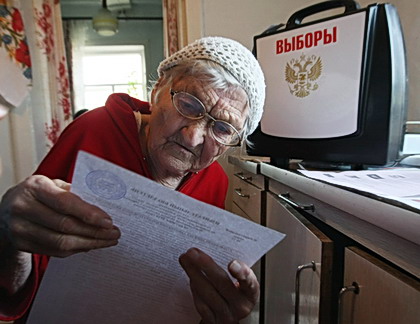
The regional elections have not brought sensations that have passed on Sunday. In all six constituent entities of the Federation, where local legislative meetings were elected, United Russia won. The best result is 77% (tuva), the worst - about 45% (Novosibirsk). Is everything as usual - predictable and boring?
And yes, and no. Yes - because the main features of the electoral behavior of voters who vote for “United Russia” are preserved (the fact that the result of the “party in power” cannot be explained only by the administrative resource is quite obvious - the numbers are too great). This is a paternalist voter, a “consumer of stability”, for whom the election is an opportunity to vote for a candidate who is able to “break through” the completion of the construction of the school, the beginning of repair of the hospital or not to allow the date of commissioning of the physical education complex for 2020. Only the “Party of Power” has such resources - regardless of how to treat it. Therefore, the loyal voter, acting within the framework of the “economic contract” with the authorities, votes correctly, despite the negative attitude to the specific actions of the authorities.
Another thing is that such a voter does not have enough to achieve ultra -high indicators of United Russia, focused on the result, achieved in the Duma elections of 2007 - the plenipotentias of the plebiscitable, when the list of the party was headed by the current president for the first time in Russian history. Therefore, it is necessary to use the administrative resource, and in the current elections-there were also substantial technologies forgotten (the benefit of the administrative resource at the beginning of the year was somewhat limited-it is necessary to compensate for it with something). However, the differences from past years in this matter can hardly be called fundamental.
No - because the behavior of parliamentary parties is changing, which used to look like the statists within the framework of a one and a half -party system. A year ago, three of the four Duma parties defiantly left the State Duma meeting in a situation where a one and a half -party system gradually drifted towards a single party. The Socialist-Revolutionaries and the LDPR were replaced by the political space, and the Communists suffered as a party of political pensioners without a minimum "drive" and any prospects. The result of this demarche was the possibility of passing into regional parliaments of all Duma parties. In the March elections, this principle was meticulously, on the current exception was Tuva, in which only two parties passed into the local parliament. Even in the Belgorod region, however, the “Socialist-Revolutionaries” did not overcome the 7%barrier, but even the federal party leadership admits that the regional party organization that showed servility in relation to the “United Russia” (and forgetting, apparently does not divide into two parts, is to blame-everything is received by the main player).
Now the rivals of “United Russia” are already not enough only to pass into local parliaments - their behavior from the hardware is becoming more and more political. It is not surprising that now the Communist Party is boycotting the elections to the City Duma of Krasnodar, because at the start of the election campaign, four of her candidates were removed from the distance - and thereby, in fact, they “suspended” the rest, who at any moment could share their fate. It turned out, however, that the collective boycott is prohibited by law (single -mandate elections), we can refuse to participate in the elections only on an individual basis. Then 31 candidates from the Communist Party wrote a statement of withdrawal from the election race, and only four decided to continue to participate in it (and, thereby, increase the legitimacy of the action). By the way, none of these latter was elected. “United Russia”, of course, won a convincing victory here, but the effect of this success is very doubtful. The Communists promise to reach the European Court of Human Rights in order to protect their interests.
As for the Social Revolutionaries, the example of the Belgorod region mentioned above showed that attempts to agree with United Russia (as a younger partner, of course) lead to a decrease in the electoral result. And, on the contrary, the real political struggle leads to the fact that “Fair Russia” can get a result at the level of 15-16%, as happened last Sunday in the Chelyabinsk and Novosibirsk regions. And this is a pretty decent result, twice the resulting in the Duma elections. By the way, just part of the "Socialist -Revolutionary" politicians initiated the creation of a new political project - the movement "Russia, Forward!" - What caused the discontent of the "United Russia". As part of this project, the Socialist -Revolutionaries intend to cooperate with liberals, trying to expand their electoral base and get additional support in reference groups.
Will these political trends receive further development? Much will depend on the script of the Duma elections that will take place next year (and can be combined with regional). Will they again turn into a plebiscite with the hard rules of the game or will the parliamentary opposition receive additional opportunities for them? The answer to this question will be received soon.
Author-First Vice President of the Center for Political Technology
Photos of RIA Novosti