
Translated material
The superiority of parliamentarism
Today's Ukrainian public polemic about what separation of power should be in Ukraine is timely and useful. Numerous political crises in Ukraine over the previous 15 years have clearly demonstrated that the Ukrainian Constitution needs a revision. However, today's discussion regarding constitutional reform almost completely ignores the study of political science about the suitability of certain forms of democratic government for post -Soviet transitional states. For this reason, most of the recent public debates about the separation of power in Ukraine do not affect a truly urgent problem. Disputes are mainly on the prerogatives that a more or less powerful president should own, the need for which for the country is perceived by many as given. Thus, many debates do not go beyond the comparison between Kuchmism 1996-2004. and dual power 2006-2010. - Although none of these periods can be called a successful phase of the latest political history of Ukraine. What the country actually needs is a serious discussion about the range and structure of the prerogative of the parliament . The reform of the Ukrainian political system adopted as a result of such debates should lead to the creation of a political system with a weak elected president in which the Verkhovna Rada would dominate. Or a deep reform would have formed de Yura's parliamentary republic with an unfamiliar, nominal president.
Between SCILLA and Haribda: the presidential and semi -presidential systems
Most of the discussions about the modification of the Constitution, which today are broadcast by Ukrainian television channels, relate to whether Ukraine should have a presidential-parliamentary or parliamentary-presidential form of government. The need for one of these two versions of the presidency by the majority of the participants in the discussion is considered to be granted by itself. The first, presidential-parliamentary version, dates back to the original version of the Ukrainian Constitution of 1996. It implies virtually a superpreterity system in which the role of the Prime Minister is reduced to the post of assistant to the head of state, his scapegoat and a beating boy. The second option, the parliamentary and president of the Republic, takes as a basis the redistribution of government, which entered into force on January 1, 2006. Since then, the state powers of the executive branch have actually been divided between the president and the Prime Minister. Since 2006 alone, the term “semi -president” has acquired its true meaning to determine the Ukrainian political system. Prior to this, the president’s power in Ukraine was closer to a full -fledged and strong presidential government system than to the separation of the powers of the executive branch following the example of the political system of today's France.
The problem of hotly discussed “pros and against” both political systems is that both of them are ignored by the research of political scientists specializing in comparing post -communist political regimes. This situation, of course, is just a separate manifestation of the general absence of serious political science in Ukrainian political debate. In the Constitutional disputes of today's Ukraine, politicians, political technologists and journalists dominate, who, for various reasons, are poorly prepared for the nomination of constructive arguments in the debate about what political system is required by Ukraine. Many politicians (often deeply mistaken) proceed from the fact that one constitutional castling will be more profitable for them than the other. Although arrogant politicians sometimes express useful arguments, they do it for doubtful reasons. The same applies to the majority of politically engaged analysts (sometimes in -scale) who have flooded the Ukrainian media and who are paid not for providing objective analysis, but for the pseudoanalytic public lobbying for the interests of certain political forces. Most of the journalists commenting on the semi -presidential do, perhaps, with the best intentions, but often these commentators do not have sufficient knowledge in the areas of comparative political science, empirical sociology or constitutional engineering. Sometimes even artists, writers and other intellectuals, who are not averse to speaking regarding modern Ukrainian domestic policy, but at the same time go far beyond their professional competence, participate in such debates.
Modern Ukrainian debate can be compared with a hypothetical public discussion about the construction of a new bridge, the construction of which would be based on the opinions of drivers, pedestrians and fishermen who will regularly use this bridge. Attracting engineers and architects to participate in such a project would be considered an extra waste of time, since these experts would be only a small part of those who will use the bridge. In addition, such professionals would surely begin to express complex terms, use the highest mathematics and put forward intricate ideas. Non -specialists would consider such interventions incomprehensible, tiring and pretentious. Bridges must be built by those who need them, and not extraneous bespectacles who do not have patriotic feelings for the construction object! A similar method of thinking is possibly responsible for the current absence of specialists in comparative political science and constitutional engineering in Ukrainian debates regarding the reform of the political system. This is even more surprising in view of the fact that the reconstruction of the Basic Law of Ukraine is a task is possibly more significant, and no less complicated than the construction of a new bridge.
The hundredths of the branches of power in the young state and the success of its democratization
Two fundamental recent political sciences of Eastern Europe and the post -Soviet space, independently from each other and on the basis of different methodology, came to similar answers to the question of what political regimes most contribute to the democratization of post -communist societies. In 2006, Stephen Fish presented a fundamental study based on a quantitative comparative analysis with the expressive name “the stronger than the legislature, the stronger than democracy” in influential Journal of Democracy ("Journal of Democracy", T.17, No. 1), which publishes the National Fund in support of democracy. In 2008, Robert Elgi and Sophie Mustrup published a collection of Semipresidentialism in Central And Eastern Europe ("semi -presidency in Central and Eastern Europe") published in the Manchester University publishing house. The conclusions that Fish came to, Elgi and Mustrup are given in something different, but equally clear criteria for assessing the impact on the democratization of various forms of semi-presidentiality that have existed in Ukraine since 1991.
Both analyzes of various forms of separation of power come to similar conclusions regarding the chances of the success of democratization: both the presidential-parliamentary and parliamentary and presidential systems are problematic for young post-communist democracies. Summarizing the results of the study of 16 authors of their collection of twelve central and eastern European states, Elga and Mustrup concludes that especially those variations of semi-presidentiality in which the prerogatives of the president are medium or extensive, create more problems than they solve. Only semi -presidential regimes with a relatively weak, but, nevertheless, popularly elected president do not have significant detrimental consequences for the level of democracy of the young post -communist state.
Elgi and Mustrup concludes that “most often the influence of semi -presidential or not useful, the negative effect of semi -presidentiality was obvious, in particular, in the case of a high degree of presidential semi -presidentiality [the regime of Ukraine until the end of 2005 - A.U.], as in the case of a condemned presidential parliamentary semi -presidential [as in Ukraine from the beginning of the beginning of the beginning 2006 - A.U.]. "At the end of his book, both expert -political scientists advise the Eastern European constitutional engineers:" If democracy is still weak, it is best to avoid any forms of semi -presidential. "
Stephen Fish uses a slightly different approach in his statistical analysis of twenty -five post -communist countries. He does not explore the presidency, semi -presidency or parliamentatism as such, but measures, on the one hand, the relative political power of the parliament and, on the other hand, the democratization success of the country. Fish discovers an unexpectedly distinct connection between these two indicators. The measure of the prerogative of the legislative power of the post -communist country, established in its constitution, has a significant impact on the quality of the democracy of the political regime of this country. At the time when the countries considered by Fish adopted their constitutions in the 1990s, a noticeable relationship between the quality of democracy and the division of power was not yet traced. But a few years later, in the new century, those countries that previously created a relatively strong legislative body were largely more democratic than those countries in which there was a relatively weak parliament.
Based on this, Fish comes to an even more definite conclusion than Elgie and Mustrup, regarding the transitional states of Central and Eastern Europe, as well as the former Soviet republics. His conclusion reads: "The data obtained clearly show that a strong legislative power is an unambiguous blessing for democratization." Regarding the depth of the relationship between the power of the parliament and the degree of democratization, Fish notes: “The correlation is very high. The power of national legislative power is a significant, and maybe the most important institutional key to democratization. ” Based on this, Fish recommends: “The practical conclusion from the results obtained is obvious. Those politicians who want to democratize their country should focus on creating a strong legislative body. In political systems with weak parliaments, the main priority of democrats should be constitutional reforms aimed at strengthening the legislative branch of power. ”
It should be recalled that the results of studies of both Elga and Mustrup and Stephen Fisha are based on empirical studies, i.e. on real experience of countries comparable to Ukraine. Most of what can be heard in modern Ukrainian public debate, on the contrary, is based on blurry political conclusions, inappropriate intercultural comparisons (for example, with the USA) or bold counterfeiting. Sometimes this or that constitutional regulation is even justified by historical speculation or metaphysical reasoning.
What way will Ukraine go?
Against the backdrop of these finds of experts, the main issue of the next weeks will be as follows: but the new rulers of Ukraine want the success of democratization? Are they really ready to tie themselves this purpose? Or will they try to introduce a certain alternative action plan that will be focused exclusively on economic regeneration, political stability and administrative reforms? The behavior of the current president of Ukraine Yanukovych during the "Orange Revolution", as well as the recent actions of his government and the Parties of the regions are more likely to indicate the last assumption. But the problem of this approach is that democracy is an important prerequisite for prolonged political stability, rational management of the economy and effective public administration. In contrast to the widespread belief in the post -Soviet world, the parliamentary political system gives the head of the executive branch, i.e. The Prime Minister, more power than a semi-presidential system-the president. In the latter case, prerogatives are separated and thereby spray both the political system, in general, and the executive branch of power in particular.
In addition, in the case of Ukraine, consolidated democracy seems doubly important for the future of this nation. Firstly, it provides a mechanism for resolving conflicts between the insatiable economic elites of the country, as well as between the culturally divided population of the West and the center of the country, on the one hand, and the south and east, on the other. Secondly, democratization is also the key to the long -term prospects of Ukraine in the international arena, namely, to more rapid advancement towards Ukraine’s membership in the EU. European integration with the final goal of joining the European Union, in turn, represents an important unification idea that leads to a common denominator in other respects the opposing political camps and social groups of the East and West of the country. All of the above indicates that the creation of either a weak semi -presidential system with the dominant power of the Verkhovna Rada or a purely parliamentary republic would become an important step towards stabilizing the Ukrainian state, its future political development and integration into the international community of democratic countries.
Graphs
Schedule 1: Parliamentary prerogatives and the level of democracy at the time of the adoption of constitutions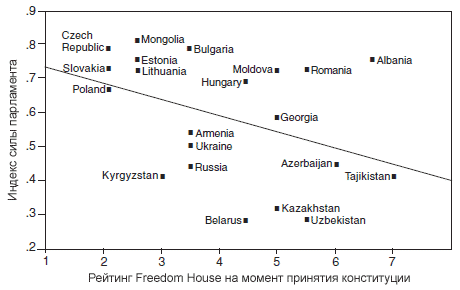 Source: Fish MS Stronger Legislatures, Stronger Democracies // Journal of Democracy. 2006. Vol. 17. No. 1. 5-20. Graphic 2: Democratization and power of parliament
 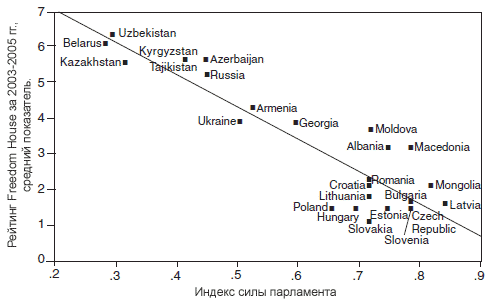 Source : Fish MS Stronger Legislatures, Stronger Democracies // Journal of Democracy. 2006. Vol. 17. No. 1. 5-20.
The Ukrainian version of the article is published in the journal "Ukrainian Tizhenya"