
Translated material
Electron catcher
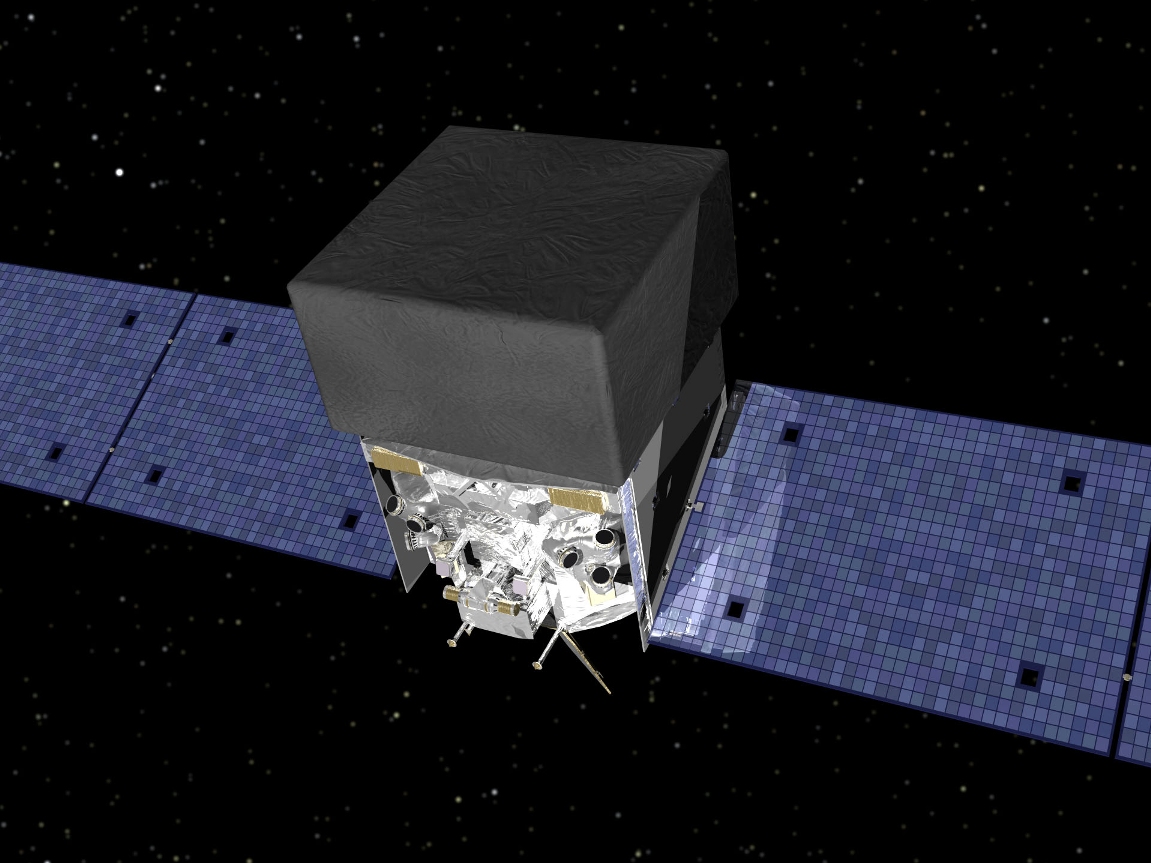
We asked Alexander Moiseev to talk about his work and about the Goddard Award:
- This is an annual prize, which is awarded as part of the Goddard Space Flights Center for a fairly large number of employees. This year, 105 people received it, among them a large number of engineers, technicians, workers, and there are also three scientists. I was honored to get in their number. The other two are presented by the James WebB space telescope - this is a huge project that is the world's largest in its kind. He will replace the famous Hubble orbital telescope, which discovered a lot of interesting things.
-You are awarded the prize for work related to the Gamma-observation of Fermi. What is it?
- This observatory was launched in June 2008. Its main task is to measure the high-energy gamma radiation of the Universe. The energy of one gamma-photon that we measure by nine orders, that is, billion times higher than the photons of visible light. Our observatory “closes” that radiation range that is no longer available to any project. Here, imagine, fire burns; Observing its spectrum, you can understand what coal is there, you can determine what is there, but you need to see the whole spectrum for this, all colors. So the Fermi Observatory simply adds additional colors to our view of the Universe. We were waiting for interesting results from our project, but what we get now is superior to all expectations.
-Are there any other, competing gamma-nozzles in the world?
-There were not so many in history, only 3-4 gamma-telescope, which worked in this area of the spectrum. One of them was built in the former Soviet Union. It was called "Gamma-1" . Unfortunately, due to problems in the satellite system, the experiment failed. I spent 15 years in this project. This experience has allowed me to work successfully in the Fermi project now, there was a very familiar atmosphere for me.
-So, the main task of the Fermi Observatory is to observe gamma quanta, that is, hard electromagnetic radiation. But amazingly, the most cited work, still done at the observatory, is not connected with gamma radiation, but with the registration of energetic cosmic electrons. For gamma observations, they are an obstacle. But it was precisely the protection system from these interference, as it turned out, that gave one of the most interesting results, marked by the Goddard Prize. How did it happen?
- I was very surprised by this award. Because the measurement of the electron spectrum has never been the main focus of the project. But the method of measuring electrons is very similar to the registration of gamma quanta. Therefore, it was obvious that our device could also register electrons. But a certain work was required, it was necessary to create a method how to "pull out" them, to separate them from gamma quanta. We managed to do this. I am a leading scientist according to one of the three systems of our telescope, who is just engaged in protection against charged particles, that is, from protons and electrons. This is a detector that, like a casing, surrounds the telescope from all sides. If there is a signal in it, then the telescope at this moment records a charged particle, and not a gamma quant, and this event from gamma observations is thrown away as a noise background. But in the observations of electrons it is necessary to take the events when the signal was in the defense, and such a moment the telescope records an electron or proton. By the way, distinguishing them is another difficult task.
- Why does the measurement of the spectrum of space electrons are of such interest for astronomers?
- The fact is that before our project, there were very few data on space electrons. All of them, with the exception of one project, were obtained on high -altitude balloons. There was very small statistics and very scattered results. Some serious theoretical conclusions about where the electrons come from was difficult to make, everything was limited to qualitative grades. Nevertheless, there were models from where the electrons come from. It was assumed that they are formed in the remnants of supernovae. But these were very modest, limited results. The Fermi Observatory with our telescope is a large project. The previous ones recorded 10-100 electrons, and now we have 10 million of them. This gives a statistically very accurate measurement of the spectrum. If gamma quanta practically does not deviate, and we see the directions where they come from, then the electrons are mixed in the magnetic field of the galaxy, and therefore the main thing here is their energy spectrum. In nature, spectra of sources of electrons are usually smooth. But they are distorted if several factors are included in the game. And so we found that the spectrum is actually not smooth, it has heterogeneity. The interpretation of this spectrum is now being discussed in many dozens of articles. It is incomprehensible to the end, but it seems that everyone agrees that sources of electrons are not one process, but several types of sources. Moreover, it is possible that here gives its contribution and dark matter, which everyone tends to detect. We gave a very accurate spectrum, which is suitable not only for high-quality comparison with some theoretical models, we can already make quantitative calculations, what energy from which source can be. This is perhaps the first time we come close to the question of which sources of space rays can be in the nearest cosmic space.
- Why are you talking about the sources close to us?
- High -energy electrons very quickly lose energy. Therefore, we can only see the sources that are in the very nearest galactic space. Our galaxy has 20-40 kiloparsk in a diameter , and we are dealing with sources no further than 1 kiloparsk. And it turned out that somewhere nearby there are very powerful sources of space rays.
-You worked on the Russian gamma-volume for 15 years, but real success came only in NASA. Tell me, is there any opportunity for Russian scientists to take part in the most modern astrophysical studies, such as the Fermi Observatory? Or is it necessary for this to go to America?
- Our project gives information for a huge number of scientists around the world who interpret the results, the construction of sources models, which is happening in the universe, which is happening in the center of our galaxy. The results of the Fermi Observatory by law are the property of the whole society. Any person, any scientist has access to this data bank in which it is known about each registered photon what energy he had, where he came from, at what point in time. Please take them, draw pictures of the spectrum ... And I would very much like Russian scientists to take an active part in this matter.