
Translated material
Ice in the mantle of the earth
And “ice-nine” existed on our land.
Kurt Vonnegut, "Cradle for a Cat" (1963)
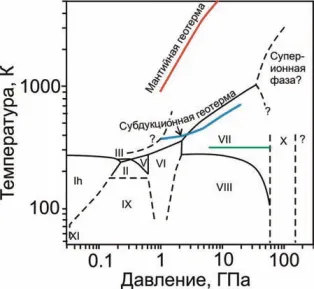
Everyone knows that water at a certain temperature turns into ice. Fans of science fiction also remember that Dr. Honnaker, the hero of the fantastic novel by Kurt Wonnegut “The Cradle for a Cat”, created a special crystalline shape-an ice-nine that was able to freeze it in contact with liquid water. However, probably, few know that ice-nine is not a fantastist fiction, but one of the many possible crystalline phases of water (see Fig. 1). Studies of various high -bary polymorphs of ice cause increasing interest in the scientific community. So, the Earth and Planetary Science Letters magazine accepted to print the article of the group of Japanese experimenters who studied the properties of ice at pressure from 6 to 60 GPA and room temperature [1]. With such pressure, the crystalline phases are stable-LED-7 and LED-10 (Fig. 1). The article [1] is a purely technical, and its detailed description is unlikely to cause interest among non -specialists, but it is a good informational occasion to tell about seemingly incredible things that water can be present in the form of high -forming forms of ice in deep parts of the earth and on other planets.
The immersion of the oceanic slabs in the Earth’s mantle is called subduction. Minerals that compose breeds of such plates, being under the influence of ocean water for a long time, are recessed, including OH groups in their structure. So, for example, olivin ((Mg, Fe) 2SIO4) over time turns into a sickle ((Mg, Fe) 3Si2O5 [OH] 4). During subduction, the plate all the time is deeper and deeper, in contact with the more hot regions of the mantle. This leads to the fact that the water (prisoners in the structure of minerals OH groups or hydrogen are called water) is released from minerals. Adding water to mantle breeds leads to a lot of important effects. For example, the melting temperature is reduced, a magma appears, which ultimately breaks to the surface, forming volcanic belts, such as a ridge of Kuril volcanoes.
The main degasation zone of subdacing plates is located at a depth of 100 km. Can a certain amount of water subdoming deeper? Until recently, most geologists were inclined to be that there could be. The mantle is deeper than 100 km - “dry”. In parallel with this, experimenters synthesized various water minerals that are resistant at high temperatures and pressure, but, again, according to most geologists, not enough high temperatures to reflect the temperatures in the Earth's mantle. In contrast to the in -country opinion, the assessment of the water balance - how much water enters with minerals to the subduction zone and how much is returned back to the surface through volcanism - show that about 85% of the water subdames in it remains in the mantle [2]. Why does it remain in the subdacing plate and where then goes in the mantle? The experiments of the beginning-inventions of the 90s of the last century showed that the main minerals of the so-called transitional mantle zone located at a depth of 410-650 km,-Vadsleit and Ringwitite, which are high-flown polymorphs of Olivin, may contain several percent of water in their structure. Accordingly, this region is the main tank of water in a mantle, in which approximately two or three world oceans can be at the existing temperature gradient [3]. This deep water reservoir of the Earth can be primary, or can be depleted as a result of magmatism and replenished as a result of subduction.
It should be noted that, speaking of water in minerals at mantle depths and subdoming plates, we did not mean molecular water, but hydrogen. Molecular water can be present in the subdacing plate in the form of the so-called phase “10-angist” [4]. This is one answer to the question why the water does not fully degass from the subdomaining plate when it is heated. Another answer is that water can subduce in the form of high -barbaric ice - it looks like a fantastic. The first to write about this in 2000. Outstanding American professors Craig Bina and Alexander Navrotsky (Alexander Navrotsky) [5]. In their article, they showed that the temperature inside the oceanic slabs that subsurient with abnormally high velocities (~ 14 cm/ year) passes through the ice stability field-7. In the same article, they suggested that on Mars all water is already in the Martian mantle in the form of ice-7, since this planet, due to its size, should cool faster and, accordingly, in its mantle the temperature gradient is lower than on Earth.
The article by Craig Bin and Alexandra Navrotsky has not yet attracted much attention (less than 30 links in 10 years), as one could expect based on her conclusions. It is too difficult, apparently, to imagine ice in the hot conditions of the Earth’s mantle (Fig. 1). Nevertheless, if the conclusion about subdomaining ice is correct, then this has a lot of important consequences for the Earth. The article [1], for example, discusses the possibility that the transition from ice-7 to ice-10 inside the cold subservative plates and the viscosity jump associated with this is responsible for the drainage of plates at a depth of about 1000 km (often fixed by the methods of seismic tomography) and for further immersion of the stove up to the earth's nucleus after the alleged delay. Another important consequence of water subdomaining in the form of ice is that after heating the plate of LED-7 or LED-10 (depending on the depth) will inevitably have to melt, forming the local regions of the mantle saturated with water. This, in turn, should lead to the appearance of a melt and abnormal volcanism on the surface [6]. Undoubtedly, the interest in the high -barbaric polymorphs of ice will only grow, and in the near future, interesting and very unexpected results await us.
Alexey Ivanov,
cand. Geol.-Min. sciences,
Institute of the Earth's Corean SB RAS (Irkutsk)
- Asahara Y., Hirose K., Ohishi Y., Hirao N., Murakami M. Thermoelastic Properties of Ice VII and Its High-Pramorps: Implications for Dynamics of Cold SLAB Subduction in the Lower Mantle. Earth and Planetary Science Letters, in the DOI press: 10.1016/J.epsl 2010.09.037
- Peacock SM Fluid Processes in Subduction Zone. Science, 1990, v. 248, p. 329-337.
- Ohtani E. Water in the Mantle. Elements, 2005, v. 1, p. 25-30.
- Wang J., Kalinichev AG, Kirkpatrick Rj Molecular Modeling of the 10-a Phase At Subduc-Tion Zone Conditions. Earth and Planetary Science Letters, 2004, v. 222, p. 517-527.
- Bina CR, Navrotsky A. Possible Present of High-Pressure Ice in Cold Subducting Slabs. Nature, 2000, v. 408, p. 844-847.
- IVANOV AV, Litasov KD What is the Role of Subduction in the Flood Basalt Origin?: Siberian Traps Case Study. Geophysical Research Abstracts, 2008, v. 10., EGU2008-A-02970
- Lin JF, Schwegler E., YOO C.-S. Phase Diagram and Physical Properties of H2O at High Pressures and Temperatures: Applications to Planetary Interiors. In earth's deep water Cycle. Eds. SD Jacobsen, S. Van Der Lee. American Geophysical Union, 2006, Geophysical Monograph 168, p. 159-170.