
Translated material
Mongolian road
“In one part of the Earth there are several small forests, the other part is completely treeless, but they boil food and sit [for heat] as an emperor, so nobles and all other people with a fire diluted from bull and horse manure. Further, even the hundredth part of the above land is not fertile, and it cannot even bear the fetus if it is not irrigated by river waters. But there are few water and streams there, and the rivers are rare, where there are no villages, as well as some cities, with the exception of one that is quite good and called karacaron ... ”
So wrote about Mongolia, Franciscan Giovanni del Plano Karpini, who visited this country in the middle of the 13th century. Since then, even in the Mongolian low -water rivers, a lot of water has flowed, the boundaries of states have changed, humanity has increased among almost 20 times, and even the climate has changed a bit.
In Mongolia today it is also unimportant with sources of fresh water, agriculture is also not developed, and the stoves are still drowned with a dumb. The population density in Mongolia is the lowest in the world; At the same time, almost half of the population is concentrated in the Ulan-Batore millionaire city. Ulan-Bator (in its central part) has the appearance of a quite modern city with high beautiful buildings, wide avenues, chic restaurants and hotels. But all this quickly disappears as it moves away from the center and is not found anywhere else throughout the country.
If you look at the space picture of the outskirts of Ulan Bator, you will see huge areas occupied by some square cells with small white circles inside. This is nothing more than yurts fenced by fences. In these yurts there are about half of the inhabitants of Ulan Bator. Inside such a fence there is usually a completely naked plot of land, but there should be a fence, otherwise it is impossible to register ownership of the land.
Well, now, wandering through the city traffic jams in combination with the almost complete absence of traffic rules, let's try to get out of the capital. Our gaze will open a terrain, for the designation of which there is a literary stamp “Endless steppe”. This is the very endless steppe, which Turgenev, Chekhov and Sholokhs wrote about, but which you have not seen in Russia for a long time anywhere. The steppe, not drawn by fields and not blocked by forest belts. Just a drilled surface of the earth, overgrown with grass. Sometimes yurts will meet and even more often - cattle. Cattle in Mongolia is much more than people. Although people, despite the notorious sparse of Mongolia, are not so invisible: the visibility of the terrain is tens of kilometers, there is nowhere to hide. In addition, Mongol nomads, not concentrated in settlements, are quite dispersed by the steppe. Therefore, in order to get into a truly deserted area, Ulan Bator will have to go far (for example, in Gobi). However, if you travel far and besides in different directions, then you can make sure with your own eyes that in Mongolia, except for the steppes filled with grazing sheep, there are taiga, real deserts, and highlands ...
But you and I left not far from, we will stop to eat in the roadside hazard. Be sure - everything is “present” here, there will be no Potemkin villages or dishes specifically for tourists (unlike souvenir shops, clogged with fakes for antiques). "Tsaina" - from the word "tsi", i.e. tea. But do not expect to see tea here in the usual form. The Mongolian Soutei Tsai is a hot salted milk (suu - milk) in half with water. Tea is also put there (green pressed), but its taste is practically not felt. If you do not want to subject your stomach to such tests, ask for Lepton - this means just black tea. But keep in mind that, as they move away from civilization, the probability of satisfying this request will be less.
By the way, there are quite a few tourists in Mongolia - French, Germans, Poles. And every year there are more and more. But the Russian Mongols are always distinguished - too much connected the last century to Mongolia with our country. The entire older generation taught Russian in schools - therefore, on occasion, the majority can squeeze out at least "What is your name?" And "Where are you going?" (In fact, in the reverse order-for some reason the first phrase is more popular.) For many Mongols to talk with the Russians-something like an attraction, the most reckless will offer you to drink vodka together. At the same time, they can be very intrusive, but most likely not aggressive. In general, according to my observations, the attitude to Russia and Russia as a whole is quite positive, much better than to the second large neighbor - China.
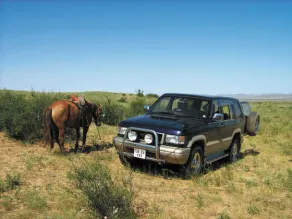
Well, we had a snack (do not worry too much, most likely, in a few days, your stomach will digest lamb fat much better) and we can move on. If we go from Ulan Bator to the west, north or east, we have a chance to see relatively large rivers-Kerulen, Orchon, Selenga.
The water in them usually (especially after rains) is quite muddy, in addition, there is always such a amount of cattle by the water that you are unlikely to swim. Small rivers can often turn out to be dry, and water in them is only a short period of time, for example, after severe rains. In the Mongolian language there are two different words denoting large rivers and small ones. The "large river" is indicated by the same word as the ocean. Here he is, the ocean in Mongolian.
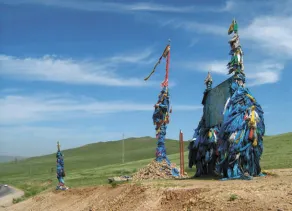
What? When will it finally stop shaking and we will leave for the track? So this is the track! The construction of roads in Mongolia often boils down to ... Well, let's say, if you drive several times in the same place, then the road in general appears itself. It's so convenient! And if the track is too broken, then you can just go nearby, a parallel road is formed. As a result, the road on the plain, like a river, breaks up into many sleeves, a duct, branches; They either merge, then diverge again, covering the steppe by an intricate network ... In the mountains, of course, everything will be somewhat different - a complex relief hardly dictates the direction. According to the disintegration, on the valves of dry channels you can crawl onto the mountain range and then, as well as looping, go down from it from the other side. But let's stop here, upstairs, for a few minutes, because from here such a beautiful look! What? Why is this stick with blue rags here? This is called about. They are arranged at the sources, on passes - in special, remarkable places. Spirits live in such places, and the traveler must somehow honor them. One of the traditional ways is to drink with the spirits of vodka (the part due to spirits is sprayed around). Non -meres can go around three times clockwise. You can bring a stone to everything (large heaps of stones are often growing), you can tie a blue ribbon (hadag), you can leave something else-part of the clothes, food, money.
The tradition of the construction is rooted in the ancient, good of the Mongols of the Provobuddian. The blue color of ribbons is the legacy of the cult of the eternal blue sky (tengri). The custom of worship was so tenacious that with the spread of Buddhism it was not supplanted, but included in the circle of Buddhist rites. In general, the “folk” Mongolian Buddhism quite much varies with Buddhism “Book” - the fact that in temples and monasteries. The essence of “folk” Buddhism (as, probably, of any “folk” religion) comes down to worship of some higher beings there-they can protect, give items, and they can punish.
Particular religious zeal for the Mongols is not noticed - Buddhism is not the basis of national identity; The most popular national symbols today include, firstly, Genghis Khan, as well as attributes of nomadic life-horses, yurts. At the same time, the Mongolian Buddhism is quite monolithic in confessional terms: the Mongols profess the Tibetan branch of Buddhism (Lamaism), and the confrontation of various religious movements and sects is practically unfamiliar. By the way, in the modern world, Mongolia is the only “country of the victorious Lamaism” - after all, Tibet, the birthplace of this branch of Buddhism, is under the jurisdiction of China. In this regard, the Mongol political leaders are often forced to solve the dilemma: maintaining ties with the Dalai Lama, they usually accept it unofficially so as not to spoil relations with China, with which the Dalai Lama has far from the most rainbow.
Well, let's return to what surrounds us directly, and move on along our shaking road. A table with a bottle of the roadside is not just. See the yurt a little to the side? Irag is sold here. Europeans are known under the Turkic name "Koumiss". Want to try? Keep in mind the fortress approximately like beer. It is no coincidence that in the Mongol language, beer is called "Aurag Sharg", i.e. "Yellow Ayrag." It is prepared from mare’s milk, and from sour-milk drinks it differs in that in this case, milk is fermented by yeast. It turns out a thing with a very specific taste - the first time it is unlikely to like it. But it is worth getting involved a little, and then! ..
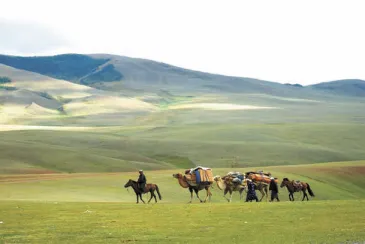
Oncoming trucks, embedded as if giant bales, under which the truck itself is barely visible, is carried out a gat out of wool - a valuable sales product of the Mongolian cattle breeders. But this truck transports the yurt with the whole belongings - see the wooden circle at the top of the entire cargo? This is not a wheel for a giant cart, this is the upper part of the wooden frame of the yurt, called “tono”. Previously, yurts were transported on bulls or on camels, now, of course, more and more often in trucks. But the Mongol and his wife and two children on the Chinese motorcycle went towards, do not turn his neck, think, business. Well, four on one motorcycle, here it is in the order of things. You should have seen how many people climb into their minibus! Look better at the sky.
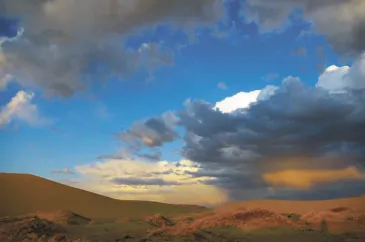
The sky in Mongolia is one of the main attractions. Firstly, it is so enormous that it contains a bunch of different events at the same time: it rains there, and there it is clear, but it also rains there, the clouds are twisted in this direction ... Clouds, it happens, can be seen at once in several types-both heaps, and high-dino ... Looking at this sky, you begin to understand why it was his Mongols once chosen as an object of worship. What kind of shades, whatever forms you will see there! It seems that the whole thoughtful whirl of the figures and colors took it, leaving only a monotonous steppe under it is an eternal blue sky!
Georgy Rurikov,
Institute employee
Ecology problems of evolution
(IPEE RAS)