
Translated material
Merciless determination
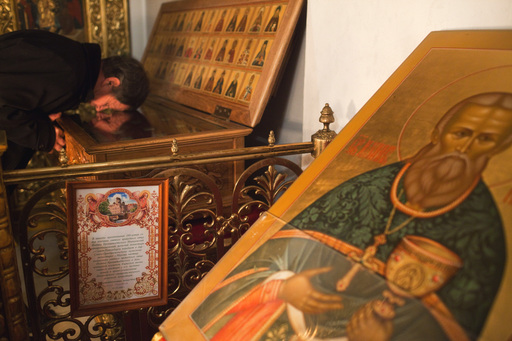
On November 17, the State Duma approved in the second reading the government bill "On the transfer of religious property to religious property, which is in state or municipal property."
What is the new law that is new? The most important thing-if earlier a religious organization could refuse to transfer property, now, now there is no such right: there are grounds for transfer (documents confirming ownership)-property is transferred without fail. It can only be refused if the documents are in doubt - then the religious organization has the opportunity to challenge the decision in court. The concept of “religious property” is clarified is “buildings, structures, structures, including cultural heritage objects (historical and cultural monuments) of the Russian peoples, monastery, temple and other cult complexes intended for religious rites and ceremonies, religious education, etc. As well as objects of interior decoration of religious buildings and structures or objects intended for liturgical and other religious goals. ”
The property is transferred in its entirety: if some state or municipal premises are a single complex with religious property, then it is also transferred, the only relief-it can be transferred later than the property of religious purposes. An authorized body received from a religious organization must consider within a month.
Deputies prepared 58 amendments for the second reading. The chairman of the Committee on Public Associations and Religious Organizations representing the bill, Sergei Popov recommended 18 amendments to adopt, and reject 40. Among the adopted are the following: the authorities are now obliged to provide a new premises to traveling museums or other cultural institutions, if they are not able to find it on their own. The bill includes the provisions on the rules of access to buildings and premises that religious organizations will receive. (Now, it’s not uncommon to such a situation when the former museum temple is transferred to the church, and the museum is still responsible for the preservation of icons in it, whose employees are not allowed into the temple and they do not give their condition.) The provisions that oblige religious organizations are also responsible for the values received. The issues of protecting the rights of tenants and citizens who live in transferred buildings on the terms of social hiring were reflected in the bill. The first version of the bill did not concern this problem at all, and many people could be thrown out into the street.
Before the revolution, the church in Russia was the largest owner of real estate, so if it suddenly decided to regain all the surviving former property at once, it would have turned into a potential billionaire. Potential, because many church buildings, especially in the outback, lie in ruins and the church is unlikely to rush to regain them. The rural priests have very limited funds, their temple in which you serve would be put in order, and you don’t have to think about the rest (in the outback, as a rule, one priest for several villages and many temples are empty). For a massive restoration, dioceses would have to revise all their financial policy, in particular, to allocate funds from the diocesan budget, which is difficult to believe - almost all temples are restored for sponsorship money. The state is ready to give certain amounts for the restoration and restoration of church real estate - in the 2010 budget, more than 2 billion rubles are forced for these purposes, but these are small crumbs. So the process of restitution will primarily affect the capitals and large cities, where the most tidbits of real estate are located, which can also be easily leased. It is not yet clear whether the amendment of the Moscow City Duma deputies has passed, allowing the religious organization to remove the transferred property, if it has not been used for three years, but today's practice is such that both seminaries and diocesan administrations often rent their premises and not always those who use them “for religious purpose”.
The bill caused the most serious protest among the museum community . In the “HD”, this topic was repeatedly discussed , the amendments made to the bill partly take into account the wishes of the museum workers - the rules for accessing the museum temples transferred to the churches were formulated, the areas of responsibility are distributed. But unresolved - and not solved overnight - the problem of professional training of priests remains. The Russian Church “today is able to take care of its temples,” the executive secretary of the Patriarchal Council of Culture Archimandrite Tikhon (Shevkunov) told the Izvestia newspaper. I don’t know how long did Father Tikhon leave Moscow, but I just just returned from the Vladimir region (one of the richest to the ancient churches), where in the diocesan administration I observed such a scene.
So far, sitting in the corridor, I was waiting for the reception at the head of the department of religious education and catechization, a man and a woman approached the duty officer.
- Who is there to ask how to bury the suicide? The man asked.
- The priest who is responsible for these questions accepts on Tuesday from ten to an hour. Come with a death certificate, ”answered the duty officer (was Thursday, I note).
“How can we be, we are not Vladimir, we are from the region, we specially arrived and are leaving today,” the man was upset.
“Well, what can I do, this is not a priest today, and everyone else is busy,” said the duty officer (in the diocese in connection with the events in the Bogolyubsky monastery, there really was a real crowd of all kinds of verifying commissions and journalists).
“Maybe you can still talk to someone,” I did not endure, “because you need to bury a person.”
“No, we have already buried it,” the man explained, “we wanted to ask what to be now, then, if, say, to submit a note.”
- But what, where did you come from, do you not have a priest there? - the duty officer was surprised.
“There is, but he said, go to the diocese, they will tell you everything,” the man answered sadly.
Such things. And I am afraid of such priests, if not most, then a huge number. It is no secret that in the province the bulk of the priests receives seminar education in absentia - and then thanks to the pressure of the patriarchy. Now people without education are trying not to ordained, but in the early 90s, when there were a lack of priests, they were chopped enough. Archimandrite Tikhon is sure that these people are able to take care of museum values?