
Translated material
The restriction on the entry of freight vehicles will begin to operate on January 15
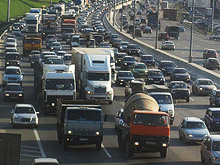
From January 15, 2011, Moscow will be introduced in the entrance and movement along the roads of the city of all heavy vehicles more weighing more than that of the Gazelle. The ban will be valid from 7:00 to 22:00, this was reported in the metropolitan department of transport, the Russian News Service reports. Mayor Sergei Sobyanin believes that this change will allow normalizing the situation with traffic jams, especially on the garden and third transport ring, which are always loaded with heavy transport. Truckers scare the mayor with even greater traffic jams, and metropolitan stores - a significant increase in prices for goods.
- The expert criticized the plan for rid of Moscow from traffic jams
- on Tverskaya was forbidden to park, cars migrated to neighboring courtyards
Recall that at the end of September, the Moscow Transport Department published a draft resolution providing for the introduction of a daily ban on the movement of trucks in the Moscow Ring Road. The document, in particular, was proposed to prohibit vehicles with a carrying capacity of more than one and a half tons with a ring road from 7:00 to 22:00. In October, this idea was supported by Mayor Sergei Sobyanin. The mayor also ordered that the officials think about the possibility of restricting the movement of trucks not only in the Moscow Ring Road, but also on all other roads of the city.
According to Sobyanin, cargo transport, which is building building materials to the capital, providing large wholesale and retail complexes, various fairs, markets, medium and small shops, can cope with their functions only at night.
Truckers: Closed MKAD will lead to a transport collapse
Representatives of the trade business and truckers opposed the initiative of Sobyanin. They warned the mayor that the costs that arose would be reflected in the worst way in the road situation and lead to raising prices in stores and shopping centers, Komsomolskaya Pravda writes.
Members of the Transfigurate trade union in an open letter to the deputy mayor Nikolai Lyamov expressed concern that the ban on entering the city of heavy vehicles will turn into a transport collapse. "Closed for trucks" daytime "MKAD will mean a round-the-clock cake on federal routes in the region and on two possible bypass routes along the A-107 and A-108," they say.
The struggle in the epistolary genre was continued by the largest industry unions of sellers. The Association of trading companies and producers of electric power equipment (RATEK) sent a letter to the Moscow City Hall in defense of the trucks. “We calculated that due to the ban on the daily movement of the MKAD trucks in retail, they rise in price by 10-20%,” said Anton Guskov, a representative of the association. He clarified that this applies to absolutely the entire assortment of Moscow retail outlets. RATEK states that 70% of goods to the capital are brought precisely by large and medium-tonnage cars. And in a letter of the Association of Retail Companies, it is said that instead of one truck they will need eight Gazelles. Not only is there more cars on the capital's roads, but logistics expenses will also grow by 70%.
The Ministry of Transport of the Russian Federation blames in traffic jams of wealthy Muscovites
According to the Ministry of Transport of the Russian Federation, Muscovites themselves are the cause of giant traffic jams on the roads, or rather, their high salaries. As the representatives of the ministry explained, in many Moscow families there are now at least one, and often two cars. So the citizens themselves who bought their cars are to blame for the maxi. And the transport infrastructure of Moscow was simply not ready to increase the well -being and financial situation of its inhabitants.
“It is obvious that in the capital they began to live better: in many families one at a time, and often two cars,” said the media Sergey Sobolev, deputy director of the Department of State Personnel in the field of the road economy of the Ministry of Transport of Russia. “This result in the Soviet Union was planned to be achieved only by 2020-2030. But we live by old performances. We believe, for example, if we purchased a car, then the state should provide parking lots at the place of residence and at the place of stay. "
According to the Central Internal Affairs Directorate, today 3.89 million cars are registered in Moscow. Every year, 200 thousand units of vehicles appear on the roads of the capital, writes Motor Page .
The transport problem is one of the key to the mayor of Sergei Sobyanin. The President of the Russian Federation Dmitry Medvedev was also concerned with the “resetting” of traffic jams in Moscow. In particular, he instructed the capital's government to develop and approve the program to improve the city transport system until March 1 next year. The president’s order was carried out by officials. The plan of priority measures to solve transport problems is posted on the website of the Moscow Government.