
Translated material
The creator of the Internet called Facebook a threat to the future of the World Wide Web
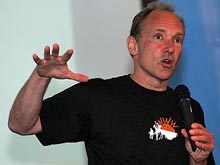
The British scientist and inventor Timothy Berners, who is considered one of the founders of the Internet, called large social networks a threat to the future of the World Wide Web Planet .
In his article dedicated to the 20th anniversary of the World Wide Web (in December 1990, the first website in the history of Tim Berners was on the computer of Tim Berners), the scientist, more and more, recalled several "recently arose" for the Internet. The article was published in the December issue of Scientific American magazine
.
The main of these threats, according to Berners -Lee, should be considered large social services - they divide the network, because they hold data "behind the wall" and do not use universal addresses.
Tim Berners-Lee recommends making a choice in favor of more democratic services such as Gnusocial and Diaspora, and generally speaks out in favor of open standards.
In his opinion, when open standards are not used, “closed worlds” are created, similar to Apple iTunes: although music and video recordings in iTunes have certain URI, all this wealth is available only to those who use the proprietary “apple” ITUNES program.
“Once you enter your data on one of these services, you will not be able to use these data on other sites. That is, each site is similar to a silo tower separated from other sites with a wall.” The creator of the World Wide Web writes. “Yes, your site is not on the Internet, but there are no data on the network. You may have access to the web page with a list of contacts, which you created for some site, which you created for some site. But you cannot send this list, nor any of its points to another site. "
Further in the article, Berners-Lee reveals his thought about the “Silosnaya Tower”: “Isolation is due to the fact that each specific particle of information does not have its own URI. Therefore, the connection between the data exists only inside the site. And the more you use the site, the deeper the social network becomes the central platform-the closed silver tower of the content, and this fact does not allow you to completely control the information on the site. The more widely used such architecture, the more the Internet becomes fragmented and the less we have a single common information space. "
The scientist emphasizes that when one specific site of the social network (either one browser, or one search engine) becomes so large, he turns into a monopoly, and this, in turn, leads to limiting innovations.
First of all, Facebook can be attributed to such sites, since to date, the social network already has half a billion users around the world - this is about a quarter of the total number of network users.