
Translated material
Britain: Students protest demonstratively
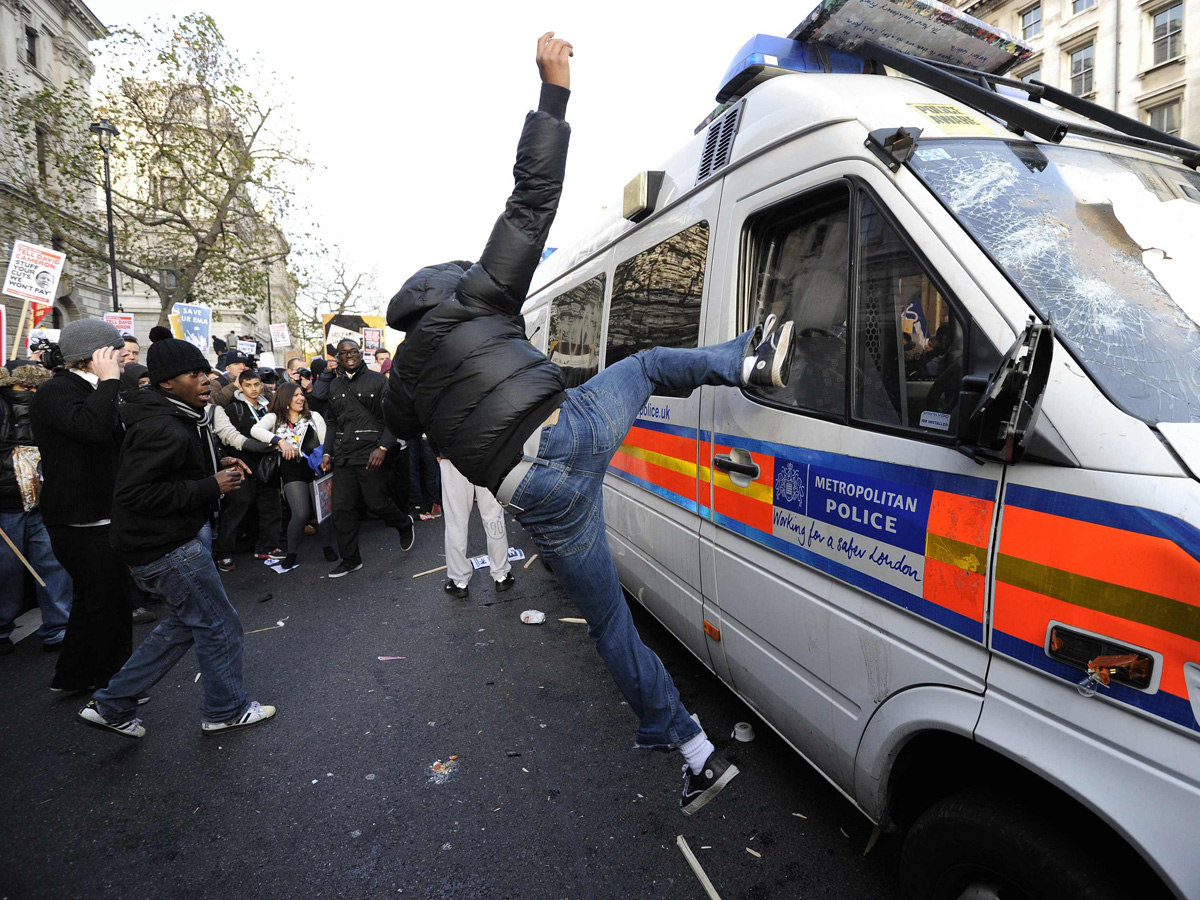
If the requirements of students are not satisfied, then the state will reduce the financing of universities and the proposed ceiling of prices - nine thousand pounds a year for training - will be approved.
The last time something similar happened in 2006: until that time, the amount was more than a thousand pounds a year, then increased to 3,300 pounds, and now it could increase three more times.
Our correspondent in London met with participants in the protest and professor of the London Kings College Max Sonders . He, in particular, said:
- I think that one of the consequences of raising the prices of training will be an unacceptable gap between the universities prestigious and less known. The former at the expense of their status will be able to take a significantly higher fee, while receiving funds from the government, and as a result, all the best forces will concentrate there. The rest of the universities will have to be very difficult.
As far as I understand, the government’s conversations that universities want to provide more freedom, in fact, mean one thing: they will cease to finance. This will greatly hit the research work. Until now, British science has relied on the financial assistance of the state, evenly distributed between universities. A considerable concern is that the proposed measures will put people less secured in an even more difficult situation. True, the hope that the government will provide immigrants from poor families of benefits remains. However, this idea is only discussed.
As a representative of the humanities, I am very concerned about how the proposed reform will affect us. The government is going to completely deprive humanitarian research on financial support, and therefore, faculties like ours will have to rely only on a fee charged with students. The board will grow. This will lead to the fact that students from wealthy families will come to us first of all - they will not be stopped by increased amounts, since they do not consider the diploma as investing. Another category is people who, having paid a lot of money, will dictate to us the conditions of training. This means that the educational process will also suffer: students will begin to demand that they be presented with ready -made knowledge on a saucer, in their eyes it is the university that will be responsible for how well they will learn the course, regardless of the efforts they themselves, ”said Sonders .
The fee in Britain is charged from all students, except for those who live and study in Scotland - there is usually free training for local residents. In addition, there are a small number of grants for the most unsecured. As for most graduates of British schools, when entering the university, they take a loan that covers training and accommodation. The terms of payment are still quite preferential - the percentage does not exceed inflation; From those whose income is less than 15,000 pounds a year, nothing is taken. This is today's order. But if the reform is carried out, not only the amount of the debt, but also the interest rate will increase.
James Ouers , a third-year student of the Kings College, like many peers, will pay the debt when he finishes training. Realizing perfectly well that you can’t call the current economic situation, he, nevertheless, is convinced that if you are going to go to the university, you should not focus on financial aspects. In an interview with Radio Liberty, he said:
- I already participated in such a demonstration of protest - I went to support the student council in which I am consuming. It was important for me to talk with other people, to find out what they think about the reforms. I do not think that education must be free-in my opinion, it will not be quite fair. But the fact that they are going to increase the fee three times and at the same time cutting out the financing of universities is too cool turn. Therefore, I decided to go to the demonstration. The fact that 50 thousand people gathered then will force the government to listen to us. I was hoping that my presence would play some role in this, ”said Ouers .
Students with whom they managed to talk do not at all make the impressions of naive young people: they count on themselves, do not expect mercy from the state, many are earned to make ends meet. But what is now offered as a reform seems to be the wrong thing to them fundamentally. In their opinion, economic problems in the country cannot be resolved with such measures.
Fragment of the program "Class hour" .