
Translated material
Proton missile manufacturers and GLONASS satellites will be checked by the Prosecutor General's Office
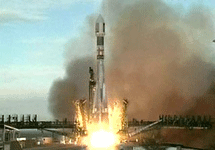
The working group of the Prosecutor General’s Office will check the manufacturers of the Proton-M missile carrier and Glonass satellites. According to RIA Novosti, the official representative of the department Marina Gridneva, organizations will also be checked at the Baikonur cosmodrome. "The working group will check the legality of spending funds by the Federal Space Agency as part of the implementation of the federal target program" Global Navigation satellite system. "In addition, prosecutors will conduct inspections in organizations that participated in the manufacture of the Proton -M and Glonass satellites," Gridneva said. The facilities located on the territory of Baikonur, according to her, will be checked "for compliance with legislation."
According to Gridneva, the Prosecutor General’s Prosecutor General’s Office, in collaboration with the State Commission to investigate the reasons for the unsuccessful launch of the Proton launch vehicle, will study the technical, as well as objective and subjective circumstances of the loss of satellites.
The day before, President Dmitry Medvedev instructed the head of the control department of his administration Konstantin Chuychenko and the Prosecutor General Yuri Chaika to check the expenditure of funds for the GLONASS program. The President also demanded "to check the loss of three satellites of the GLONASS group and submit to him proposals on the responsibility of persons involved in what is happening."
The overclocking unit with three Glonass satellites fell on Sunday in a Pacific Ocean of 1.5 thousand kilometers northwest of Gonolulu. The Ministry of Defense announced the failure, sources familiar with the circumstances of the emergency, that an emergency situation occurred.
The Russian global Glonass satellite system, an analogue of the American GPS, was commissioned in 1993. GLONASS is designed to determine with the help of portable wearable or built-in satellite devices-navigators of the location and speed of the sea, air and land objects, including people, with an accuracy of one meter. For navigation, digital cards are used, the data of which are entered into navigators.