
Translated material
Enlighteners: from the first person
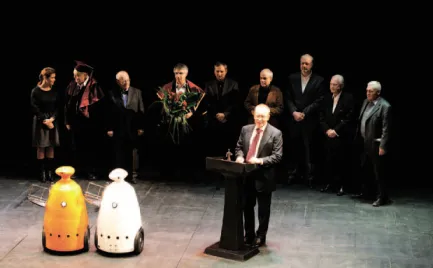
On November 18, in the Theater Center “On the Passionate”, the Award “Enlightener”, established by the Dynasty Foundation for the best popular science book, took place.
The TRV-hobby represents a photo report and performances of the winners of the award at the award ceremony.
Vladimir Andreevich Uspensky, Dokt. physical. Sciences, professor of Moscow State University, author of the book "Apology of Mathematics", St. Petersburg: "Amphora", 2009, which won the nomination "Natural and exact sciences":
-At some point, I prepared to say that the prize was awarded to me incorrectly, because if it is by the nomination of the natural sciences, then mathematics, in my deep conviction, does not apply to the natural sciences. But once it was said “in natural and accurate”, then mathematics applies to them. This is the first.
Second: I am extremely grateful to the jury and is grateful for the honor I provided to me. I am extremely grateful to the Dynasty fund and personally by D. B. Zimin not only for this prize, but also for the fact that this Dynasty Foundation exists. Everything that I know about his deeds is extremely inspired and pleased. If we still have people in Russia such as Dmitry Borisovich, who are ready to invest their funds into something completely idealistic, then maybe not everything is lost yet.
I also want to thank the Amphora Publishing House, which published me and call two people personally. These are deputy editor -in -chief Elena Sergeevna Suvorova and my lead editor Tatyana Germanovna Filatova. I was extremely afraid of my whole life and I am afraid of editors. And when they told me that the lead editor was appointed to me, I was terribly scared. The fact is that I had an editor once, I can’t say that he was bad, he is a good scientist and a person, but he once told me after reading the proofing: “I did not correct the typos, so as not to deprive you of the pleasure of finding them.” But Tatyana Germanovna was a wonderful editor, and I want to specifically thank her here.
What did I want to say this book if I wanted to say something at all? It is not clear to me myself if I wanted to say something definite. There is now a fashionable word Message - it is incomprehensible and intelligent. Let me express such Message, however, I do not really understand what it is. “Messages” two.
The first that mathematics is part of a universal culture. The fact is that it is generally considered part of culture by music, poetry, sculpture, architecture ... Exhibitions are opening, there are lines of people who want to get there because it is supposed, this is part of the culture, and mathematics-somehow on the sidelines. No, I think that mathematics is also a part of universal culture.
And the second. I tried to somehow indirectly designate this, unsuccessfully, of course, I understand myself. At school, from my point of view, they teach something not to that. What exactly, I do not really know. But I know that schools are mainly busy with the fact that they are hatred for any subject that they study there.
I had to meet people who graduated from school and mathematics, of course, could not stand it, and sometimes I managed to convince them. Then they began to understand that mathematics is not at all what they teach at school. I do not know very exactly what to teach, but I have a deep conviction that they are taught not to that. Let me once again bring the gratitude of the jury and the fund and finish it on this.
Sergey Arkadievich Ivanov, doct. East. Sciences, leading researcher at the Institute of Slavic Studies of the Russian Academy of Sciences, teacher of St. Petersburg State University, author of the book “1000 years of insights”, M.: “Around the World”, 2010, who won the “Humanities” nomination:
- All my respected rivals wrote their books about what each of them is a specialist. Only I wrote alone about what I am not a professional. “The history of natural science and technology” is a separate venerable discipline in which I do not specialize, although I spent a lot of time working in the library of the corresponding institution - so that the practical conclusion from this award is: a drop of amateurism, gentlemen!
How easy it is to calculate the title, the book in its first version was written to Millennium, and was created even earlier, in the second half of the 90s. She was born as a result of two motives. The first is connected with my work: I am a Byzantineist, and I wanted to understand when there was the moment from which Byzantium began to lag behind the West in a technological sense. Apparently, this happened in the 12th century, and by no means not only as a result of military inventions, such as a crossbow and required, but because of such completely peaceful achievements as a car, a windmill and a stern wheel on ships.
But there was another, in a sense, a stronger incentive for writing a book. In the 90s, the historical consciousness of our compatriots was struck by injury: due to the fact that the official story was compromised, people have a strong feeling that there was no story at all that it could be blown up at any point, about any fact that everything was exactly the opposite. This is what led to the huge popularity of the crazy theories of Fomenko or Suvorov. It makes no sense to argue with them rationally, for the root of their success goes into this injury.
So it seemed to me that the only way to convince people that the story was was to touch the things that surround them with them, and reflect that each of these objects once arose, that others could not appear without only; that feudalism could not have developed before a solid stirrup was invented, and disappear later than invented manual firearms; That totalitarianism would not have appeared without cheap newspapers, loudspeakers and radio and would not have died without the success of multiplying equipment and in general individual information means.
Now, in the zero years, the falsification of history has shifted its focus: today, instead of the exotic “destruction of history”, the ball of banal nationalism rules. If earlier it was drawn to believe that instead of Ivan the Terrible there were six people, now I would like to say that Ivan the Terrible was not just alone, but was also the best. If earlier I wanted to make sure that the history of mankind is a thousand years shorter, now it is as if Russian history is a thousand years longer. The pop migrant from the screens of the TV for jokes convinces millions of people that a person descended from Russian. Fighting this is much more difficult. Focus on itself is characteristic of small countries and young cultures. But Russia is a great country, and such provincialism is not to the face, the task of the enlightener is to gradually wean the public from it.
In the twentieth century, in Russia, enlightenment took up the enlightenment: SanDsvets, People's Commissariats, Political Services. For some reason, it was believed that the “Enlightenment” was the lower step of the “education”. The publishing house "Enlightenment" published not at all Voltaire, but Bukwari. An unexpected side result of the efforts to enlighten the masses was a large layer of people interested in history. Remember what “bestseller” (if this word applies to the clumsy Soviet book market) became the “manuscripts of the Dead Sea” of Amusin in 1960, how they fought in stores for the “categories of medieval culture” Gurevich, as Averintsev and others were breaking up. This layer, perhaps, has not even disappeared than in developed countries. It is enough to come to the annual lecture of Andrei Anatolyevich Zaliznyak about birch bark letters and see how hundreds of people in their desire to listen to the master literally hide from the ceiling to understand that the prestige of real humanitarian knowledge did not waste. But, of course, in the cacophony of modern culture, the voice of enlightenment is more difficult to hear. It’s not that the scientist does not use prestige - it’s just that there is very little public space in Russia in which the figure of a public intellectual is in demand, this is the problem of society as a whole, and not the status of a popularizer.
I would like to end with words of gratitude to those three people who supported humanitaria over the past twentieth anniversary. Firstly, this is George Soros. Its fund literally saved people in the early 90s, I was a member of the jury, which quickly and without any red tape transported the so-called “money for survival” (500 dollars each) to the most needy researchers. Not to mention the grandiose programs of Internetization, book publishing, etc. Soros not only did not receive for his disinterested efforts of gratitude - he was sunglable, Oshelmovan and expelled from Russia. But such a day will come when our country will bow low to him. The second name that I want to name is Mikhail Borisovich Khodorkovsky, whose “Open Russia”, which has been helping so many at the beginning of the zero, has been closed for four years. And, finally, I am immensely grateful to Dmitry Borisovich Zimin, whose Dynasty Foundation picked up the fallen Enlightenment torch and carries it further. Thanks to him for that!
Pavel Mikhailovich Borodin, Dok. Biol. sciences, head. The laboratory of the recombination and segregation analysis of the Institute of Cytology and Genetics of the SB RAS, professor of Novosibirsk State University, author of the book “Cats and Gena”, M.: The book House “Librock”, 2010, awarded the special diploma of the club of scientific journalists “For the spectacular use of cats for the popularization of science”:
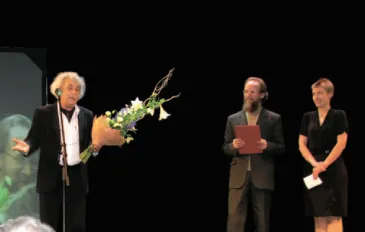
- Honestly, I feel a little uncomfortable. People write about high science, and here I am with cats. Although, in fact, this is an old technique. Where the children come from, usually explain on birds and butterflies. So I'm with cats. If Mendel described the laws of Mendel on cats, and not on peas, then maybe it would not have been required for forty years until they reached the public.
Yes, I cynically and purposefully used cats so that people, caught on cats, would learn about something completely different. We would have learned about genetics, evolution and how everything arose. To feel evolution. The main difficulty in popular science affairs is not to report some new facts to people, but to understand the emotional charm of science.
We take the same cat. We read that the last common ancestor of man and cats existed about 85 million years ago. What is it? This is not just a common ancestor of a person and cat ... This is your personal ancestor! This is your grandmother, who lived 85 million years ago and was small and fluffy, there were two daughters. And one line went to you with mice and rabbits, and from another daughter the line went to the cat, horse and bat. Isn't that wonderful?! So I wanted my readers to feel the charm of this kinship!