
Translated material
Dinosaur colors
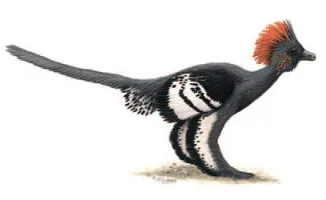
Until recently, scientists could not say anything about how dinosaurs were painted. Bright colors of the characters of the film “Jurassic Park” are a product of the fantasy of film artists, and not recreated on the basis of paleontological data.
Now the group of American paleontologists from Yale University managed to restore the true colors of the cover of some extinct giant reptiles. This became possible after Jakob Vintner, Derek Briggs and their colleagues found that the flattened structures in the prints of feathers belonging to the dinosaurs of the Cretaceous period are melanosomes - cellular organelles, the type and location of which give the feathers of modern birds all the diversity of their diversity. flowers. The research results are set out in an article published in the February issue of Biology Letters magazine for 2010 ( www.jakobvinther.com/biol.%20lett.-2010-Vinther-128-31.pdf ).
The fact that some of the ancient giants wore feathers is known for a long time. The most amazing thing is that at the same time the feathered dinosaurs were not capable of flight. Paleontologists believe that feathers allowed these cold -blooded creatures to maintain body temperature constant during cool mesozoic nights, since these structures are an excellent thermal insulation material.
It is interesting that paleontologists found the petrified casts with melanos in the feathers of prehistoric animals before, but they were traditionally considered ... bacteria. Winter and his colleagues managed to prove that this is not so. They studied strange “sausages” using x -ray spectroscopy. Paleontologists compared the results of the analysis of the imprint with the results of the same analysis of a real pen of a modern bird - a red -swimming black corporate (Agelaius Phoeniceus). At the same time, no difference in the structure was revealed - it means that the ancient bird's reptiles in the feathers really had precisely “paint bubbles”.
Currently, using the methodology developed by the Winter group, paleontologists have been able to restore the color of 8 species of opera dinosaurs and two species of ancient birds. In the future - “coloring” of 10 more species of prehistoric monsters.
However, the full color portrait in the near future will still not be able to get, since not only the melanin in the melanosomes determines the color of the pen in birds. This pigment is only responsible for black, gray, blue and brown, and there are other coloring substances in feathers, such as carotene, which determines orange and red colors. It is still impossible to detect these pigments in fossil feathers, so the exact coloring of the opera dinosaurs is still a mystery to us.
Anton Evseev