
Translated material
Head of the Constitutional Court: "Putting power with crime" threatens the statehood of Russia
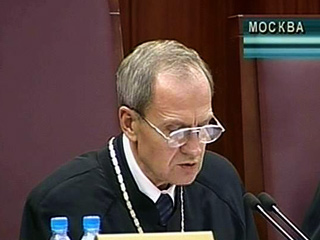
The head of the Constitutional Court of the Russian Federation Valery Zorkin believes that the criminalization of society and the “fractions of power with crime” has reached such scale in Russia that it threatens the country's constitutional system, and has called into question its future and grandiose plans for modernization.
“The question of the effectiveness of the leading fight against criminalization is the question of whether Russia will remain in the next ten years ...,” he writes in the article “Constitution and Criminalization” , which is published by the Russian Newspaper today. - All grandiose plans in the field of development, they are also plans for the modernization of Russia, will collapse, since the state will not be able to protect its citizens from criminal arbitrariness. "
He reminds that “the fusion of power and crime according to the model, which is now called the“ Kushchevskaya ”is characteristic not only for the Krasnodar Territory. The same thing happened in Novosibirsk, Engels, Goose-Khrustalny, Berezovsk, etc., according to him, it is, in fact, about“ replacing the critical functions to be conducted by the state and civil society, and “the consequences of such a notice” are not simple They are anxious, but terrible. "If precedents of this kind become the norm," the state will turn from criminal into criminal. "It will mean that society will be divided into two parts, where the" predators "will make up a minority, and" walking beefsteks " - a majority that" desperately will not dream of democracy, but about an iron dictatorship that can offer at least some alternative Criminal jungle. "
"A state that is not able to protect its citizens from mass violence by bandits and corrupt officials doom itself to degradation," Zorkin emphasizes. "It is to degradation, and not to stagnation, according to many."
“The criminal system cannot be stable by definition. Therefore, all praise addressed to the notorious stability instantly lose all meaning, since it ceases to be clear what we mean by stability,” the head of the CS warns.
“What stability is we talking about? Who is guaranteed stability? The people or the people of criminal communities are guaranteed? And what is stabilized? Norma or criminal pathology?” He asks rhetorical questions, coming to the conclusion that all sentences that are reduced to the “apologetics of stagnation” - “from the evil one”, and “as they say, the penny of broken does not cost”.
The head of the KS admits that it deliberately dramatizes the situation in order to fix the scale of the problem, to initiate a discussion of ways to solve it.
In his opinion, one should carefully analyze the world experience, in particular, the experience of the United States, where, at least twice in the twentieth century - in the early 30s and in the 60s - came across a similar problem. The response to the criminal wave was the creation of two special bodies to combat organized crime in the United States. This is the so -called "bureau for tobacco, alcohol and firearms" under the Ministry of Finance, as well as the "Bureau of Investigations" at the Department of the General Proced - now the FBI. At the same time, as Zorkin notes, the “extraordinary powers” in the activities of these departments had “limited use”, and legislative measures that ensured “anti -corruption” and “anti -criminal” filling of authorities and law enforcement agencies became “the main weapon in the fight against organized crime”.
Then the FBI received the right to control the appointment of "sensitive" positions in the law enforcement system. “And most importantly, federal control over all local law enforcement agencies was strengthened through the FBI,” Zorkin emphasizes. He also cites an example also adopted by the US Congress in 1970 by the so -called "Rico Act", which significantly expanded the sphere of jurisdiction of "organized crime" acts. "We now need to urgently need to urgently and soberly engage in study and understanding, and then the practical application of the best decisions of world experience," he said.
Zorkin calls not to be panic, one of the "varieties" which considers to be a hope on the "iron dictatorship". In the current conditions, he warns, "we will talk about the dictatorship of the same crime" and "such a scenario is quite likely, especially at the regional level."
“The delay in the beginning of such a struggle with organized crime catastrophically undermines the main basis of the existence of Russia - the foundations of its constitutional system,” Zorkin emphasizes. “Our duty today is to recognize the acuteness and scale of the threat overhanging over Russian society.”
"Decriminalization of social, economic and political life is now our main task in protecting the rights and freedoms of citizens, in the approval of a constitutional law and order," concludes the head of the Constitutional Court.