
Translated material
Poet and executioners
Published by the investigative documents of Osip Mandelstam
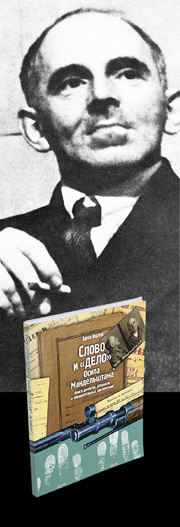 |
| Pavel Nerler. The word and "business" Osip Mandelstam. Moscow, 2010 |
Blooded fate. Mandelstam Society (Moscow) has published a book on the persecution and death of the poet. The New Times read the published documents
Once upon a time, the poet Wilhelm Kuchelbeker wrote: “Gorky is the fate of the poets of all tribes; Fate executes Russia heavier. ” The life of Osip Mandelstam (1891–1938) is fully consistent with the thoughts of the famous decabrist writer.
On December 27, it will be 72 years since the death of Osip Mandelstam in the Gulag. And January 15 - 120 years since his birth. Pavel Nerler “Word and“ Osip Mandelstam ”, which collected and commented on the poet from the Special Department of the Police Department, counterintelligence of the Russian Army, the investigative affairs of the OGPU, and then the NKVD, came to these two dates.
It seems that the poet had a special gift to attract misfortunes in the person of any special services. And it seems he felt it himself. According to the memoirs of contemporaries, Mandelstam was panicky (before the half -fainting state) was afraid of police officers, and then policemen (even guide controllers). And if Mandelstam never found out about the interest in his own person by the police (there was a collection of information in connection with suspicion of anti -government activity), then the arrest was quite natural: Mandelstam arrived in Crimea from the territory occupied by the Reds. Again there was only a suspicion, this time, however, in "belonging to the party of the Bolshevik-communists and in his participation in the activities of the Extraordinary Commission of this party in Feodosia." How logical and release is: "This is not a suspicion of investigations and surveys in the case."
Under the Communists, such “vegetarianism” could not be. Dzerzhinets Yakov Agranov, a second person in the OGPU, personally oversaw the intelligentsia. It was his conscience that was the execution of Nikolai Gumilyov. Actually, the arrest was carried out by the operative Sergey Veprintsev, who would subsequently arrest Boris Pilnyak (the latter did not help cooperation with the Chekists and the implementation of some “delicate” instructions). The first investigation against Osip Mandelstam in 1934 was led by Nikolai Shivarov, a genuine “literary critic in uniform”. At different times, he conducted the affairs of such “seasoned enemies of the people” as Nikolai Erdman, Nikolai Klyuyev, Pavel Vasiliev, and also made up the dossier at Maxim Gorky and Andrei Platonov.
What was the poet accused of? Naturally, he was persecuted for poems that recorded the state of society and the feelings of the poet (“My age, my beast, who will be able to look into your pupils”), for the satire on the “Kremlin highlander”. For a totalitarian society, by the seven -mini steps approaching Orwell described in “1984”, the ships over “thought -crushing”, composed (and read) lines were enough.
It is interesting that if Mandelstam found himself guilty in 1934 (if you can seriously consider such “confessions”), then when repeated in 1937 he did not sign any confession (however, at that time they were no longer needed).
The book also discusses the rehabilitation process. The executioners and their victims were rehabilitated almost simultaneously: both Agranov and Shivarov and Mandelstam with Pilnyak ... of course, “for the lack of corpus delicti” ...
At one time, Alexander Solzhenitsyn rhetorically reasoned that "there are many ways to kill the poet." The fate of Mandelstam offers several options for execution of the poet. To choose from ...