
Translated material
Take it to a share
Deceived housing co -investors require help from the state
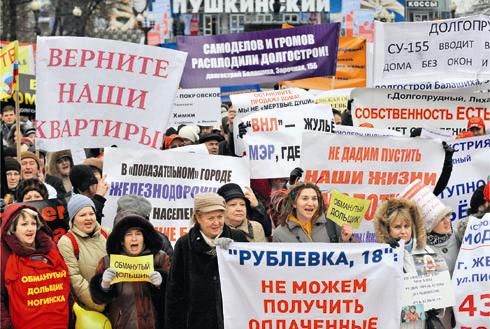
Moscow, November 28, 2010. A rally of deceived equity holders on Pushkinskaya Square Speesors in law. At the end of November, thousands of people who became victims of fraud during the construction of housing went to rallies throughout the country, demanding the protection of their rights. In response, the Ministry of Regional Development proposed to generally cancel the law on shared construction. What can come of it-found the New Times 51-year-old Antonina Loseva-Bomzh. Just like her mother, husband and two sons. Eight years ago, having sold two apartments in Novosibirsk (their three -room and two -room mother), they arrived in the capital with the whole family and invested the proceeds of $ 57 thousand in the future, a spacious four -room apartment in Shcherbinka Moscow Region. “They invested and began to wait for a bright future. We are still waiting for, ”Antonina is ironic. The developer - the Stroymetresurs company - turned out to be bankrupt in 2006. Losev’s house remained standing with a 17-story empty box, as well as the houses of the rest of the equity holders of Shcherbinka: today there are about 3 thousand people.
“What we just did - we went out onto Red Square, seized two unfinished apartments, kept the defense in them for a year, led from there broadcasting on the Internet, turned to the deputies, to the president - everything is useless,” says Antonina. But he has not yet parted with hope: he says that the authorities have found a new developer with whom the contract has already been concluded. True, Antonina has a fear that the current activity is due to ambulance, and if they are not completed now, they will never be completed. In the meantime, Losevs live in a rented apartment in Lyubertsy and give the entire salary of Antonina for it - 25 thousand rubles a month. All family members have in the column “place of residence” in the passports are empty. And the youngest son 23 years old, due to the lack of residence permit, threatened to take a simple soldier into the army, despite the fact that he studied at the military department and bears the rank of officer. “The Motherland requires the fulfillment of duty from us, but does not want to return his duty,” Antonina summarizes.
Comrades in misfortune how many deceived equity holders in the country, no one knows for sure. The Ministry of Regional Development is talking about 50 thousand. The head of the project “Odlodchikov.ru” Igor Gulev calls another figure - at least 150 thousand. On only one of its website, 54 thousand people registered for 8 months and several new ones are added every day. 28-year-old Gulev created his Internet resource from despair, when after 30 ships he did not achieve the truth. In 2004, he invested about $ 100 thousand in two apartments in the Lesnaya Crown residential complex in the city of Yubileiny near Moscow - for himself and his sister. But in the same year the construction stopped. “All unfinished houses are on the lands of the Ministry of Defense,” says Igor Gulev. “When I purchased an apartment, I didn’t even have thoughts that something could happen: I thought the Ministry of Defense is a guarantor, the strongest and most serious ministry in the country.”
When they began to understand, it turned out that the ministry was not at all a “guarantor”, because it does not perform the customer’s functions. Then Gulev created an Internet forum on the Lesnaya Crown residential complex and for three months gathered 450 comrades in misfortune. Together they rally, tried to obtain criminal cases against one metropolitan bank, clearly involved in the theft of money from equity holders, is in vain. “I came to the conclusion that the cases of deceived equity holders are not investigated in our country for two reasons: either because of incompetence or because of the unscrupulousness of investigators,” says Gulev. “There is a need to change the legislation.”
However, the Ministry of Regional Development understood the task deeply in its own way. The Minister of Regional Development of the Russian Federation Viktor Basargin at the end of November stated that the problem of deceived equity holders "took everyone out"
* * According to the Ministry of Regional Development of the Russian Federation, as of November 1, 2010, there are over 800 problem objects in the country, the construction of which is carried out during co -investment by citizens. This is 8.5% of the total number of apartment buildings under construction. . “People are desperate. The bar of their patience reached the maximum, ”the minister sympathized with the victims. The Ministry of Regional Development created a working group to solve the problems of equity holders, but its first initiative brought the victims of apartment fraud in shock: officials proposed to ban shared construction as such. In other words, to cancel Federal Law No. 214-FZ “On participation in shared construction of apartment buildings and other real estate objects”, adopted in 2004.
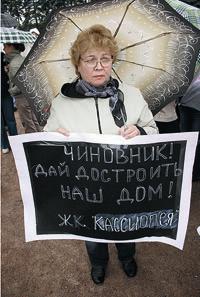 |
| Interest holders accuse of their problems not only developers |
The idea of the Ministry of Regional Development and experts in the field of construction and real estate plunged the key investor . “The abolition of the law will only worsen the situation of those equity holders who are now in a difficult situation,” Konstantin April, the vice-president of the Russian guild of realtors, is sure. -If today they have reason to demand justice in court, then after the cancellation of the law de jure there will be no such grounds. There is no law - there is no problem. ”
“All the problems of deceived equity holders are not in shared construction as such, but in violation of the law,” Oleg Rephenko, the head of the Analytical Center “Real Estate Indicators”, solidarity. “The authorities are guided by a strange logic: it is like canceling the rules of the road due to the fact that some drivers violate them and as a result people die.” According to Ropchenko, the deceived equity holders are the fruit of the so -called gray schemes, that is, various preliminary agreements on the sale of apartments in new buildings, which were just bypassing the law on shared participation (see the field certificate). “Therefore, it is necessary to fight the problem of deceived equity holders by applying strict measures to developers and stopping work on“ gray ”schemes, and not prohibiting shared construction as such,” says Rephenko.
The abolition of the law on shared participation can play a cruel joke not only with equity holders. According to experts, it can lead to the complete collapse of the construction market or to the emergence of new "gray" schemes. From 50 to 90% of housing in Russia, according to the IRN.RU portal, is built at funds from shared participation. “De facto, the following of housing in the country is being built by attracting the money of a private investor,” Oleg Rephenko notes. “In Moscow, it is about 70% of housing, in other regions - more than half.” If we cancel shared construction, representatives of the industry say, small construction companies will go broke, and the housing will rise sharply: the developer will have to take a loan at high interest rates, and pay off the loan payment by increasing the cost of apartments.
"
It is necessary to deal with the problem of deceived equity holders, applying strict measures to developers and stopping work on "gray" schemes, and not prohibiting shared construction as such
"
In addition, banks are likely to refuse to invest in housing construction. “Today's construction and development market in Russia is so opaque that banks do not go to this sector and can not replace the participation of individuals in financing construction,” says Obstanstan April. According to him, today it is very difficult to get bank investments for lending to construction. “Banks do not know how to adequately control these risks. Given the past crisis, I do not think that they can quickly turn around towards financing construction, ”Aprilov concludes
* Since the beginning of 2010, Russian banks have hidden 289 thousand transactions in the housing market in the amount of 316 billion rubles. This is more than two times less than before the crisis, when almost 500 thousand housing loans per year were issued more than 700 billion rubles. .
Money - under the "roof" where is the way out? So far, the authorities are going on by imposing fines: from June 26, according to amendments to No. 214-FZ, transactions with housing in which citizens' funds are attracted should be concluded only under the law on shared construction. In November, the amendments gave the first results: Mosadzor fined three companies that sold apartments bypassing the Law on shared construction
* Trade Invest LLC-a fine of 400 thousand rubles, ASMOTO LLC-20 thousand rubles and PPSK TPP-25 (two fines)-for 100 thousand and 20 thousand rubles. Companies that have fallen in penalties refuse comments for the press. But the Mosadzor willingly informs that he currently checks another 25 companies (including the peak group, Su-155, Don-Stroy, System-Kals, Miracs Group). This measure can prevent the emergence of new deceived investors, but does not solve the problems of already deceived people, Igor Golyev is sure.
In order to fundamentally solve the problem of equity holders, he proposes to introduce licensing companies on the right to attract funds from citizens. “Those developers who can build for their money or attract loans, let them build it,” explains the author of “monoders”. “But those who attract citizens' money and risk it, let them first receive the FSFR license, as is customary in all financial markets.” According to Gulyev, in this case, the very fact of attracting a company without a license from citizens for the construction of apartment buildings will already be a crime under which the guilty can be prosecuted - under the article “illegal entrepreneurship”.
In addition, the “monockers” suggest that a financial agent - the bank without fail to stand between the private investor and the developer. At the same time, only 20-30% of the funds of equity holders are transferred to the developer’s account, and the remaining money is accumulated by the intermediary bank-until the investors receive the keys to the apartments. “Thus, the largest part of the money of equity holders becomes the property of the developer only when the house is completed,” Golyev concludes.
And the deputies of St. Petersburg made the initiative to create equity insurance funds in the country: each developer will have to pay 2-3% of the amount received from the sale of apartments to the fund. Thus, the total amount of funds will be several billion rubles. According to deputies, developers will agree to pay money, since the guarantee of risk insurance will attract more buyers.
As for the "old", already deceived equity holders, here the wine lies mainly on the state and municipalities, Oleg Rephenko is sure. “Since the authorities themselves brought unscrupulous developers to the market - they issued a license for construction, allocated land, now they must find the resource themselves to solve the problem,” the expert says. According to him, such a resource can become not yet mastered sites that can be given to conscientious developers - as compensation for the completion of the houses of deceived equity holders. There are such sites in any city, the expert assures, including in Moscow.
The main schemes of the "gray" contracts,
who use developers to avoid liability before the law
- Preliminary purchase and sale agreement
The most common "gray" scheme. The buyer and developer conclude only a preliminary contract of sale-that the developer after the time after the start of construction undertakes to conclude an agreement on shared participation in construction. If the developer had problems, the fact of investments will have to prove in court.
- Bill scheme
According to the bill scheme, interest holders receive not the apartment itself from the developer, but only to transfer the obligation to this equity holder. If the buyer for any reason did not receive the promised apartment in the property, he can only sell a bill or demand a refund of the cost of a bill through the court, but not an apartment.
- Requirement of the Rights of Requirements
It involves the redemption of shared participation agreements. As a rule, equity holders who invested in construction in the earliest stages are selling their own share in order to earn money. They may be very good acquaintances of the developer. The new shareholder is obliged to repay the available debts of the previous equity holder on time.
- Soinvesting agreement
When concluding a similar contract, the shareholder becomes a business company partner and equally carries all possible risks. In this case, he cannot count on protecting his interests under the law “On participation in shared construction ...” and “On the protection of consumer rights”.
Source: Bpn.ru