
Translated material
A cruel weaker sex
There are not enough places in women's colonies
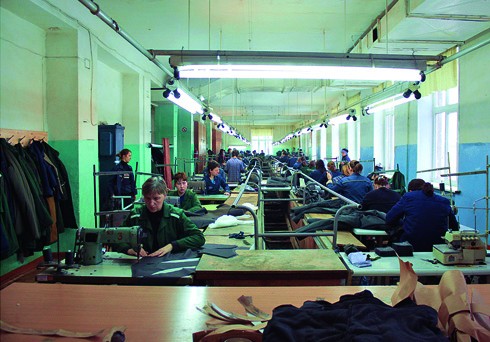
Sewing factory. Convicts work 40 hours a week not to get here. There are not enough places in the female colonies - they say in the Federal Service for the Penitentiary. For which the weaker sex sits and how the punishment is serving - The New Times recognized in the most famous Russian zone for women - the Mozhaisk colony “Unas Praise. The colony is designed for a thousand convicts, and there are more of them here, ”says Irina Gadaeva, the head of the Mozhaisk colony. - Most are sitting for murder and drugs. The rest are for theft and fraud. ” Gadaeva has been working in the prison system for thirty years. The last ten is in charge of the Mozhaisk colony.
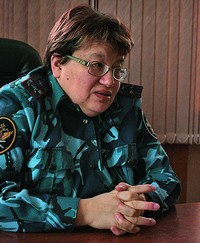 |
| The head of the Mozhaisk colony Irina Gadaeva admitted in an interview with The New Times that many of the convicts for her as lost children |
Gadaev was not going to the jailers. Born and grew up in Mozhaisk. The house is across the road from the zone. Mother worked in a colony in the planning and economic department, so she arranged a daughter in the personnel department. And then, when vacancies appeared in the service of the regime, Gadaeva went to work there. “I liked it in the frames, but my mother persuaded,” Irina Raimovna admits. - Then the civilians received much less than certified employees who earned from 200 rubles or more. Not every engineer received such a salary. ”
The change in the contingent for thirty years, the prison contingent, according to the head of the colony, has changed a lot. “When I came here to work, most women were sitting for economic crimes. There were those who could receive three years of imprisonment for theft of three rubles from the wallet. The killers met, but there were fewer than now. ” Irina Gadaeva says that women sitting in those days for murder can be divided into three categories.
“These are those who, unable to withstand the beatings of the husband, killed him with a poker or what came to hand. The second category: murders in a drunken frenzy when a woman kills, because it seems to her that a man offended her. And the most insignificant category of killers are women who have committed intentional crimes from hooligan or selfish motives. A unit sat for drugs. Not like now, when almost half is sitting for drugs. We began to get to us more women who committed murder from selfish goals. The number of deafs increased. And if earlier we tried to hide from other convicts that these women had committed, they came up with legends so that nothing would happen to them in the zone, now there is no need for this. The rest of the women are calm to the childcollers. ”
Irina Gadaeva sees the reasons for the growth of female crime in the lack of education. “Children are brought up for cruelty,” she says in an interview with The New Times. - The heroes of modern cartoons are all freaks. Films on television - TV shows with blood, violence. They teach to talk about how to substitute a competitor. All this just infuriates me. "
The monastery for the stumbled several heavy iron doors separates the administrative building from the zone. "Do you have prohibited items: drugs, weapons, mobile phones, voice recorders?" - asks the correspondent of The New Times, a security guard on the entrance.
Women in the same green coats and gray down scarves smoke near the hut. Two, three for three slowly wander where: some in the club, some in the medical part. If it were not for the barbed wire, one would think that you were walking around the provincial village. Here is the female kingdom. Women-tires guard the convict.
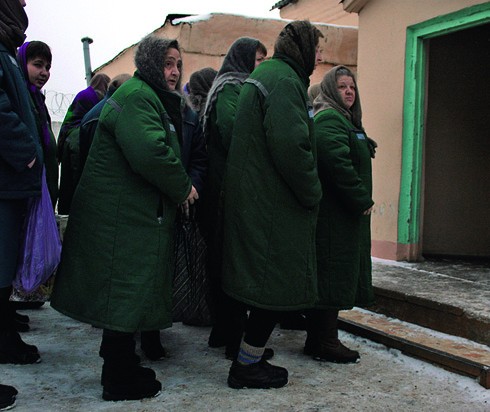
These women worked out a shift and are waiting for the door, which leads to a residential zonubarak - a residential building or a detachment. Here, as a rule, about eighty convicts live. They show us the bedroom. Double -tier bunks, covered with snow -white sheets with lace muses. In the hut, sterile cleanliness, on the walls - paintings, on the windows - flirty curtains with frills. The rest room is a large plasma TV. Elderly women in the same checkered dresses reluctantly come off the screen. They refuse to be photographed and do not want to speak. They are retired, they don’t go to work. Most of the time is spent on the TV.
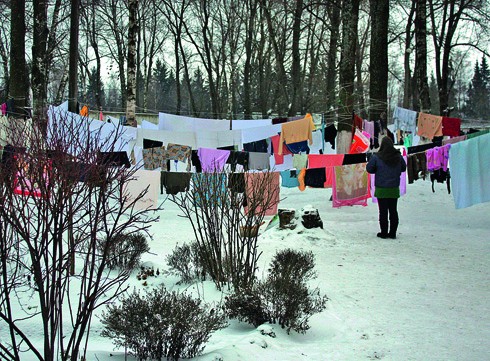
If not for the “thorns”, one would think that you are in an ordinary Russian village, where it is customary to dry linen on the street
Only the so -called activists agree to talk for a lifetime .
* * Convicts from among the “asset”, those who participate in the life of the colony, in amateur performances, are in good account of the administration. On January 2, 2011, the annual ballroom dance competition will be held in the colony. Olga and Lyudmila rehearse the Chicago-Jazz-2020 dance. “We ourselves came up with this plot,” says Olga. - Imagine: a girl dressed in a black tight dress, goes on stage to dance, a man can’t stand it, shoots her from the stage and they dance together. ”
The batch of a man will be fulfilled by Lyudmila. She is 25. She wears a short haircut and prefers to walk in trousers. In the colony, Lyudmila is only six months and says that he still cannot get used to it. She had to sit for four more years. “I am terribly offended by the lost years,” the girl admits. “It's a shame for your misconduct.”
Vika, who has spent three years in the Mozhaik, is also tormented by a feeling of guilt. She got used to the local life of the year and a half. And when it adapted, I understood the main thing for myself: you need to do everything possible to leave here as soon as possible. How? It is good to work, follow the rules of the internal routine, live the life of the detachment, participate in competitions, consist in a psychological asset, prepare psychological essays. The topics of abstracts are very different: “Children without parents”, “Children of concentration camps”, “Tatyana's day”.
Vika 21 years old. In the wild, she studied at the Institute of Natalia Nesterova. “I was taken into custody in the courtroom,” recalls Vika. - The verdict is too harsh. Could give a conditional term. And now I have a stigma for life. Where can I work? " It is not customary to ask a crime here. But it is clear that all these girls from the “asset” are not killers and not soldered fraudsters. They are most likely victims of the notorious 228th article, part of the 2nd.
* Illegal production, sale or shipping of drugs on a large scale by a group of persons is punishable by a period of 5 to 12 years in prison. “As a rule, these are girls from good families,” says Irina Gadaeva. - We went to prison by stupidity. They study at the institute, someone offers drugs there, they take a dose for themselves, they give a girlfriend to try. They are attracted as sales - and sentence: five years in prison. I am not a judge and I will never be, but I think that such cases should be taken more attentive. Here I would close such girls for a day in prison, and then I would put it home. I am sure: they would be so scared that they would never have done anything like that. ”
The child’s house at the thorns is a special place in the Mozhaisk colony - the house of the child. It is separated from the zone with special gates on which multi -colored animals are drawn. In the courtyard, not far from the barbed wire, - swing, carousels, children's slides ... Here, mothers walk with children. In the child’s house now - 111 children. Some of them constantly live with mothers, the convicts come to the rest of them to take a walk and play. “There are women who will live with the kids, and then write statements to be returned back to the detachment,” Gadaeva notes.
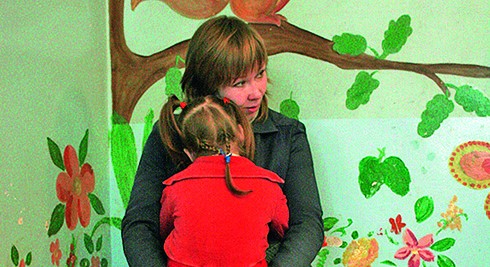
Convicted Sasha N. comes to his three -year -old daughter Vika in the child’s house once a day in the Mozhaisk colony is kept up to three years. If mom is not released during this time, then the child is sent to relatives or to an orphanage. Many children born in prison have neurological problems. In children of drug addicts, for example, breaking begins immediately after birth, there are children with ugliness, with HIV infection.
“Children living in a colony are behind development,” says human rights activist Alla red. “I don’t see any point in keeping them in a colony if the mother does not live with them.” Indeed, for the child, the most important thing is that from an early age there is someone who is constantly caring for him. Therefore, if a mother does not want to live with her child, it is better to send this child to an orphanage so that he has the opportunity to be adopted at an early age. ”
To a broken trough in the child’s house is a quiet hour, and I will eat on Schweik: some women finished work, others come to replace them. In the Mozhaisk colony, they sew a uniform for employees of the Ministry of Internal Affairs. Be sure to work. Galina is a medical worker. She could not sew to prison. And now he is proud that he fulfills the norm.
Near the office of the head of the colony, people crowded. Irina Gadaeva came to say goodbye to the convicts. On Tuesday, December 7, seventeen women were released at UDO.
“Many are leaving,” says Irina Gadaeva. “But many are returning.” There are women to whom the punishment is replaced by correctional work, and they cannot withstand - and again to us. And there are those who do not find work after liberation, but in the family of problems, they commit some new crime and come to us joyful: “Hello, I returned!” The horror is that some of them, living in a colony on everything ready, understand that it is not so bad here, and nobody waits for them in the wild. There should be a special service for working with the freeds from the colonies. There should be psychologists, lawyers, escort services. After all, here, in captivity, we solve all their problems. They are generally good. There are, of course, among them poison on which my eyes would not look. But there are those who later write letters from the will and thank. ”
From the Mozhaisk colony are freed by Tuesdays, and stages with new convicts come every day ...