
Translated material
All paths lead to orbit
The note by Marat Musin describes two almost opposite programs for the development of spacecraft-closed military development of the X-37V and the private transport ship Dragon.
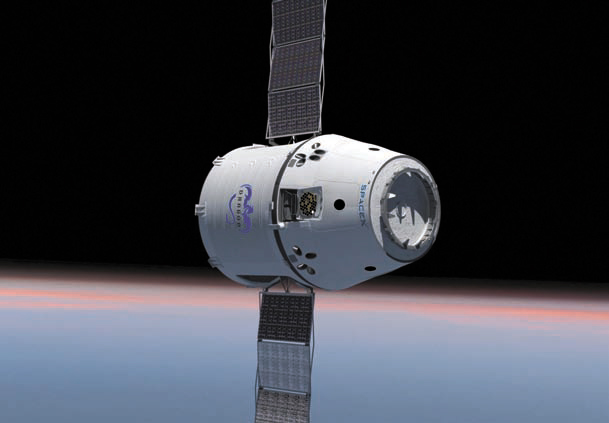
In December 2010, information appeared in the news at once about two spacecraft, which can be called antipodes. Judge for yourself: the first, created as part of the US Air Force Order, sat after 226 days of flight, the goals of creating the ship are not disclosed, but there is an assumption that they are rather exclusively military. And the other, on the contrary, first rose into the air, belongs to a private company, and out of the payload there was only the head of the Le Brueer cheese-a reference to the popular sketch of the Monty Pieton comedian group [1]. We are talking about the X-37B project of Boeing and the Dragon spacecraft, which is being developed by the private company SpaceX.
X-37V is the first unpillable small (a quarter of the shuttle) reusable winged spacecraft, which was finally brought to a space flight. This is the most modern of reusable space ships: it can be in orbit 270 days due to the use of solar panels, all hydraulic systems (including brakes) are replaced by electromechanical. In favor of the version about the seriousness of the military’s intentions, this apparatus says the development period of the X-37V-since 1999, i.e. It is made 2 years longer than, in due time, the Space Shattl project.
The scarcity of information about the project published by officials leads to the emergence of many messages about the alleged aerodynamic characteristics of the device (to a lesser extent) and its possible use (most of the messages). The range of statements on the Internet about the alleged use of the X-37V is unusually wide: from “in short, in fact this is a truck. ... Military use is still visible ”[2] to“ X-37 ... is the next, most logical step towards the creation. The military apparatus for the "end-to-end" flight range of heights is 20-2000 km. In the future, the tasks are also seen in higher orbits, up to the implementation of the inspection and interception of satellites in the geostationar ”[3].
I must say that the Americans themselves are engaged in fortune-telling about the true purpose of the X-37B apparatus. In the note [4] Brian Weeden, a former US Air Force officer, and currently the consultant of the Security World Foundation, the possible, from his point of view, the options for using the X-37B. I must say that the tone of American assumptions is much less “militaristic” compared to domestic-the combat use of the X-37V seems to Mr. Wyden the least probable.
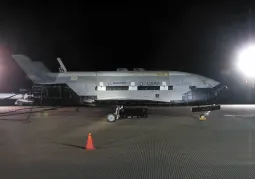
Actually, the reason for writing the note was the successful return of the X-37B ship to the ground after a 7-month flight. The spaceship launched in April made one revolution around the Earth in 90 minutes. During the flight, he received seven damage from clashes with cosmic garbage. Take -off, maneuvering, landing was completely performed by automation (it is impossible not to write here that this is just a repetition of the result of the “Buran”, which landed in 1988, controlled by the onboard digital computing complex). During landing, for unknown reasons, the chassis was bursting. Despite this, the ship continued in braking on the runway, without deviating from the middle of the strip. According to the US Air Force, the purpose of the flight was to check management, navigation systems and the heat -shield. However, amateur astronomers who found the X-37B telescope say that, judging by the trajectory, most often the ship turned out to be “problematic” countries: Afghanistan, Pakistan, North Korea, Iraq [5], which can speak in favor of the theory of the use of a spacecraft as a short-ray scout. In fairness, the same astronomers admit that the X-37V trajectories for the weeks of observation lay between 40 ° C. And 40 ° Yu.Sh., and if you adhere to this version, almost all countries of South America, North Africa, the Middle East, and Southern Europe, too.
Dragon is a completely different story. As already noted in the article “Race for Cosmos. For paid space ”(TRV-hobby No. 65), NASA is trying to transfer freight transportation to private companies, leaving such financial and high-tech areas as the development of robotic space systems, the development of heavy launch vehicles, extension of the life of the international space station and the expansion of applied research on it and the creation of surveillance changes and the creation of surveillance satellites. SpaceX, which developed the Dragon spacecraft, is one of the winners of the contest “Commercial Orbital Transportation” (COTS), conducted by NASA. Under the terms of the contract, Dragon should deliver the first cargo to the ISS in 2011. However, the dates of test starts were transferred several times, and the first successful flight came in handy.
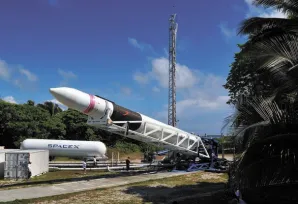
On December 8, after a small hitch at the start, when the automation found inconsistencies in telemetry data and canceled the launch of the ship in the first (three) window available for starting, the Falcon 9 rocket raised the Dragon spacecraft for the first time. The entire flight passed more than successfully: the diagnosis showed that all the devices work, the second step was separated on time, the device made two turns around the ground, changing the flight altitude, after which it left the orbit and spent only 800 m from the appointed point (with an acceptable deviation of 20 km). In the future, the company plans to develop a landing system for land.
After the successful end of the first flight (Cots Demo Flight 1), it was announced that the tasks of the second and third test flights may be united. In this case, on July 11, 2011, the ship will not only come close to the ISS, but will also be controlled from it, and not from the ground center and even make an attempt to dock with the station. Dragon docking will go in the same way as the Japanese spacecraft HTV-the ship under the control of the computer will come closer from the ISS to a distance of 10 m, and then the astronauts capture the ship with a special manipulator and pull it to the hatch.
The design feature of the ship is the possibility of repeated use of some elements. The motor installation, fuel tanks, batteries and other equipment return to the ground along with the capsule, which reduces the cost of subsequent launches. The Dragon ship is developed in three modifications: cargo (withdraws up to 6 tons of cargo into orbit), cargo -passenger (4 people and 2.5 tons of cargo) and manned (7 people).
SpaceX is trying to reduce the cost of each launch, therefore it is logical that since the Falcon 9 rocket (unlike a spaceship) makes a second flight, then it does not have to be only test. Together with the launch of Dragon, several miniature Cubesat satellites were brought into orbit [6].
In the end, I would like to note that SpaceX is not the only company with which NASA has concluded a contract for the development of transport spacecraft. It is possible that the next note on the launches of private spacecraft will be devoted to the competitor of Dragon-the Cygnus project, which is planned to be launched in May-June 2011.
1. Www.youtube.com/watch?v=b3kbuqhkhkx0
2. Www.warandpeace.ru/ru/news/view/45960/
4. Www.secureWorldfoundation.org/images/x-37b otvfactsheet.pdf
5.Www.nytimes.com/2010/05/23/science/Space/23Secret.html?_R=1&HP