
Translated material
Do not "overheat" on the exchange
Financiers choose gold
Time to take risks. Last year, international investors frantically wondered what financial instruments to bet in order to get the greatest profit. Building plans, financiers are still in painful doubts-macroeconomic risks are very great
Before the crisis, investors knew firmly: there are no tools in the world more reliable than the state -owned bonds of the United States and leading European countries (Germany, France, Great Britain). The crisis violated the usual order of things: due to soft monetary policy (low interest rates, pumping up the economy of money, weakening of national currencies) of the US Federal Reserve and the Central Banks of Europe, the government bonds of these countries no longer promise serious income. In addition, they ceased to be a “quiet harbor”: the economic situation in the USA and in Europe can worsen due to serious problems with budget deficit and external debt. At the same time, other assets that could give a more significant income - promotions, raw materials, precious metals - turn out to be too risky in fact.
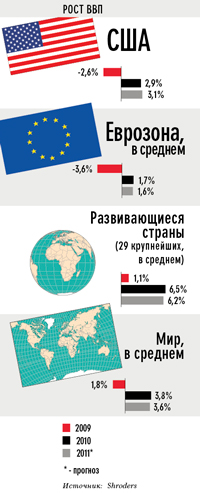
The danger of “overheating” most likely, in 2011, Europe will continue to flounder in economic troubles: GDP growth will remain weak, and individual countries will experience budget crises. In the United States, the situation will be somewhat better. From developing countries, most economists expect confident growth. This is the main version of the forecast adhere to the IMF, the World Bank, the OECD.
Therefore, you need to actively invest in the papers of developing countries - China, Brazil, Turkey? Not everything is so simple, some analysts offer not to fall into euphoria about the prospects of these markets. For example, the Chinese economy (growth in 2010-about 9%), which ensures demand, and after it the increase in oil prices and metals on a global scale can fall into a trap: PROTRIES BANKS accumulate poor debts, and real estate in the Middle Kingdom, albeit cheaper, remains clearly “overheated”.
The situation in Brazil can also worsen (growth in 2010-8.5%): the country's budget deficit, according to the local Central Bank, threatens to grow from $ 49 billion to $ 64 billion next year. An too large deficit can provoke an alarm of investors: in this case, the influx of speculative capital in the country will decrease, and the Brazilian Real Course will decrease.
For the past five years, developing countries have grown much faster than developed, but in 2011 the difference in growth rate may decrease, Ket Wade from Shroders believes: inflation has grown in developing countries, and a constant influx of capital leads to speculative overheating of the markets.
Is it worth the investor at all next year to "look" at the stock market? BNP Paribas analysts believe that it is careful, but it is worth it: the stock markets of most states after crisis collars begin to recover.
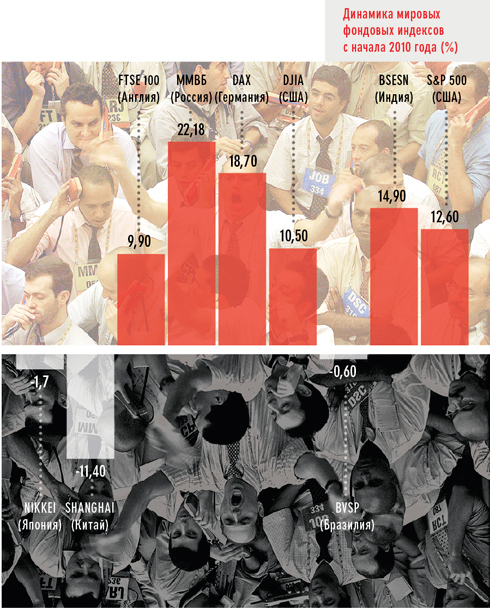
For example, shares of companies taken into account by the American Standard & Poor's 500 stock index, in the last 16 weeks have risen in price by 13%. And the shares of 24 developed countries included in the MSCI World Index have almost completely played their large -scale (46%) fall from the moment of bankruptcy of Lehman Brothers.
"
Speculative capital is inclined to flee from Russia at the slightest shocks on the leading world venues
"
W playing out the past fall, shares in world markets since March 2009 have risen on average by 87%. However, it does not follow from this at all that the increase in stock quotations will continue equally vigorously next year: the potential for recovery growth on world stock venues is practically exhausted, said Guy Lebas, economist Janny Montgomery Scott.
 |
Without income , usually during periods of economic growth, the traction of investors to risky operations increases (I want to get maximum profit), and during downs and recesses it decreases (we must “lick wounds” from losses). Now, the volume of purchases of risky tools - shares and raw materials - are growing everywhere. The reason for this is the low refinancing rates for most central banks trying to somehow revive the economy due to available loans. But such a policy of monetary authorities is extremely disadvantageous to investors, it deprives them of hope for a little-Malsky income. For example, bonds of reliable corporate borrowers (with an investment rating) this year brought investors on average 4.4%, and in 2011 they will show yield only 2-3%, Bofa ML analysts believe.
Low interest rates that in the USA, in Europe, will push in risky instruments to investment, says Kate Wade, chief economist of Shroders. So, shares and raw materials will rise in price. Actually, this happened in the past year - oil (to a lesser extent) and gold (to a larger) was added to value. However, these assets are very volatile, and the risk that their price can roll down at any time is very large (see the New Times No. 42 of December 13).
The changeable course of government bonds does not promise income, shares have no growth potential, oil and precious metals can easily fall in price ... Maybe the winnings will bring the foreign exchange market? Well, if the money is not the latter: it is likely that one of the peripheral countries of Europe will have to go through default and restructuring of debt, any market panic-even associated with relatively small countries like Ireland and Greece-instantly leads to a negative reaction in all financial markets, and especially on foreign currency.
If the macroeconomic problems of Europe will continue this year, then the euro will most likely be less cheaper and by the end of 2011 it will reach a course of $ 1.25 per euro (now $ 1.32), Shroders predicts. True, there are directly opposite forecasts based on the assumption that the US economy will be no less difficult in the coming year than Europe, and therefore the course may be at $ 1.4-1.5 per euro.
A win -win strategy , so where to go to the investor in 2011? Pimco investment managers (the world's largest investor in the state -owned nibblers) Sebastian Page and Mark Taborski believe that during the period of weak economic growth in low inflation, the best investments are government bonds and gold. If inflation is high and there is no economic growth, gold and raw materials. And during the rapid growth of the economy with low or average inflation, shares and corporate bonds show better profitability. If you are ready to believe Pimco analysts, then the case is small: to correctly determine the macroeconomic prospects of a particular country. Risk to health!