
Translated material
Rally with obstacles
Blue chips change orientation
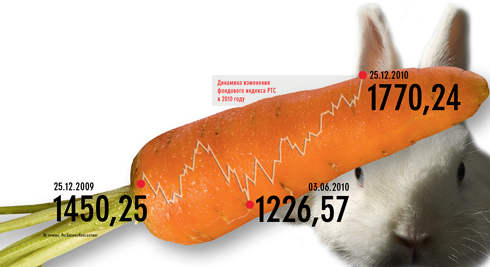
Rally with obstacles. The Russian stock market grew in 2010 by more than 20%. However, even with such impressive dynamics, the indexes of domestic “blue chips” are still far from their pre -crisis meanings. What will happen to them in 2011? Exchange players are waiting for New Year's days with the same impatience as sellers of Christmas toys. By tradition, the so -called “New Year's rally” begins in the stock market before Christmas holidays - the prices of shares of many promising companies rush up. And if the exchanges correctly “catch the wave”, they can take care of this seriously.
The capricious "Neftyanka" the Russian stock market did not disappoint: only for the period from 13th to December 20, stock indices added 2%. And in just a year they grew by 21–22%
* * From January 1 to December 22, 2010, the MMEVB index increased from 1360 to 1670 points, and the RTS index - from 1425 to 1760 points ..
The growth of the Russian market, the leading role in which the shares of the raw material sector companies play, is easiest to explain the high price of oil, which has risen in price by 17%over the year. However, the paradox is that precisely the "oilfight" shares were by no means growth leaders in 2010. “The shares of leading domestic fuel companies demonstrated bad dynamics this year. The growth of Lukoil and Tatneft quotes amounted to only about 5%, and Rosneft shares generally fell by 13%, having experienced the abolition of the preferential rates of the NDPI for oil of the East Siberian deposits, ”says he says
Analyst VTB 24 Stanislav Kleshchev. At the same time, many experts doubt that next year the oil industry paper will be greatly added to price. Analysts give this a few explanations. The Ministry of Finance increases the tax burden on the economy, and a serious burden falls on oil companies that will encounter an increase in mineral production tax (personal income tax). In addition, for private companies in the raw material sector in Russia, now far from the best times: the most attractive deposits without a competition are in the state “Rosneft” or “Gazprom” (in particular, on the shelf of Karskoy, Barents and the Black Seas). Finally, the fate of Mikhail Khodorkovsky does not inspire optimism in the holders of the papers of the Russian "oil".
Upensively protected by the Russian stock market, new leaders - Polymetall, Severstal and Novatek, whose shares rose in price per year by 100% and higher. “Polymetal papers increased almost doubled due to high prices for precious metals, Novatek and Severstal attract investors by the successful implementation of new projects that enjoy obvious support at the government level,” explains the secret of success
Citibank shares trader John Hazel. "
Speculative capital is inclined to flee from Russia at the slightest shocks on the leading world venues
"
Criminal for leaders in growth rates (90% per year) - shares of telecommunication companies. Stanislav Kleshchev from VTB24 explains this by the upcoming Reorganization of Svyazinvest, as a result of which the holding of the holding’s regional “daughters” will join the “Rostelecom”, and therefore the “New National Champion” will be created in the industry.
There are favorites in other market sectors. Exchange players clearly appreciated the operation to save AvtoVAZ at the state expense. Thanks to the car recycling program and direct state -owned state -owned capitalization, the company's capitalization has recovered almost to the pre -crisis level. As a result of the AvtoVAZ campaign, they grew 2.5 times. The Birzheviks did not ignore the recent purchase of the VIMM-Bill-Danna to the acquisition of American Pepsico at the price of “above the market” ($ 3.8 billion), which led to the explosive growth of the company's shares at the end of the year and brought papers to the growth leaders in the food sector (+70% per year).
In the banking segment, very good dynamics was shown by Sberbank shares. “His profit this year will be a record in history - over 160 billion rubles. An additional plus of Sberbank is the presence of a clear medium -term development strategy that the bank adheres to, ”says
The deputy head of the analytical department of "Investkafa" Alexander Lozovaya. Will these companies continue the growth of capitalization in 2011? Analysts do not exclude. “The Russian stock market remains underestimated, and it is clearly where to grow in 2011,” he believes
Head of the analytical department of the Capital Criminal Code Sergey Karykhalin. Among the favorite of 2011, according to John Hazel from Citibank, there are shares of companies that enjoy unconditional support of the state: Gazprom, Sberbank, Gazpromneft, Transneft. Such a set of favorites clearly demonstrates the rules of the game that have developed in the Russian market: if you want to grow - belong to the state or at least make friends with it tightly.
However, analysts do not exclude other “growth points” in the Russian stock market next year. In particular, shares relating to the segments of metallurgy and production that are still very underestimated, believes, can “tear”
Alexander Osin, chief economist of the Criminal Code of Finams Management . His list of potential leaders in 2011 includes the papers of Severstal, Mechel, Gold Pole. He also waits for a growth of papers of the consumer sector, in particular, retails “Magnit” and “X5”.
The risks of 2011 The Russian stock market in the past year was an accurate mirror of the processes that occur in the domestic economy in general,-believes
The economist “Troika Dialog” Anton Struchenevsky : slightly grew, but did not reach the pre -crisis pace. So the stock market was raised, but it still does not reach the record high indicators of 2007: now the RTS and MMEVB indices are at 1670–1760 points, and then they went through for 2500.
At the same time, experts interviewed by The New Times pay attention to two fundamental and permanent risk, which is faced with the domestic stock market. The first is his high sensitivity to processes taking place in the world stock markets. The crisis clearly showed that the international speculative capital that dominates our stock market (according to the Troika Dialogue, foreign investors provide 75% of financial capital turning out in the Russian stock market), is inclined to escape from Russia at the slightest upheaval at the leading world venues.
The second is the dependence of the domestic market on the price of oil. In this regard, Anton Struchenevsky recalls that at the beginning of the crisis, when the oil in the world was violently cheaper, our stock indices collapsed 5 times, for a few months rolling from record heights (about 2550 points) to a level of just above 500 points. Since then, the dependence of the Russian economy on the oil conjuncture has only increased, which means that the probability of collapse of the quotes remains very high.