
Translated material
The price of global warming
Interview with Kennet Errow
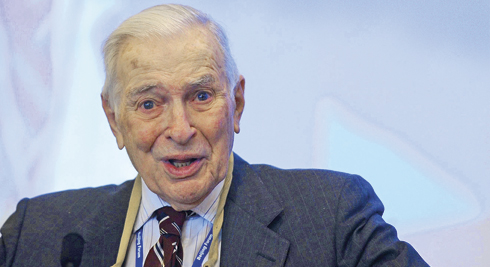
“If people do not care about their children and grandchildren, nothing needs to be done.” The natural abnormalities of the past summer, which affected not only Russia, but also many other countries, showed how the world economy depends on the climatic factor. Meanwhile, there are many people who believe that global warming is a myth invented by interested organizations in order to knock out all new billions from governments. The New Times turned to the Nobel Laureate in the economy, a member of the intergovernmental group of climate experts (IPCC), Honorary Professor of the University of Stanford Errow, this misfortune happened - global warming? The source of all energy on Earth is the sun that heats the surface of our planet. The Earth "hangs" in space, the temperature of which is close to absolute zero. Why does energy delay on Earth, and does not go back into space, as this happens on the moon? Because we have an atmosphere consisting of a mixture of gases that delay energy. The main volume of gases in the atmosphere is occupied by nitrogen (79%) and oxygen (20%). They are important for human life, but they pass the rays of the sun and do not delay the infrared radiation emanating from the surface of the Earth. But a mixture of twenty gases, the volume in the atmosphere of the Earth of which does not exceed 1%, passes solar radiation, but prevents reverse radiation into space. So there is a “greenhouse effect” known to everyone. The main volume of these gases is water vapor, carbon dioxide (CO2) and methane. And since humanity began to burn much more fuel than it did before the XVIII century industrial revolution, CO2 began to accumulate in the atmosphere. Accordingly, the temperature of the Earth began to gradually increase.
The price to a degree to spend billions of dollars on the fight against global warming without any guarantees for achieving the result? The level of CO2 in the atmosphere of the planet today is 430 particles per million (the accepted measurement measure of CO2 in the atmosphere. - The New Times). Until the industrial revolution of the 18th century, this indicator was 280, and by 2035, if everything goes unchanged, there will be 550. This will lead to the fact that the Earth’s temperature will increase by an average of 2 ° C, and by the end of the 21st century, with a probability of 50% - 5 ° C. And these changes have very specific negative economic consequences. By 2200, the climatic factor can reduce the global GDP by 20%. I'm not talking about the social consequences associated with possible flooding, for example, the Maldives, Bangladesh or Manhattan due to an increase in the level of the ocean caused by the melting of glaciers.
And if we talk not about the distant future, but about today's day? Scientists from the Massachusetts Technological Institute have proved that the temperature of the oceans changes due to warming, and therefore the number of storms increases and their strength increases. For many countries, including the United States, this is a very serious problem. Remember the hurricane "Katrina" in 2005: only American insurance companies paid $ 50 billion to their injured customers.
The fundamental moment remains that we can fight the emissions of carbon dioxide into the atmosphere. If the world community undertakes seriously for this problem, then we will be able to at least bring down the rate of warming.
And when can this happen? If measures to combat emissions are implemented by 2020, about which 55 countries of the world were voluntarily at the summit in Copenhagen (December 2009), then for half a century or century. Because scientists diverge in the assessment of how much it will be possible to lower the temperature by reducing CO2 emissions into the atmosphere. Some researchers talk about the tenth share of Celsius, others about several degrees. But even the most pessimistic forecasts of events can be better than the reality that the next generation will face, we do not take any action. And the risks will be even higher!
And what will change if humanity does not spend money on combating warming? We will analyze two options. In the first - the world community spends money on combating warming, carries costs, but after half a century it comes to the conclusion that this has no effect on the global climate change. What do we have as a result? New technologies and more environmentally friendly production. In the second case, we do nothing. And what do we have in the same 50 years? There is no technology, pollution is at least at the same level, and the risks that everything will be even worse, higher. Which option is preferable? Of course, if people do not care about their grandchildren and great -grandchildren, nothing needs to be done ...
 |
Dear alternative economic tools to combat climate change do you consider the most effective? Economists have a universal recipe: "If you don't like something, tax it." Therefore, the governments of many countries, for example, the United States and France, plan to introduce fuel tax.
Another method is regulation and licensing. The world community agrees that it fixes its emissions and seeks to reduce them by a certain value, and the one who cannot cope buys quotas from those who do this in the best way. So not only entire countries, but also companies within states can act.
The third option is subsidizing production and introducing new technologies that will produce the same volume of energy, but with a minimum emission of carbon dioxide into the atmosphere.
For example, when burning natural gas, less CO2 is released than during oil burning. The production of atomic energy is generally not associated with emissions of carbon dioxide into the atmosphere, but other sources of nature pollution and, accordingly, the problems of recycling and the spread of weapons of mass destruction appear.
So, solar panels, the energy of windmills and electric cars - our future? Alternative energy sources give only 6% of current needs. Moreover, any transformation of energy requires economic costs.
The electric car works on electricity, which also needs to be produced somehow. The last calculations that I have seen show that we do not benefit from the fact that cars will drive in electricity: we will need to burn the same amount of gas or oil for energy production.
Solar panels are a great idea, but due to the fact that the production of components of batteries (photoelectric converters) is very expensive, 5 times cheaper to use traditional sources of energy (gas or oil). Moreover, it is very expensive to store solar energy: after all, at night and in cloudy weather we also need electricity. Geothermal springs, like windmills, have limited use for geographical reasons.
Atomic stations are already generated about 20% of energy, and the world will gradually switch to this type of energy production. But what to do with waste - we still have to come up with.
Kennet Errow - 88 years old. He is the author of the "Errow Theorem", which has become one of the few axis of political science. He proved the theorem about the existence of competitive balance in the market (together with Gerard Debre) and introduced into the economic theory of uncertainty. In 1972, together with John Hicks, he received the Nobel Prize for Economics for the development of the theory of economic balance and well -being. He was awarded the Clark medal (1957) and the US National Medal of Science (2004). Annual Review of Economics Co -editor. The fundamental book of Errow “Collective choice and individual values” (2004) was translated into Russian.