
Translated material
X-Files Julian Assange
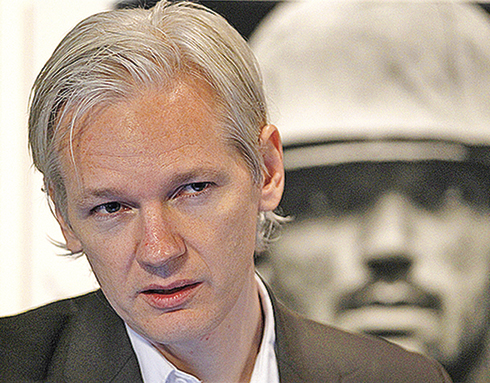
X-Files. There is no doubt: today Julian Assange and his WikiLeaks website are superbrand. The publication of the Iraqi, then the Afghan military diary, then - thousands of ciphergrams of American embassies caused a flurry of applause and a sea of accusations and hatred. Does Web 2.0 replace the WikiLeaks era? He himself calls himself a journalist, human rights activist, programmer and encryption. Opponents often call him a hacker and recall that the court of his native Australia in the early 1990s found Assange guilty of 19 episodes of hacking, but he got off with only a small fine. The Assange himself the word "hacker" prefers to avoid. Those who are involved in research journalism are inclined to call Assange an “information broker”, whose documents must be seriously analyzed and checked.
The 39-year-old Assange has neither a family nor a permanent house, he endlessly changes his phones and email addresses, works in some rented apartments with tightly curtained curtains for days on a lot, preferably in countries with liberal legislation in relation to the media. He has enough reasons for paranoia: in recent years, he angered the governments and secret services of many countries of the world.
The Assange matrix The idea that the WikiLeaks website is simple and straightforward: if the governments hide information from those who pay for it, taxpayers, then they are illegitimate if the organizations do the same, they want to deceive the public and, therefore, are also illegitimate. Moreover, the more financial resources both the first and the latter spend on protecting secrets, the more reasons, Assange believes, try to reveal their secret.
Assange, who studied physics and mathematics at the University of Melbourne, writes the American magazine The NewYorker, several years ago even wrote a job - “Conspirology as a management method”. In it, in it, he proved that the survival of “illegitimate governments” really depends on their ability to hide information from fellow citizens, therefore, he says, the more their secrets will become publicly known, the faster such “illegitimate governments” will cease to exist - without a conspiracyological pillow they will simply collapse. In 2006, when the WikiLeaks web project started, Assange outlined “repressive regimes in China, Russia and Central Eurasia as objects of close interest, but we also want to help the West who is ready to publish information about the lawless and immoral behavior of our governments and corporations.” In 2010, the US government became the main object of its attacks.
The web-okhota took off their first scandalous documents Assange and his colleagues, saddled the information flow of Chinese hackers, who gained secret telegrams of foreign embassies on the Web. And for the first time, WikiLeaks got into the news strip in 2007, publishing compromising documents on leading Kenya politicians, including its newly elected president. “According to Kenyan intelligence, this information has changed 10% by the alignment of the votes and the final results of the elections,” Assange said at a conference in the summer of this year. But true glory came to Wikileaks after publications of documents related to the war in Iraq and Afghanistan. The documents were transmitted by WikiLeaks, according to the American intelligence analyst, Private Bradley Manning, who served in Iraq - he is now arrested, he was charged with theft of secret letters/documents of the Pentagon, he is waiting for the court and prison. Assange himself does not call the source for obvious reasons.
Information and/or life? The publication of the Afghan archive of the Pentagon caused a storm, including in journalistic circles. Actually, the dispute is about which connecting union should be used between the words “information” - “life”. “And”, one believe, “or” - others, bearing in mind that the publication of documents can cost life, for example, soldiers fighting in Afghanistan, and the Afghans fighting against the Taliban on the side of the NATO forces.
The Kovach, the famous journalist The New York Times, was convinced - he is convinced that he saves life: “In democracies, you can’t manage under the cover of secrets or wage war in secretly,” he said in an interview with The New Times. “If voters and authorities cannot accept the war as it is in reality, then this means that to solve problems, you should choose other methods than war.”
The editor -in -chief of The New York Times, Keller, whose newspaper published both the Afghan Diary and the Cipherogram of American Embassies, wrote on the newspaper blog that they had been checking the documents for a long time until they were convinced that the information in them corresponded to what his military correspondents wrote about. In addition, the newspaper removed all the names from the documents, with the exception of the names of Afghan officials. The newspaper also received the same newspaper in relation to the cipherograms: in the texts laid out on WikiLeaks, instead of the last names of a number of sources - crosses.
The country of Wikileaks in Julian Assange is a lot of mystical. A thin, pale, with a narrow nervous face, gray hair - it seems that he just lacks a black cloak and the ability to pass through the walls. However, passes.
The main WikiLeaks server is in the suburbs of Stockholm - in the town of Solnah: Sweden legislation does not allow journalists to disclose the sources of their information, so neither special agents nor police officers can come and take the server. By irony of fate, it is Sweden that now requires the extradition of Assange, accusing him of sexual crimes
* * In Sweden they joke: if you want to sleep with a woman, it is better to get written consent to sex from her. In Sweden, sexual violence is of three types, Assange is accused of the easiest: he had sex with a woman who, by the time of the beginning of the action, no longer wanted him. According to the laws of the country, this is a crime .. In total in different countries and on different continents, WikiLeaks have about 200 servers. To transmit information between computers, WikiLeaks uses a special network - Tor, which allows you to send files in such a way that even if information passes through the territory of countries whose government agents are right - and actively use it - monitor information flows, they still can neither decipher the encoded texts, or to understand where and where they go. Files fly on a virtual labyrinth with many branches, stopping in different places-they are called the “Torah nodes”, they, these files, are shrouded in many encryption layers-experts say that this is something similar to the bulb: in each transshipment point (node) the receiver of secret information (and this is a volunteer that helps the Assangeus exclusively from sympathy for its ideas) It removes one layer of the “bulbs”, from which he recognizes the whereabouts of the next intermediate point and sends it there. Neither the sender of the file, nor what is in it, he cannot find out - only the next destination. “And there are 500 such passes on the Tor network in 50 countries,” says Igor Sviridov, a specialist in building super-defended Internet structures. But this is not all: when the file flies through the virtual labyrinth, there are still millions of bits of the same, but fake fakes sent into the Assanje swim exclusively in order to bring down the pantalyk of the pursuers. “In our system, of course, there are weaknesses,” says the creator of this country WikiLeaks, “but it is protected much better than banking networks.” You can, of course, try to embrace this country with barbed wire. Is it enough for her? And if enough, is it for a long time?
From an interview with Julian Assange - Channel 4, Great Britain, 06/25/2010
Are you pacifists?
We believe that the path to justice is transparency, and we make it clear that our ultimate goal is to detect injustices in the world and an attempt to correct them. Naturally, death is injustice, and death during the war of peaceful citizens is an unfair war.
This publication (we are talking about the "Afghan diary") endanger people ...
We looked at the material for cases where innocent informants appeared: we put a lot of effort to exclude the slightest chance of harm to anyone.
Does Wikileaks have any taboos? Will you publish, say, CIA reports?
Yes. But provided that we will carry out a procedure to reduce harm.
The location of the weapon?
Undoubtedly.
Nuclear weapons launch codes?
Well, here we will have to go through the procedure to reduce harm.
Yeah, the harm would be great.
Well, when the launch codes change, we can publish them. This would show that it is not easy to keep such things safe, and we all need to know that the atomic war, although unlikely, is technically possible / ... / There is secret information, there is no secret information. Many soldiers have access to this material.
But not everyone can download it on the Internet?
Well, if they have brains, why not?
Translation from English
Anna Lesnevskaya, The New Times