
Translated material
"I am optimistic"
Interview with Hillary Clinton
 |
Better later than nothing. December brought relief to the supporters of the “disarmament race” between Russia and the USA: an agreement on a 30 percent reduction in strategic offensive weapons (START-3), signed by Presidents Dmitry Medvedev and Barack Obama on April 8 in Prague, ratified by the US Congress. The New Times monitored the progress of negotiations on START in 2010
In mid-November, the influential Senator Republican from Arizona, in mid-November, said that ratification should not be in a hurry, "given the other things that the congress should finish." But President Barack Obama seemed to be able to convince Kyle, whose opinion many colleagues in the Senate listen to, change their position. This finally became clear after the ambulance of START-3 predicted another influential Senator-Republican-John McCain. “The START-3 Treaty may be ratified next week,” McCain said on December 10, emphasizing that the document is “important for international security”. Well, a week later than a week earlier ... The main thing is that the efforts of the presidents of Medvedev and Obama to reboot Russia - the United States bear fruit.
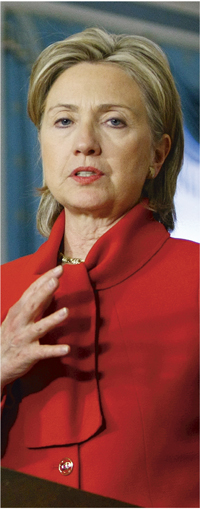
The importance of this process was in an exclusive interview with The New Times on the eve of a working visit to Moscow in March 2010, US Secretary of State Hillary Clinton. “I am optimistic: I think that soon we will reach an agreement,” said the New Times, Ms. Clinton, referring to SNV-3. “The main task: how to make an agreement so that it succumbs to verification and control on both sides and at the same time is not so costly and complex from the point of view of practical application as the previous agreement.” Exactly a month later, the document was signed by the presidents.
In an interview with The New Times
Hillary Clinton affected various aspects of Russian-American relations. Here are excerpts from this conversation:
Madame Secretary of State, a year ago you announced the "reboot" of Russian-American relations. Has it succeeded? Yes. But the true indicator of the success of “rebooting” will be how we can expand our cooperation in matters of mutual interest. We work closely, for example, on such a issue as Iran. We reached progress in our common efforts in Afghanistan, trying to achieve stability and reduction of threats associated with al-Qaeda and other extremists. We also work closely on the problem of North Korea and Middle Eastern peaceful settlement.
Iran is the hottest theme of 2010. Considering that the government of this country refuses to satisfy the requirements of the international community regarding its nuclear program, what is the likelihood that the United States use not economic sanctions against Iran, but military power? The United States has always sought and strive to solve the problem of Iran’s nuclear program peacefully. Together with Russia, France, and the International Atomic Energy Agency, we strove and strive to find a way to provide Iran fuel for his reactor intended for medical research. But Iran refuses such opportunities each time. Therefore, we will continue to work with Russia and our other partners - in order to strengthen the pressure on Iran and force him to reconsider the current position on the nuclear issue.
The United States is preparing to increase their contingent in Afghanistan. What are you trying to achieve in this country, where others, including the USSR, failed? As President Obama said about this, announcing a new American strategy in Afghanistan, our ultimate task is to defeat al-Qaeda and prevent it from returning to Pakistan or Afghanistan. It is to achieve this goal that we attract new resources to destroy terrorist networks in Pakistan and Afghanistan, as well as to help create a more effective government of Afghanistan, which will ultimately be able to fight terrorists.
The world media write a lot about the fact that Pakistan provides its territory for terrorists, and even that employees of the Pakistani secret service help Taliban. Are you not afraid that Pakistani nuclear potential can be in the hands of extremists? It is quite obvious that it is impossible to achieve stability in Afghanistan, without assisting the Pakistani government in the fight against terrorism in the region. That is why the new strategy of President Obama provides for assistance to Pakistan in achieving stability and strengthening constitutional civil government.
The administration of President Clinton has always been a supporter of the democratic development of Russia, while President Bush and his administration were rather inclined to a completely different approach, we will call him pragmatic, which suggested that human rights were fading into the background. What approach are you a supporter? I am sure that the Russian people in the same way want to possess the entire amount of human and civil rights as the Americans and any other people. The “reboot” of relations between Russia and the United States implies not only connections at the government level, but also steps to bring our peoples closer. And this is possible only if in the basis - common values: the accountability of governments and the rule of law.
The previous American administration was quite aggressively protesting about the statements of the Russian authorities that the former republics of the USSR “are a zone of privileged interests of Russia”, Ukraine and Georgia are primarily. What is your view of this question and is the entry of Ukraine and Georgia in NATO in the near future possible? The United States has always adhered to the principle that sovereign states have the right to make their own decisions in foreign policy and enter into those unions that they want. For us, the position on the presence of special spheres of influence is the ideas of the XIX century, and we fully support the decision of the North Atlantic Alliance to pursue a “open door” policy regarding membership of Georgia and Ukraine ...
Vice President Joe Biden during his visit to the Caucasus last year * * * June 22 and 23, 2009. He used very sharp words about Moscow’s policy in relation to the former republics of the Soviet Union. Does this mean that you and Biden have a different approach on this issue? We are both, and the vice president of Biden, and I support the views and politics of our president. And we both would like to have productive working relations with Russia. At the same time, we are well aware that between us (between the USA and Russia. - The New Times) can be discrepancies. The United States continues to fully support the territorial integrity and sovereignty of Georgia. And we, like the vast majority of other countries, continue to consider Abkhazia and South Ossetia as inalienable parts of Georgia ...
Chronicle of Movement to the START-3 Agreement
“On December 29, the most authoritative person from the outside - Prime Minister Vladimir Putin intervenes in the negotiation process (according to STAR. - The New Times). He insists on the rigid linking of START and pro. Medvedev is silent. Obama - too. A heavy pause occurs. A month later, with a little, like a thunder among a clear sky, news: Romania agrees to post a new system about the United States. Minister Lavrov requires an explanation. Instead, a week later, another news collapses to Moscow: Bulgaria is also ready to join the new about the new about. What is Obama’s “new course”? No, just a “trial ball”. The United States showed Moscow: “We can also be able to echo, do not want to sign the START - you will receive a new headache,” one of the Russian experts comments on the situation for The New Times on the terms of anonymity. Moscow tightens the position, insisting, in addition to linking with about on more radical abbreviations of American nuclear weapons. Negotiations in Geneva are held in a stretched atmosphere. And then Obama decides to dot I over I. In the twelfth, a telephone conversation with the Russian leader, on February 24, he leaves no ways to retreat: the United States will not go to the legally binding restrictions on its pro or further reduction of carriers - this would mean the destruction of the entire nuclear triad of the country. If this is the price of an agreement, then there will be no agreement. “It was the most difficult and at the same time decisive moment in the whole negotiation process,” said Peter Baker, the New York Times, the New York Times, the New York Times observer. It was he who published an article in his newspaper with a detailed description of that telephone conversation: Obama hung up a pipe in rage - no one saw him like that. “In the option in which the Russians proposed to sign it, the agreement would never have passed through the Senate,” Baker explains ... ”(“ Better later than nothing, ”Boris Unanov, The New Times No. 12 of April 5, 2010)