
Translated material
The State Duma should finally ratify the DSNV on January 25. The Communists are replacing obstacles
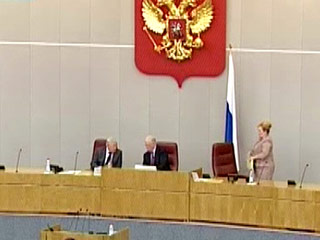
The State Duma, which in the first reading adopted a bill on the ratification of the START agreement in the first reading, will return to this issue on January 14. Finally, ratification in the third reading may take place on January 25. This became clear after the statements of the speaker of the lower house Boris Gryzlov after the Council of the Duma.
As Gryzlov said, in the 2nd reading, 11 pages of amendments were prepared for the project, and the consideration itself is stretched. “We were forced to do this, since the US Congress adopted certain reservations to the text that was signed by the presidents,” said the speaker.
“The period of time has passed during which amendments were adopted, the amendment was one, but it is very large,” Gryzlov said. “An additional 6 articles are introduced to the ratification law: there was one article that sounded -“ ratify ”, now there are another 6 articles,” he explained.
In parallel on January 25, it is planned to make 2 statements: "One is international and will be sent to the US Congress, the other will relate to our domestic policy, our internal issues, which involve the constant improvement of our defense capabilities." “We understand that the contract for the STRICE should in no way affect our defense capability,” the State Duma chairman summed up.
Communist Party against: She is ready to have a draft application
The Communist Party faction in the State Duma has prepared an alternative project for a statement of the chamber "on strategic security issues that arise in connection with the ratification of a new SVV agreement," Interfax reports.
The faction opposes the ratification of the DSNV, believing that its implementation will cause significant damage to the national security of Russia. The Communists proposed a document at a meeting of the Duma International Committee, which notes: the START Treaty does not limit the missile defense systems, which, in fact, become a shield, behind which a nuclear aggressor may take refuge from a response. Meanwhile, in the resolution of the US Senate, it is directly stated that the START Treaty does not impose any restrictions on the development of European PROs on the American side, ”the faction said.
Then, the document scrupulously lists a number of positions, which, according to the Communists, make the contract much more profitable by the American side than the Russian. "The contract does not consider as a strategic weapon and does not limit the number of high -range winged missiles, while the United States has multiple superiority over Russia in this type of weapons. And in the conditions of the dominance of the American Navy in the ocean, Tomagavk cruise missiles in relation to Russia are strategic, rather than tactical weapons," the project said.
The START Treaty does not provide for weapons restrictions that are today developed in the United States within the "Fast global blow" concept. " It is noted that the intention to create such weapons is clearly expressed in the ratification resolution of the US Senate. “In particular, it refers to the development of strategic carriers capable of high -speed aerodynamic flight, which can imply both high -range supersonic cruise missiles, as well as shock aerospace ships, the prototype of which (X -37) completed its first flight in December 2010,” the document says.
All of the above requires from Russia to establish the main quantitative and qualitative parameters of the stipulated reductions by "federal law."