
Translated material
Tunisia President escaped - the authorities passed to the military
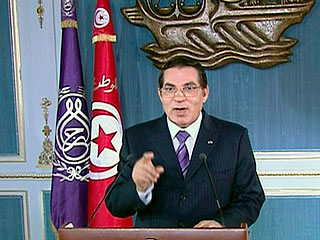
Tunisia President Zin Al-Abidin Ben Ali left the country and flew to France, and the authorities in the state passed to the military, Interfax reports with reference to Al Jazeera. The president’s functions will be temporarily performed by Prime Minister Muhammad Gannushi. Meanwhile, in France itself, the arrival of the Tunisian president in Paris does not know anything. The administration of the head of state Nicolas Sarkozi, as well as in the Ministry of Foreign Affairs, said that they did not have such information.
Prime Minister Hannushi himself made a sensational statement on the departure of Ben Ali on the air of state television. He explained that the president temporarily cannot fulfill his duties of the head of state, therefore, during his absence, he will be replaced by the head of government. As Tunisia reports state television, Hannushi will remain temporary president until extraordinary elections.
The prime minister promised to comply with the Tunisian Constitution and restore order in a country covered by mass protests covered since December, and dozens of people became victims. He also promised to realize previously declared political and socio-economic reforms, consulting with the political forces of the country, including party and the civil community. Gannushi called on the country's citizens to unity and patriotism.
- The people rejoice and celebrate with the military and gendarmes
- the country has been announced a state of emergency
- The troops were introduced into the capital's airport. The airspace is closed - the fate of tourists in question
- European countries were going to evacuate their citizens
- Foreign Policy: Events in Tunisia - the first Wikileak -revolution
- The head of the Tunisian delegation under UNESCO fired in protest
The fugitive will not be accepted in France
France President Nicolas Sarkozy refused to accept President Tunisia Zin al-Abidin Ben-Ali in the country. About this, as RIA Novosti reports, reported on Friday evening the ITELE information channel with reference to a source close to the government.
Earlier, the media, citing sources in the French police, reported that the president of Tunisia was waiting in France on Friday evening. According to the Government of Malta, his plane flew at 21:00 Moscow time above the country's territory and headed north. The Foreign Ministry of France said that he did not receive a "reception" of the president of Tunisia. The ministry also noted that in the event of a similar request, it will be consulted "with the constitutional authorities of Tunisia."
Apparently, after the departure of Ben Ali, the airspace over Tunisia was closed. The metropolitan airport is now under the control of the troops. It is reported that security forces detained several members of the Presidential President Zin Al-Abidin Ben Ali at the same Tunisis Carfagen International Airport, who left the country, but there is no confirmation of this yet.
At the same time, it is worth noting that earlier on Friday the president managed to dissolve the government and introduce a state of emergency in the country, allowing the military to use weapons against demonstrators.
Having resigned the government, Ben Ali also announced the holding of extraordinary parliamentary elections. They must take place over the next six months. The President explained that he made such a decision to normalize the situation in the country. Gannushi was instructed to form a new government that would rule the country before the election.
Meanwhile, the Tunisian parties who are in emigration in Paris have already demanded the formation of a transition government. In a joint statement, the Party of the National Congress, headed by Montseph Marzuki, the Communist Labor Party and the Islamist Movement "An-Nahda" emphasized that the main task of the temporary cabinet will be to hold free democratic elections in Tunisia. The opposition took six months to prepare universal elections, following which new authorities will be formed.
Earlier, speaking on the air of the French Europe 1 Radio, the Minister of Foreign Affairs Tunisia Camel Morjan said that he did not exclude the possibility of forming a new government along with opposition politicians. According to him, Ben Ali realized his mistakes. One of the most obvious opponents of Ben Ali in the political arena of Tunisia Najib Chebbi, whom Western diplomats consider to be the most worthy of confidence among the Tunisian oppositionists, also spoke out in favor of the dissolution of the government. He described the latest events as a "change of regime."
Earlier, the demonstrators themselves, commenting on the proposals of the dissolution of the government, called them insufficient. “We don’t need bread or something else, we just want him (President Zin Al-Abidin Ben Ali) to leave. After that, we will have everything we need,” repeated displeased citizens. In fact, Ben Ali fulfilled the demands of the people - he left the country.
As for the French authorities, according to the results of an emergency meeting, the President of Sarkozy, the Champs Elysees, issued a statement. It says that France recognizes the fact of the transfer of power in Tunisia by the head of government, Mohamed Gannushi and "performs on the side of the Tunisian people at this decisive moment," ITAR-TASS reports. According to official Paris, "only a dialogue can lead to a democratic and long decision" the current political crisis in Tunisia.
The people rejoice and celebrate with the military and gendarmes
The Tunisians, having achieved that Ben Ali hated by them left the country, began to celebrate their victory. On the streets of Tunisia, universal glee reigns, everywhere there is the fraternity of people with the military and gendarmes. However, in the capital, shooting was still heard in the evening, despite the emergency mode.
At the same time, anti -government demonstrations and clashes with the police continued on Friday afternoon. About eight thousand people gathered near the building of the Ministry of the Interior in the capital of Tunisia. They chanted: "Ben Ali is a killer!" And "Ben Ali, get out!" As a result, the police decided to disperse the demonstration. The sounds of shots were heard, law enforcement officers used tear gas. The youth group began to throw policemen stones, to which they responded with an enhanced blow of tear gas, Reuters reports.
Hundreds of protesters were forced to flee. Many of them had eyes watery, and the exposure of the gas also caused a gag reflex. The 21 -year -old Emen Binmulka said that he saw how a bus with the police drove up to the demonstrators, and they used tear gas, so that absolutely everything was under the blow - and women with children including.
Regarding the promises given in recent appeal by the president, the participant of the action stated that no one believes them. “He always lied. Today we are protesting, because we know that he then said a lie,” the young man said.
The soldiers also guarded the building of the Central Bank of Tunisia. People who fled from the demonstration approached them and shouted insults at them.
The demonstrations also continued in the city of Sidi Buzid. Several thousand people walked along the streets of the city, chanting the requirements of the immediate resignation of President Ben Ali. Tunisian trade unions declared, in turn, about a universal strike.
Over the past day, 12 people became victims of riots
In addition, it became known that since last evening, 12 more people became victims of riots. Ten of them were killed in the capital of Tunisia, two more - in the city of Rasybel in the north -east of the country.
It is still unclear whether these people were killed before or after the president’s appeal to the people, in which he forbade the police to enter into clashes with the participants in the shares. Recall that he ordered employees of the Ministry of Internal Affairs to stop the use of firearms against demonstrators and conduct a thorough investigation of the death of citizens during the riots. In addition, the president ordered to create an independent commission that will be investigated by corruption in Tunisia.
Ben Ali also promised to reduce food prices and not put his candidacy in the next presidential election, which will be held in 2014. The opposition welcomed the promises of the country's leader, but demanded guarantees of their implementation.
In general, the government claims that the number of victims during the riots that last almost a month has amounted to 23 people, but the International Human Rights Federation based in Paris estimates their number of 66 people. The representative of human rights activists from the UN Rupert Kolvil said that the organization is ready to assist in the investigation of these deaths.
The country has announced a state of emergency
Even before the president’s departure from the country, the authorities announced a state of emergency. It is forbidden to gather in groups of more than three people. On television, they warned that in case of disobedience to security forces, weapons would be used. The commandant hour was introduced from 17:00 to 07:00 in the morning.
The other day, the commandant hour has already been introduced in the capital of Tunisia, but this did not prevent new clashes. Now the country's leadership went to the most stringent measures, allowing the police to shoot on suspicious personalities refusing to obey. At the same time, only on the eve of the President forbade the police to deal with demonstrators by force methods.
The world community has already responded to the new statements of the Tunisian authorities. UN Secretary General Pan Hi Moon called for "refrain from using troops" to disperse demonstrators. He called on a peaceful way to solve problems arising in the country. The administrative head of the international community said this at a press conference at the UN headquarters in New York.
Recall that the demonstrations in Tunisia, directed against unemployment and political collapse, began back in December, after December 17, a man shot himself because the authorities did not allow him to engage in the sale of vegetables on the street without a license. Following this, several more suicides were committed in the country, and the people took to the streets.
Troops were introduced into the capital's airport. The airspace is closed - the fate of tourists in question
Meanwhile, according to Reuters sources, the military forces are pulled to the metropolitan airport. The introduction of a state of emergency in Tunisia led to the closure of the airspace of this country.
Air France reported that it temporarily suspend all flights to Tunisia in connection with the introduction of a state of emergency and the closure of airspace.
The abolition of all sorties from Tunisia for an indefinite period in question makes the possibility of evacuating tourists, which foreign tour operators were going to begin. In particular, the British travel company Thomas Cook announced plans to send six flights for evacuation of almost four thousand vacationers from Britain, Ireland and Germany. Airplanes were supposed to land at the airport of the Tunisian city of Monastir.
In total, in Tunisia, according to the British Association of Tour operators, there are now about five thousand tourists from the United Kingdom. Cases of attacks on the hotels where foreigners live have not yet been recorded.
The head of the Tunisian delegation under UNESCO fired in protest
Meanwhile, the head of the Tunisian delegation under UNESCO Mesri Haddad resigned in connection with the riots. “I can no longer watch my country plunging into anarchy, I can no longer bear death,” the diplomat said France Press.
The corresponding petition was sent today to President Zin Al-Abydin Ben Ali. Previously, he already called on the president of Tunisia to "stop the bloody massacre."
At the same time, the head of the Tunisian delegation under UNESCO expressed the conviction that numerous protests "were not directed against President Ben Ali, but against the oligarchy, which ruins the country and scares away foreign investors," ITAR-TASS reports.
Foreign Policy: Events in Tunisia - the first Wikileak -revolution
The Foreign Policy publication sees the effects of WikiLeaks revelations in Tunisia and predicts the development of this trend. As noted in the article, the dispatches of American diplomats illuminated the details of monstrous corruption in the country. The published messages say that the power in the country belongs to the narrow circle of the elite, which has already turned into a mafia clan.
In general, this did not become an absolute revelation for the inhabitants of Tunisia, but their assumptions began to be supported by facts. In particular, the population could not but cause indignation the fact that the president’s son -in -law orders desserts that he was brought by a plane from San Trope to dinner. After the authorities closed access to the WikiLeaks portal on the Internet, the information still seeped through social networks.
Protest shares were also organized through Twitter and Facebook networks. In addition, young demonstrators pumped videos from YouTube shares using various tricks, despite the fact that video hosting was prohibited by the authorities of this country back in 2007. The oppression of freedom of speech on the network was reflected in the slogans that sounded on the streets, writes CNN .
In general, WikiLeaks materials served as a catalyst for the latest events that became the apogee of the people's discontent with the policy of the authorities and their attitude to their citizens.
Zin al-Abidin Ben Ali came to power in 1987 as a result of a bloodless “palace” coup, shifting Burgiba from the post of Khabib Burgib, who has been unlimitedly ruled Tunisia since this country gained independence from France in 1956, summarizes GZT> ru .
The regime of Ben Ali’s reign and his party, the democratic constitutional association was distinguished by rigidity, he was repeatedly accused of non -compliance with democratic rights and freedoms, the political isolation of the opposition, and ignore the social problems of the population.
In 2002, under the pretext of combating terrorism, changes were made to the Tunisian Constitution, which abolished the restriction of the number of presidential terms and age qualifications (70 years) for presidential candidate. The president in Tunisia is elected for a period of five years. The head of state is the Commander -in -Chief of the Armed Forces, appoints the head of government and the cabinet.