
Translated material
The oligarchy is against the bourgeoisie
How to build modern democracy in Russia
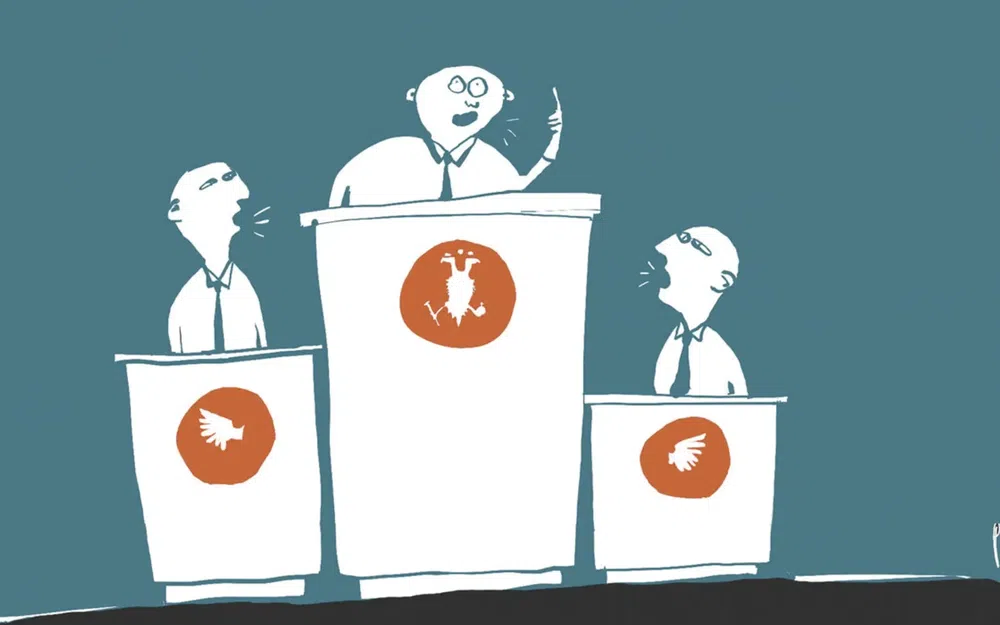
We offer readers excerpts from the discussion article by the chairman of the Yabloko party, Sergei Mitrokhin, which analyzes the oligarchic system and its inhibitory impact on the real modernization of the Russian ...
We offer readers excerpts from the discussion article by the chairman of the Yabloko party, Sergei Mitrokhin, which analyzes the oligarchic system and its inhibitory impact on the real modernization of Russian society.
With all our current attempts, the modernization remains out of the fact that for Russia to this day remains inaccessible to the central conquest of the European modernization of the new time - the legal state.
In modern Russia, universal suffrage is guaranteed, but there is no rule of law, since those in power have almost unlimited rights to form and permanently transform the law “for themselves”. In these conditions, the elections turn into falsification, and democracy itself into a fiction.
The belittal of the law is expressed not only in a constant change in the rules of the game, but also in the deliberate optionality of the rules themselves. "The stiffness of Russian laws is compensated by the optionality of their implementation." Or: "It’s impossible at all, but if you really want to, then you can."
Such a phenomenon as democracy without a rule of law existed already in the USSR. Universal suffrage there also was and got along with a communist dictatorship, covering it like a fig sheet ..
Today, the same leaf covers the oligarchic system. But the very presence of such a “passing” sheet indicates continuity, which allows to indicate one of the distinguishing features of the “special path” of Russia.
This path has many signs, but the most obvious is that it runs past a certain stage of development, passed by most leading countries of the modern world, some earlier - others later.
Missed stage
The “special path” of Russia passes by the stage of historical development at which the Great Triad of Western Modernization is being formed: the bourgeoisie is a civil society - the legal state.
The bourgeoisie, more than other social groups, was interested in the assertion of such fundamental principles of modern Western society as universal equality before the law, freedom of personality, entrepreneurship, etc., which created the prerequisites for a colossal breakdown in the development of the Western world.
Civil society is connected with the bourgeoisie already at the level of linguistics. In a number of European languages, “civilian” is a synonym for “bourgeois” (for example, German BuergergesellSchaft). It was the bourgeoisie who performed at the forefront of the emancipation of society from the obsessive oppression of the state. The sphere of private interests realized by citizens independently, without the help and coercion of authorities, is the foundation of a civil society that guarantees its autonomy regarding the state.
The historical achievement of the bourgeoisie in the field of state construction is not so much democracy itself as such a condition for its occurrence as Rule of Low (“supremacy of the law”). At a certain historical stage, entrepreneurship is emancipated from the strict restrictions of the old order dictating to each its own unshakable place. Among the injustices of this order is the privilege to fully engage in business for the few close to power.
The group of emancipating is so great that it makes no sense to beg the handouts in power, which, divided on all members of the group, will turn out to be insignificant. By virtue of its own number, the group needs not privileges, but in equality as a condition for freedom and prosperity.
The bourgeoisie undoubtedly made a decisive contribution to the formation of Western democracies. As Barrington Moore said in the last century: "There is no bourgeoisie - there is no democracy."
The paths of the bourgeoisie of different nations were special. Some acted revolutionary, others in more peaceful ways. In the twentieth century, the states of catching up of modernization organized this process from above, growing a bourgeoisie by the method of "artificial fertilization". But at the exit, the result of all these strategies had one: a public request for a legal state in which the law is one for everyone.
In Russia, successful bourgeois transformations have never been carried out yet - neither by “Revolution from below”, nor through “reforms from above”.
This is the main reason as our backwardness and the inability to build modern democracy. The national bourgeoisie has not yet appeared in Russia, which could guarantee the independence of society in relation to the state and introduce a “mighty hand” into the foundations of the state system such a value as “the equality of all before the law”.
The deep indifference of society to the principles and mechanisms of the rule of law is explained precisely by the fact that we, with all our missiles and nuclear bombs, missed the stage at which all this can and should be formed - both the separation of powers, and the elections as an urgent need for society, and the very subject of the formation of power, and not vice versa, and much more, on which all developed states of the 21st century are based.
In the twentieth century, Russia had two chances to build “bourgeois” capitalism. In 1917, the Bolsheviks did not allow this, and in the early 90s, pseudoliberals, who instead of the bourgeoisie created an oligarchy with us.
The price of communist modernization
The Bolsheviks headed for the destruction of the bourgeoisie as a class, and as a social support of their policy they chose layers as far from the bourgeoisie - the proletariat and the poorest peasantry.
A social group was subjected to cutting, capable of leading the movement towards the autonomy of society from state power, and the card-blanche was given to social contingents who had the lowest immunity to coercive and manipulations of the state. It is difficult to imagine a shorter way to establish the despotism of the Asian type with its absolute dominance of the state bureaucracy over society, in fact, turned into the army of state slaves.
The cost of Russia for communist modernization was not only the multimillion -dollar sacrifices incurred by its people, but also the colossal failures in development, which obviously gaping before us today.
During the industrialization, the social capital of the traditional society (peasant culture) was destroyed, and the social capital of the industrial (civil society) was deliberately destroyed in the bud.
The murder of the social tissues of society is expressed in the almost complete absence of his ability to self -organization. The political and social participation of citizens strives for zero. Mass apathy in the elections is a phenomenon, single -order with zero trade unions, weak NPOs, fictitious local and housing self -government, etc.
The rudiments of totalitarianism in the public consciousness (primarily Stalinism) are a serious factor in the paralysis of society, working for its conservation in a weakened state.
To the limit, a weakened society in itself is the heritage of the totalitarian past, and, perhaps, one of its most dangerous and difficult to elements.
Triumph of the oligarchy
The emergence of the oligarchy, apparently, was largely predetermined by the long domination of the communist regime, which over the record for a long period destroyed the independence of society and prevented the emergence of the national bourgeoisie.
A weak society is a relay wand that the communist regime transmitted to the oligarchic regime. Accustomed to patiently demolish any arbitrariness of power, society has reconciled with the fact that the authorities began to rob him.
A weak society has periods when it suddenly becomes strong, as a rule, in those moments when the state weakens. We had this in the late 80s-early 90s. Then our society eagerly rushed to the ideals of democracy. The energy of this jerk could be used as a powerful impulse for movement in this direction if it were backed up by the necessary reforms.
One of the key roles in the prevention of such a script could be played by a small privatization program aimed at creating a mass owner as a certain prototype of the bourgeoisie. To do this, this program should have been gradual and phased, contain mechanisms that impede the rapid concentration of property in the hands of a few.
Pursuing a policy of forming a middle class, it was possible to try to realize the chance of some kind of nationwide bourgeoisie after the collapse of communism. However, the reformers of the 90s did not set such goals for themselves.
The resources necessary to solve the problem of creating an independent middle class went to the formation of a completely different social group - the oligarchy. It was very simple to do this - after carrying out not small, but a great privatization for a handful of close people, making them superbanas overnight.
This is one of the reasons why the novel of Russian society with democratic ideals quickly ended, and it returned to its weakened state, i.e. To complete apathy.
Having received the most important levers of economic influence and direct government of the state, the oligarchy continues, albeit in other methods, the policy of the Communists aimed at eradicating any conditions for the formation of independent owners in the country. After all, the presence of such a class is equally fatal both for the communist bureaucracy and the oligarchy.
These efforts had a very tangible result: at the end of the 90s, perhaps the most odious oligarchic system in the history of mankind was created in Russia.
In 2002, the 10 largest private owners controlled more than 60% of the capitalization of the Russian market, more than anywhere around the world. The share of small business in GDP after 10 years of “market reforms” was 10%with us, and in European countries - 40-50%. Today, these ratios have not changed.
That is, having adopted the relay wand from Soviet communism, the Russian oligarchy again turned out to be “ahead of the whole planet”.
The oligarchy is against the bourgeoisie
The oligarchy is similar to the bourgeoisie only externally, on the basis of making money through entrepreneurship. But the differences between them are more important than similarity. The fact is that the oligarchy makes money due to privileges (preferences) that the power or proximity to it gives it. It does not need equality before the law, but on the contrary, in inequality. The exact meaning of this word is "the power of the few." If these privileges try to get many, then nothing will work out, there will be not enough for everyone. Therefore, “many” business entities (bourgeoisie) need a law, and “few” (oligarchy) - the opportunity to circumvent the law, or, most desirable to form it for themselves.
At the same time, ensuring the dominance of the few requires that the power controlled by him be free from the restrictions established by law. After all, the restriction of the possibilities of “few” leads to an increase in the capabilities of “many”, undermining the dominance of the oligarchy.
Therefore, in the nature of the oligarchy - not only interweaving with power, but also an interest in its ability to arbitrariness, deviation from the law, in those moments when necessary. The oligarchy, on the one hand, corrupts the state, on the other hand, creates a nutrient medium for authoritarian rule. In the late 90s, the freshly baked Russian oligarchy called to the heights of the power of the security forces led by Putin, and they fit perfectly into the “oligarchic basis” of the new system, erecting an authoritarian “superstructure” on it. The period of the "oligarchic anarchy" with its information wars and other "entertainment" could not last too long.
A new -type oligarch enters the scene in the zero. This is an official, including a security official, whose business is deprived of signs of classical entrepreneurship and consists in assigning income from business structures, controlled by him formally (state monopolies, state corporations or), and informally, thanks to the creation of preferences for “classical” oligarchs. In the Putin system “old” and “new”, it has gained mutually beneficial coexistence within the framework of an oligarchic symbiosis, which rigidly unfolds the law “for itself” - against the interests of other social groups, including the middle class.
In relation to the rule of law, the bourgeoisie acts as the antipod of the oligarchy. For an entrepreneur who is not close to power, any deviation from the uniform rules of the game leads to the loss of income of both his own and the masses of other players.
Unlike the oligarchy, the bourgeoisie is not interested in using the authorities to suppress other social groups. Yes, in history you can find many separate facts that refute this thesis (Marxism relies on them), but the general trend is just that. After all, the temptation to resort to arbitrariness to suppress other social groups leads to the violation of the principles of Rule of Low, which contradicts the main interest of the bourgeoisie.
Although this interest is selfish, nevertheless, the result of its promotion is important for the whole society, since there can be no equality for only one of its groups. Equality can be either for everyone or to no one.
For this reason, it is within the framework of bourgeois democracy that trade unions and social democratic parties really function. In the conditions of the rule of law, employees get the opportunity to legally fight the bourgeoisie for expanding their rights. In the oligarchy, this is very difficult to do, since it abandones the resources of the state to suppress protest activity. In the oligarchic system there are no prospects for the formation of neither real trade unions nor mass social democracy.
The history of many countries refuted Marxism, showing that the proletariat is unprofitable to be a burden of the bourgeoisie. Nothing good from her burial, as the USSR experience showed, does not work. And from the implementation of its historical mission, the proletariat really wins, gradually ceasing to be a proletariat and praising into the ranks of the middle class.
As for the bourgeoisie, it can act as a graveter with great historical success, buried the oligarchy. The oligarchy feels this mortal threat with all the fibers of its highly developed class flair.
That is why in modern Russia the role of medium and small businesses is so insignificant, the rights of small and middle owners are so poorly protected. In this amorphous, fragmented and powerless state, entrepreneurs and owners do not pose any threat and are not a bourgeoisie in any sense, including Marxist,.
Consequently, society as a whole does not have an avant-garde that can withdraw it from the oppression of the state. In this state, society is doomed to remain weak and supple to arbitrariness.
Fascist script for Russia
In the absence of such a powerful leader as the bourgeoisie, the middle class is not able to fight for power and defend its fundamental rights. This situation leads to an increase in social dissatisfaction of the middle class, which, in turn, is a nutrient medium for right -wing political forces. The redistributive ideology of left -wing movements is not suitable for him. Another thing is the ideology of the restoration of the violated national dignity, backed up by the figure of a strong leader. In Russia, there is no such figure so far, fortunately,, but while maintaining the current status quo its appearance is a matter of time. Behind the boys arranging pogroms on the arena, the dissatisfied part of the middle class will not go, although this discontent is splashed through them through them. But for serious men (not caricatured, like Zhirinovsky), offering a solid political program, he will really even want to go. Feeling where the force comes from, the oligarchs will immediately run to give money, and we will get the same way the situation of the Weimar Republic on the eve of its collapse.
Oligarchy under the mask of democracy
The oligarchy has no sources of justification in the eyes of their own people and the world. It is impossible to find voluntary fans of the acquisition of income by the acquisition of income through power coercion either in the country or beyond.
With this deficiency of legitimacy, the only way to acquire respectability in the modern world is to portray the same bourgeois (liberal) democracy.
Reforms of the 90s are considered democratic, and their creators are called democrats. But the social system, in which the economic elite controls all national resources, is obviously incompatible with a really working democracy. Therefore, the 1996 presidential election already looked like a direct mockery of democracy.
Democrats of the late 80s-early 90s, of course, could not have assumed that they were paved the way for the most odious oligarchic regime in the history of mankind. They thought they were building democracy, and built a democratic decoration for the oligarchs.
Повторение подобного «подвига» демократами постнулевых грозит российской демократии перспективой окончательного исторического краха.
Системная альтернатива
Вместо триады модернизации (буржуазия — гражданское общество — правовое государство) в России сформировалась триада отсталости (олигархия — слабое общество — произвол государства).
Совершенно очевидно, что политическим продуктом такой триады не может быть демократия; экономическим — развитие, социальным — равенство возможностей.
Для того чтобы трансформировать триаду отсталости в триаду развития, необходима политика смены общественного строя, которая должна быть прямо названа «буржуазными реформами».
Каждая из этих триад представляет собой систему. Нельзя изменить один ее элемент, не трогая всех остальных. Системе можно противопоставить только систему. Политика системной альтернативы должна сосредоточиться на следующих наиболее крупных направлениях:
Отделять власть от бизнеса, запрещая владельцам коммерческих структур занимать государственные должности, в том числе выборные; ослабляя олигархические кланы и оттесняя их от управления государством и экономикой; осуществляя системную антикоррупционную профилактику госаппарата; запрещая бюджетные субсидии коммерческих организаций, ликвидируя госкорпорации, организуя антикоррупционную экспертизу законодательства, введя в УК наказание за коррупционное партнерство, учитывающую все виды обмена услугами между чиновниками и бизнесом и т.д.
Формировать национальную буржуазию, закрепляя за средним классом, малым и средним бизнесом все возможные виды имущества (земля, недвижимость), перераспределяя контроль за национальными ресурсами от олигархии к массовым слоям собственников; обеспечивая гарантии прав собственности, включая самую мелкую, а также интеллектуальную; стимулируя передачу земли под индивидуальное жилое строительство; легализуя теневое индивидуальное и малое предпринимательство; раскрепощая гражданское общество, устраняя все препятствия для его развития, нагроможденные в последнее время; вычищая из общественного сознания порабощающие и ослабляющие комплексы тоталитарного прошлого и т. д.
Расширять сегменты «игры по правилам, единым для всех», которые ни под кого не меняются, устанавливая мораторий на изменение законов, прошедших антикоррупционную и антиолигархическую экспертизу; присоединяясь к международным конвенциям, основанным на европейских стандартах и имеющим жесткие механизмы реализации на территории стран-участников; возвращая на выборы международных наблюдателей и стимулируя их массовость; детализируя уголовное наказание за фальсификации выборов и т. д.
Все эти меры, обозначенные здесь только крупными мазками, осуществимы только в системе. Это не означает — одновременно, но одна должна «цеплять» другую в проведении конкретной политики, пронизанной единой целенаправленной волей.
Это только основные шаги, которые должны быть предприняты для реальной модернизации России. И только таким путем можно обеспечить прочный фундамент для построения современной демократии, избежав опасности сделать ее фиговым листком для олигархии, как это произошло в 90-е годы.