
Translated material
Filonov, artist
The generation of born in the early 30s of the last century did not hear about the artist Filonov at all, although his considerable heritage was stored in the State Russian Museum.
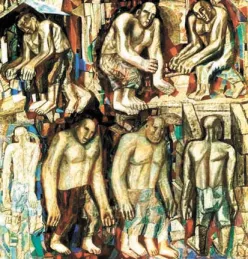
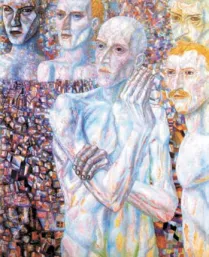
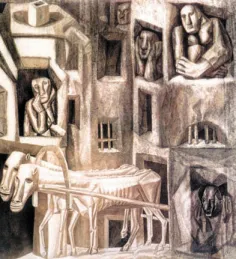
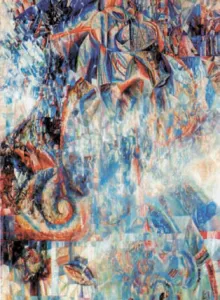
At the very first exhibition, where Filonova was a lot (apparently the end of the 80s), I was struck by the immediate neighborhood of his two works: the “feast of kings” hung on the wall, recognizable as a unique philonist work, and near Molbert stood an almost naturalistic portrait of E.N. Glebova (sisters of the artist). I only knew about the life of Filonov that he died in a blockade - as it seemed to me, lonely and unified ...
This, generally, is not entirely, the testimony of this is the artist’s diaries ( http://uni-persona.srcc.msu.ru/site/ind_cont.html ) “Diary” of Filonov for 1930-1938. I opened by chance, starting to read the vast comments of the publisher, the famous art critic E.F. Kovtuna (1928-1996).
Filonov should not have been considered lonely and unified in the sense in which the lonely and unheated was, say, Van Gogh. First of all, because Filonov had students who thought of themselves as a school of analytical art. It really was a collective - with manifestos, intra -limkh conflicts and even membership fees.
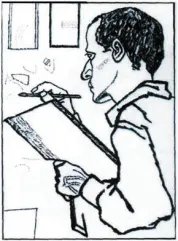
Despite all the characteristics of the character of Pavel Nikovaevich-sharpness, intransigence, exactingness, which was often turned into cruelty, not to mention the unprofiting of Filonov into the art environment of the 30s, his students, which is called “not translated”: came even from abroad. But this is Peter of the 30s, i.e. Leningrad after the murder of Kirov! ... Filonov categorically refused to take money from those whom he taught. This is understandable when it comes to his permanent students - such as Mikhail Tsybasov or Alice Porvis. But Filonov, following his principle, not refuse to teach his analytical method to anyone, set out its foundations (in his terms - “gave a production”, that is, told and showed) to everyone who asked him about it. By the way, without asking even surnames ... In 1936, MV Yudin came to him, and within three hours the master "gave her a production."
It is true that Filonov was forced to earn his bread with anything but his painting, and constantly starving in the literal sense of the word. However, this was his choice: he categorically refused to sell his paintings even to the Russian Museum, not to mention private faces: he dreamed of his own museum. This is how he himself motivated it:
For the money, Filonov agreed to write a portrait of any of the leaders for the holiday (copying standard photos); To make any work of a “masking” nature, even if it was monstrous physical work.
Although during the life of Filonov he did not have a personal exhibition, this does not mean that his paintings were not exhibited at all and were inaccessible to contemporaries. He was well known in the art world, and people were ready to stand in line to see his works exhibited in the halls of the Russian Museum at the Losch collective exhibitions.
Filonov was indeed existential alone - meanwhile, he married by love; Together with one of his stepsons - Petya Serebryakov, Filonov painted a huge ceiling ceiling over the foucum pendulum in the Kazan Cathedral. His summers of Glebov constantly tried to support him financially, but he often refused even the food brought to him. He agreed to take money only from the "daughter", i.e. The wife, E. A. Serebryakova. A few words should be said about her.
The neighbor of P. N. Filonov on the house was Espper Alexandrovich Serebryakov (1854-1921), a former naval officer, a people and an emigrant. In exile, Serebryakov met with young Katya Tetelman, also a population, and in 1885 they got married. Serebryakov were the neighbors of Filonov around the house - so in connection with the death of Serebryakov in 1921 with Filonov met his widow, Ekaterina Alexandrovna.
In the diaries of P.N. He called his wife a daughter, although she was his twenty years older, and treated her with tenderness. In 1936, Ekaterina Alexandrovna went to Moscow, hoping with the help of her friends - the old Bolsheviks to organize the personal exhibition of Filonov. Here is what Filonov wrote about this plan: it is impossible to describe how she wants to do anything for Spain and what is the power of her hatred of the Nazis. Each time, from newspapers or by radio, we will learn about the course of the Civil War with her, she says that it is necessary to make my exhibition, it is necessary to seek by all means to take place, and the whole collection to the last penny is given to Spanish wrestlers. Our thoughts are the same about this, but I think that the beloved daughter will spend their blood pennants on a trip to Moscow for nothing-the Moscow Dushegubs will rather help General Franco, with whom, in my opinion, they are one fascist field of the berry, which will agree to my exhibition. But in the small weak body of my wife, an indomitable will and Vera lives, and she breaks to Moscow.
When reading the diary of Filonov, there is a feeling that his text was written by several, and, moreover, very different people. Some fragments give a person not just a highly educated, but fluent in both oral and written syllable. For example, a conversation with I. Grabar about the exhibition at the State Russian Museum:
And then we read the paragraphs, not just full of curses against officially recognized artists and to an even greater extent - to different superiors, but also so specific in form as if their author was a “man with a gun”:
I felt enormous reassurance and joy that my blow was well calculated and came “right into the pork face” of this gilded black -hundred bastard, which would sell the Soviet government tomorrow and would finish the wounded communists if their White Guard could be crushed by the Soviet regime.
A completely different register turns on when Filonov expresses his experiences about such a significant event for him as the murder of Kirov:
It was as if something hit me in the face with an instant feeling of grief and a huge loss from the death of this person. It seemed that I myself had lost something expensive in him, although I did not know anything about him, never saw and did not hear him and did not read any of his speeches.
You should not think about Philunov as a hermit that lived in the mountain heights - he very realistically imagined how the world where he lived. Here Filonov comments on the next episode of the artistic life of those years:
Not to Comrade Zhdanov must go. I told Terentyev (student of Filonova. - R.F.) that there is a rule: without jumping over the organization, to look for justice first within its limits. And he advised to start with the workshop committee, with the jury, from the exhibition committee.
Despite his sharpness, Filonov was loved by students. He himself was deeply attached to some of them - probably not expressing his feelings in any way. In the diary of Filonov, sometimes gives himself will:
Thus, invisively disappeared and now my beloved little Vakhrameev, a master of analytical art. He suffered a lot of grief. I could do a lot.
As the famous Soviet schedule E. Kibrik wrote in diary notes, Filonov was an ascetic who unwavering his views to life. He brought to a complete minimum life expense. His clothes - an unchanged jacket made of a soldier's overcoat, gray cap, soldier's shoes and old black trousers - he wore absolutely carefully carefully. He ate black bread, potatoes, smoked a flyer. He decided to spend no more than 20 rubles a month. He earned them with technical translations (he studied foreign languages by the tutorial.
The artist Filonov died in 1941, in the blockade, dividing the fate of one and a half million of his fellow citizens. The sister Glebov was taken to the cemetery on the sledges that were seriously ill and already completely old Ekaterina Aleksandrovna. As you know, E.N. Glebova managed to preserve a significant part of the work of his brother. In 1977, she, fulfilling his last will, presented 300 works of Filonov as a gift to the Russian Museum.