Date
Author
Source

Preserved copy
Translated material
Domodedovo: Not a terrorist attack, but a cataclysm
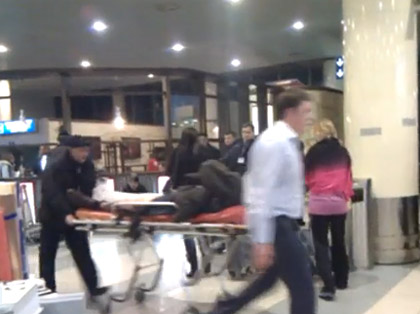
Having learned about the terrorist attack in Domodedovo, President Dmitry Medvedev convened an emergency meeting in Gorki-10. Three people were called to the meeting: the head of the Investigative Committee, Alexander Bastrykin, Prosecutor General Yuri Chaika and Minister of Transport Igor Levitin.
Thus, only those who should respond to the terrorist attack were invited to Medvedev: Bastrykin was instructed to create an investigative group, seagull - conduct a check of transport facilities, Levitin - to introduce a special regime at the airports. But two people who could ask a number of unpleasant questions (for example, whether everything was done to prevent the attack) - the Minister of the Interior Nurgaliev and the director of the FSB Bortnikov - were not invited to the meeting.
They did not come to Vladimir Putin either. The Russian prime minister, apparently, also considered it inappropriate to ask questions and, after the president, preferred to give instructions - he instructed the head of the Ministry of Health and Social Development Tatyana Golikova to prepare documents to assist the families of the dead. 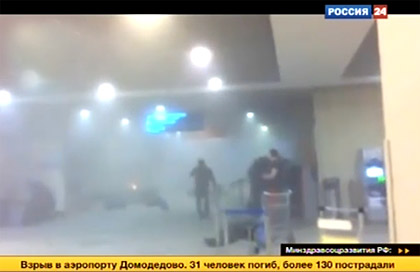
Bortnikov and Nurgaliev did not appear not only before Medvedev, that is, the authorities, but also to the television cameras, avoiding the need to answer the questions of journalists.
The tactics chosen by the authorities can only have one explanation: the terrorist attack in Domodedovo is equated with a natural cataclysm, where there are no perpetrators by definition, but there is only a spontaneously arising tragic situation, which must be correctly responded to - and in such cases not questions are needed, but leading instructions.
This tactic appeared long before the terrorist attack in Domodedovo. It seems that at least the last two years of the special services equate terrorism with the phenomenon of nature, since in 2009 and 2010 the director of the FSB Bortnikov did not report on the results of the activities of his department in front of the press (his predecessor Patrushev met with journalists every year in December, and these meetings gave at least some statistics). A year ago, we wrote that Bortnikov’s refusal from many years of practice of annual meetings with the press means that the FSB does not intend to hide anymore, that the special service is accountable only by the Kremlin. After the explosion in Domodedovo, the feeling was created that in the field of preventing the FSB and the Ministry of Internal Affairs’s attacks, they did not consider themselves the present even to the Kremlin, with which Medvedev and Putin lay down with.
Meanwhile, the impermeability of state structures during terrorist attacks becomes a rule not only for special services and the Ministry of Internal Affairs. For many years, the mayor Luzhkov considered it his duty to come to the place of each attack and go to journalists, voicing the first results of the investigation and reporting on the measures taken. This practice served as an understandable goal - millions of frightened Muscovites sitting in front of televisions, the owner of the city showed that handling was not lost and their mayor with them. This old, from the 90s, tradition died immediately, as soon as Medvedev changed the mayor of the city. Sobyanin arrived at the place of the tragedy, that is, he fulfilled his functions of the manager, but did not consider it necessary to go out to the press on the spot. Sobyanin limited himself only to a statement to “his” television cameras.
It is characteristic that Bortnikov and Sobyanin are both appointments of Medvedev, and both easily abandoned the practice of their predecessors, Patrushev and Luzhkov, to report to the press, no matter what ugly forms these reports were worn in the 2000s. The new type of manager, to whom Medvedev gives preference, does not consider himself to be any extent responsible to people. 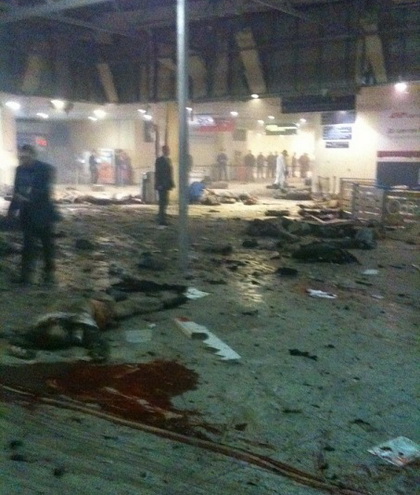
However, counteracting terrorists is not just a field of managerial decisions of varying degrees of effectiveness, the shortcomings of which can be classified. There is an enemy here, he is active, and he takes step by step, while the Kremlin and the special services receive dividends from the regime of complete impermeability.
No secrecy can hide that this regime ultimately weaned the power structures to react to the threat in time.
Here are just a few facts. The current strategy for the fight against terrorism was developed in general terms in 2004, finally designed in 2006. The main priority is to prevent the attacks of large groups of militants, which lead to a loss of controllability (that is, political stability) in the region or the country as a whole (therefore, the forces of explosives, special forces, etc.) increased.
In turn, the terrorists changed the tactics just after 2006-moved to the actions of small groups (2006), returned to the practice of using suicide bombers (2007), sharply increased the number of terrorist attacks, undermining and attacks on employees of law enforcement agencies and infrastructure facilities in the North Caucasus (2009-2010), and finally sent sucks to Moscow (2010).
However, one key decision (the appointment of Khloponin in the North Caucasus District can be left with brackets, since he was not given the authority to intervene in the actions of the security forces) after 2006 it was nevertheless accepted-in April 2009, Dmitry Medvedev solemnly announced the completion of a counter-terrorist surgery in Chechnya, and at the end of 2009 the Department of Combat Breed in the Ministry of Internal Affairs of the Ministry of Internal Affairs. Organizational and terrorism.
PS The next day Medvedev showed who will be found guilty: the president first stated that the leadership of Domodedovo would be held accountable, and later ordered the head of the Ministry of Internal Affairs of Nurgaliev to prepare proposals for the dismissal of employees responsible for safety by transport. He ordered similar measures to be taken in relation to the FSB officers. Thus, Medvedev made it clear that he was ready to criticize only those who are directly related to the airport security regime, but not a system of preventing terrorist attacks in general.