
Translated material
Anti -family Thomas Mann
New performance of Mindaugasa Karbauskis
** 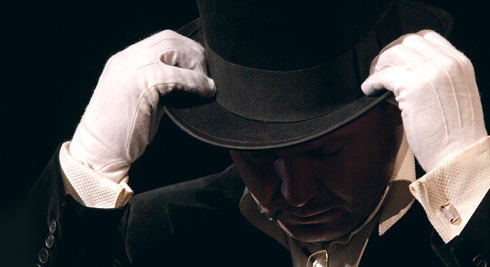 The eldest son (Ilya Isaev) is trying to be a continuation of his father
Without a family. In the midst of another campaign in defense of family values and the fight against a demographic decline, the Russian Youth Theater releases an openly anti -family performance. The distant German "Buddenbrooki" turned out to be frighteningly relevant **
The Ground novel of the Nobel laureate Thomas Mann has no stage history in our country, with the exception of the 1972 radio supply. To translate this multi -page work of the German Tolstoy into the theater is a feat in itself. To give him lightness and swiftness, without losing the philosophical depth, is doubly a feat.
The skeleton in the closet
Mindaugas Karbauskis “tortures” himself with anti -glacial prose for a long time and successfully. Andrei Platonov succumbed to him (“The Story of Happy Moscow” in the Tabakov Theater), Leonid Andreev (“The Story of the Seven hanged people”, ibid.) And William Folkner (“When I died,” ibid.). On the scene of Ramta, he put the dramatic chronicle of Izhokas MeraS “a draw lasts a moment” about the life of a Lithuanian family in a Jewish ghetto and has long been approaching the Platonic “foundation pit”.
In his appeal to the “Buddenbrooks”, it seems, there is something personal: the director of the director Ramunas Karbauskis is a prominent politician and a millionaire, one of the ten richest people in Lithuania. And Mindaugas himself has repeatedly admitted in an interview that he was a wealthy person and did not come to the theater for earnings. Material well -being gives him freedom and independence so necessary for a creative person, but, apparently, the origins of the intra -family conflicts of Buddenbroks are well known to him. No, no, and it will break out of the depths of the closed Karbauskisov soul, the hidden resentment at the father, whom the theatrical hobbies of the non-impedic son were clearly annoyed.
Maybe these Buddenbrooki are another argument in an unfinished family dispute?
The sound of a bursting string
The artist Sergei Barkhin covered the red rust of the beam of the Buddenbrook family and a thick layer of dust - an old folio, in which a year after the year, the event after the event reflects a long life of an old merchant family. We find the beginning of the end - before us the younger generation of Buddenbroks, on which, in fact, everything will end.
Actors do not dress up in lace and tailcoats - only the details resemble the time of action. The treatment of the text, as always with Karbauskis, is perfect, with the preservation of copyright remarks and precisely verified intonations. In some incomprehensible way, in his performances, literary speech sounds like a straight line, almost colloquial. Almost the entire performance goes to the music, the piano stands right on the stage, the heroes are slightly touching the keys, then sit down at the instrument-but the music is almost not interrupted, which gives the effect of silent black and white cinema. And it seems that the tempo of the performance is completely subordinated to the rhythm of the musical and acting speech in the amount of the waltz, then the Polish. Chopin and Schubert are replaced by vulgar waltzes and cabaret sheet, monotony and rattling of a frustrated instrument to the finale turn the existence of heroes into torture.
Of course, we did not hear the Chekhov’s “sound of the bursting string”, but every moment of silence was perceived as a flash, as a sign.
Home curse
An innocent musical instrument, a symbol of home comfort and well -being in Karbauskis becomes a symbol of domestic violence, a hated family rite, which is transmitted from generation to generation as a curse. Here, it seems, the main thing is hidden: “Buddenbrooki” is a director of the director against imposed family traditions and obligations that turn a person’s life into hell. When the history of the family becomes a source of mythical victories and invented ideals, where each next generation adds a new portion of lies to the piggy bank and these petrified masses of historical bowel movements are inherited as the main relic, indicating the greatness of the family.
The carriers of the great name do not notice how the seal of degeneration lies on their distorted faces, when everything that their ancestors were proud of is scattered to dust. Aristocracy degenerates into arrogance, vanity - into envy of other people's success, pride - into rudeness, and frugality and economicity - in pathological greed.
Life in constant lies gives rise to mutual hatred, which washed out all human feelings from warped souls. Yesterday's noble young men and girls from the right family who did not let out the words of heavenly prayers from the hands of books and sang by angelic voices, before our eyes they lose their human appearance and turn into monsters. Screeching from hatred of each other, mocking in the corners of the fragments of a once legendary house. 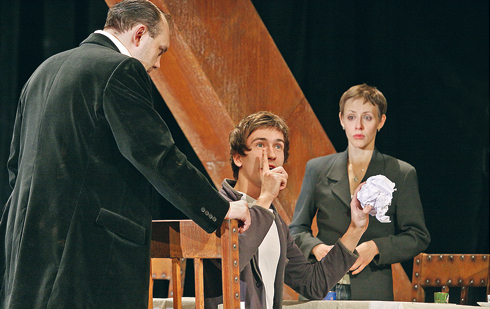
Family - as a model of a totalitarian state based on fear and on lies, on hypocrisy and hypocrisy. In this oppressive space, any manifestation of creative freedom, any manifestation of dissent, any attempt to disobedience to the general charter is regarded as a crime or as madness. Family - as a cemetery of genuine feelings and sincere beliefs, buried under the oppression of dead rites and empty obligations. Family is like a prison, as a life imprisonment, as an employment of a punishment for an imperfect crime. Family - like a meat grinder that grinds a normal person either into a madman or a criminal who does not spare either women or children.
Karbauskis staged a cruel and innocent performance at the same time, compressed as a spring, painful and gloomy, not promising either light or purification, but obviously calling for purification.
The dead, who, with everyday calm, are fired from the scene, the survival of Ida, deftly covering the inanimate faces of huge frames from family portraits, are just dead. There are neither faces nor relics, there are no achievements or exploits. Neither power, nor nobility, nor greatness are inherited. But bad diseases are transmitted. And much more often than talents.