
Translated material
The media collect rumors about Mubarak: a dictator who frightened the Egyptians for 30 years, "how much fell through the earth"
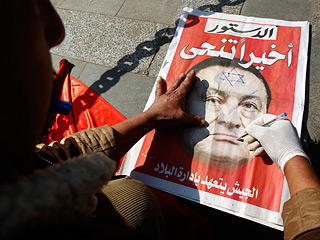
The Arab and Western media closely monitor the fate of the overthrown President of Egypt 83-year-old Hosni Mubarak, whose health was seriously undermined by the latest events in his country. Many are wondering where the ex-leader is now. "Hosni Mubarak, who had been in Egypt for 30 years with his presence, as it failed through the ground: his location is unknown," writes The Washington Post .
According to a number of Egyptian media, Mubarak is in his residence in the resort charm Esh-Sheikh, and this was confirmed by the country's prime minister. In Washington, they tend to believe this, writes the publication that inopressa refers to.
"In the charm of the esh-shohakh, Mubarak is still invisible, but it was always so. According to local residents, over the past five years he came to this resort one or two days a week, often stayed and longer and immediately dived over the high walls of the private residence, which adjoins the hotel and the golf Hussein Salem-the best friend of Mubarak," says the best friend of Mubarak. The author of the article.
- They are expected from the military: Tahrir’s protesters in Tahrir Square are already threatened with arrests
- Media: the entire Arab region can be covered by revolutions
On the other hand, there are rumors that Mubarak went for treatment to Germany, where last year he underwent surgery to remove the gallbladder, and this year he had to undergo a second examination. According to the newspaper, some sources among civil servants in Sharm Esh-shoikh claim that Mubarak really arrived at the resort after the resignation, but soon flew to Germany with a stop in Abu Dhabi. The German authorities, however, deny this.
Rumors about the health of the ex-president are also contradictory. The Al-Guumkhuria State newspaper, referring to sources in his environment, on Monday denied the data that the ex-leader fell into a coma.
According to the publication, Mubarak, who left the post last Friday after 18 days of popular unrest, "is in a difficult psychological state and suffers from periodic fainting." However, despite the disease, he categorically refuses intensive treatment.
The sources of the newspaper quoted by RIA Novosti say that the former president remains in his residence in Sharm Esh-Sheikh, where two doctors are constantly located with him. They were called there after during the recording of his speech , in which he, still desperately clinging to power, announced the transfer of authority to the vice president, Mubarak lost consciousness several times.
Even for treatment, the overthrown leader does not want to leave the country, continues al-Gumkhuria. In his recent speeches as the head of state, he repeatedly stated that he did not intend to leave Egypt, "to whom he had served more than 60 years."
At the same time, the Al-Masri al-Yaum newspaper reported that Mubarak is in a coma state from Saturday. According to sources, the doctors have not yet decided whether it was worth transporting him to the hospital.
The publication notes that in the air released on Thursday, Mubarak looks tired and haggard on Thursday. It can be seen that he is very nervous, his speech seems to be ragged, sprinkled "literally on his knees." According to leaked information, this speech, designed to become the most important, was repeatedly corresponded to the son of Mubarak Hamal.
They expect a tough government from the military: the protesters in Tahrir Square are already threatened with arrests
Recall that in this speech, Mubarak transferred the executive power to Vice President Omar Suleiman, but “swore to God” that de jure would remain the head of state until the next elections in September. However, on Friday, when the most large -scale mass performances began in Egypt from the beginning of the revolution, Mubarak was forced to completely resign.
The fact that the president left the post and transferred power to the Higher Council of the Armed Forces of Egypt, which is headed by the Minister of Defense Hussein Tantavi was announced by Omar Suleiman.
On the second day after the departure of Hosni Mubarak, the military, who had all the authority in their hands, dismissed the parliament , suspended the constitution and announced that they would rule the country for six months, or before the presidential elections and the National Assembly.
The world media have already expressed concerns that under such circumstances there is no need to talk about democratic transformations in Egypt. According to available information, on Monday all strikes will be officially prohibited, and the instigators of Chaos and Riots will be punished. “Starting from today, we no longer need any demonstrators sitting in the square,” said the chief of the Egyptian military police Muhammad Mustafa Ali at the moment when the soldiers dismantled the tent camps of the demonstrators on the Cairo Square Tahrir.
But despite the actions of the military, several thousand demonstrators still remain in the square, reports ITAR-TASS. They require the liberation of all political prisoners, the abolition of the law on an emergency, termination of the work of military courts, fair presidential elections and transfer of power from the Supreme Council of the Armed Forces to the hands of civil politicians. Protesters promise not to diverge until all these requirements are met.
According to Al-Arabiya , the military police demanded that the demonstrators remain on the Tahrir Square immediately leave her immediately, threatening the arrests otherwise. As the military explains, their strategy is to calm the nation as soon as possible after 18 days of confrontation and ensure elementary legal protection of the population due to the actual refusal of the police to fulfill their duties.
“In Egypt, everything happens very quickly, and this is after 30 years of absolute inertia,” the Italian Corriere Della Sera comments on the current situation. She writes that the Egyptian opposition considers all this a “logical” development of events, but is afraid that six months is an insufficient period for preparing democratic elections. Some "youth representatives from Tahrir Square", who relied on a mixed military-civil leadership, also express doubts.
The publication focuses on the next "delicate moment": when banning strikes and riots, the military intends to protect the people's right to manifest.
“Egypt has become the second fallen domino feature in the Arab world controlled by autocrats,” Die Welt continues, recalling the unrest in Tunisia, which also ended with the overthrow of the president. There are many reasons why the Egyptian experiment could have failed, the newspaper believes, but the Egyptians for 18 days were able to shake the chair under the dictator, whose chances experts evaluated quite highly.
Media: the entire Arab region can be covered by revolutions
Protests are distributed to all Arab states, writes The Wall Street Journal . The people's anger, which overthrew Mubarak, threatens to raise a new series of uprisings in the region. Yemen, Algeria, Bahrain and Jordan became centers of new unrest. The leadership of the Palestinian autonomy on the western bank ordered the resignation of its office, calling on Saturday to the new elections, the newspaper lists.
In Iran, despite the preventive measures and warning of the government, the opposition leaders, who had been quietly held quietly, distributed a statement with support for protests on Sunday, to which trade unions and student organizations have already joined. On Sunday evening, in Tehran, according to eyewitnesses, backed up by YouTube videos, the demonstrators chanted: "Death to the dictator."
After the events in Tunisia and Egypt, the president’s departure for this region ceased to be something exceptional, writes Le Monde . "This is as if another Berlin wall gave a crack: probably, somewhere there will be more or less strong resistance, because" concrete "is not the same equally strong, but this time we switched to the highest stage." A review of the materials is prepared by Inopressa . Comments of Arab publications are presented on the Newsru Israel website.