
Translated material
Quotation Day
In January, the Russians received new payments to pay for housing and communal services. The real increase in tariffs coincides with the promised interest by 15
At the end of last year, Deputy Prime Minister Dmitry Kozak said that the government gave concrete instructions to the regions to take all necessary measures so that in 2011 the actual payments of citizens would not exceed last year more than ...
At the end of last year, Deputy Prime Minister Dmitry Kozak said that the government gave specific instructions to the regions to take all the necessary measures so that in 2011 the actual payments of citizens would not exceed the level of last year by more than 15%. “New” decided to check whether the regions listened. We took payment receipts for December and January, asking for help from our Sobber, calculator and ...
It turned out that no average picture in Russia exists, every subject has its own troubles and its joys. In Voronezh, for example, the communal apartment practically did not rise in price, but in St. Petersburg the amount in January payments is more half as in December.
In Moscow, despite the promise of the mayor of Sergei Sobyanin, to keep within 15%, the rented rent in the payment of our correspondent was 23.1% higher in 2011 than in the past. However, the capital is practically the only region where residents pay not 100% of the cost of housing and communal services. So, due to various benefits, it will be possible to approach the indicator recommended by the federals. However, Moscow has already headed to reduce the “communal social package”, which means that the tariffs in it will soon begin to grow by a leading and fingering pace.
An equally curious picture is obtained when you begin to delve into the payment itself.
The growth of the tariff for certain types of utilities reached 490%, but in fact this is not such a terrible figure - the tariff for managing an apartment building increased in St. Petersburg from 20 kopecks to 1.8 rubles (the fee has increased to 68.3 rubles). In the same place, the content of the apartment building increased in price from 3.39 to 8 rubles - and these are the residents of the city on the Neva, it seems that they will be pulled, despite the frightening 236% of the tariff growth.
But the almost double increase in the heating fee in Moscow, which we recorded, gave the lion's share of the general increase in the cost of utilities in the capital.
Actually, how do we accrue tariffs? For example, I did not have an antenna in the apartment at all, there is no contract, and there is a service in the receipt. And if you carefully study St. Petersburg payments, we can conclude that they stopped cleaning in the entrances and export garbage, since these points from the January receipts simply disappeared.
If you read the Housing Code, then article 154 says that residents must pay the maintenance and repair of the living quarters, which includes a fee for services and work on managing an apartment building, maintenance, current and capital repair of common property. As well as utilities: cold and hot water supply, sanitation, power supply, gas supply, heating.
All other services, such as: an intercom, antenna, security, etc., are included in a single payment document only with the consent of the parties, when concluding a separate agreement. “Now everything is given to the discretion of local authorities, the HOA and management companies, which often make such points, putting people before the fact. This happens because citizens themselves do not defend their rights and often do not look at what they pay for, ”said Tatyana Ovcharenko, a member of the Yabloko party, who provides legal support in the fight against communal services to Muscovites.
By the way, unlike officials, independent experts do not at all share the belief that permanent tariff growth has an objective nature.
“In order to be possible to reduce the prices for housing and communal tariffs, it is necessary to first determine the complex of measures of administrative, economic, legal, organizational,” says Nikita Krichevsky, doctor of economic sciences. - You should start with freezing tariffs at housing and communal services next year, and in the future it is necessary to develop a program of step -by -step reduction of tariffs. Now we pay for those services that we do not receive, in a volume that is often overstated two or more times. For example, in winter, an increase in temperature on the street even one degree can save billions, and in large cities tens of billions of rubles on the fact that less fuel is consumed, but this is not tracked and not taken into account. ”
Public utilities say that we have not yet switched to 100 percent payment for housing and communal services, so they continue to raise prices, and it has been going on for a long 10 years. The question arises: if we cannot understand how much they make up and from what are the “average 15%”, then how to determine an unreal amount of 100%?
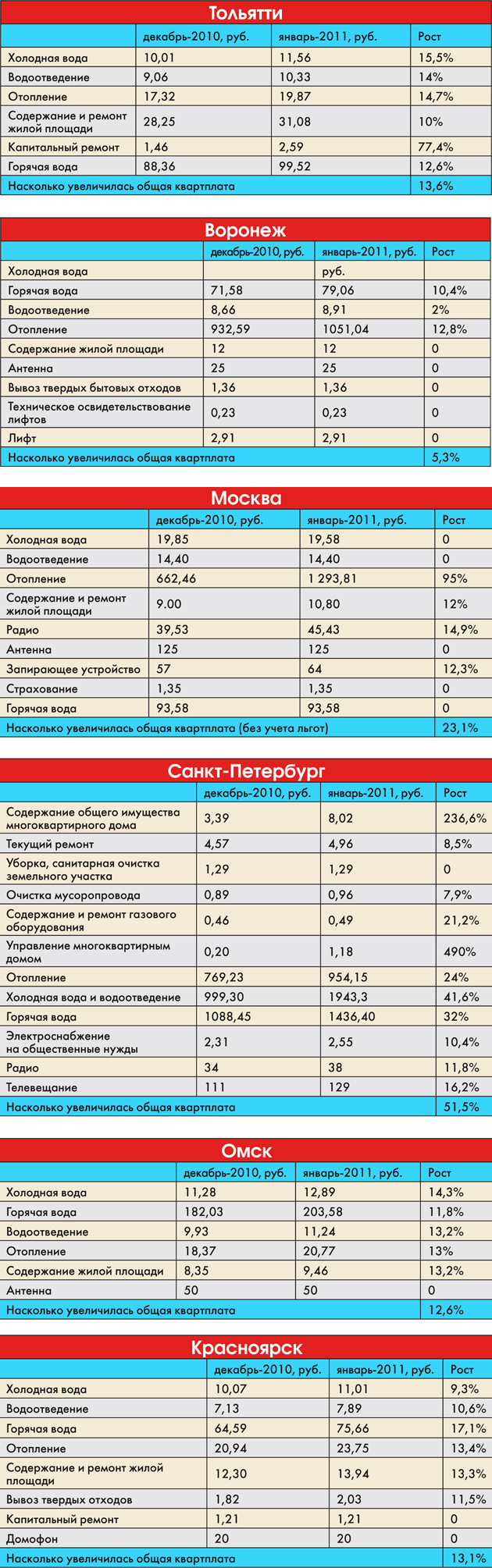
An attentive reader will surely reproach us that there are no units of measure in tables. The problem is that they, as in medieval Europe, in each region of their own: somewhere hot water is considered in gigacalories, somewhere “per person”, overhaul can be considered by the number of residents, by meter or formula, taking into account both of these indicators.
In addition, in St. Petersburg this year heating began to be considered in gigacalories, although in December they were still exhibited in cubic meters per person. And in Moscow - on the contrary! In order not to play a month and a half, we had to compare not the tariffs itself, but the amounts accrued for these indicators in each of the months.
Such nuances were in every payment.
If there are those among you who want to calculate the growth of their costs for the rent, then we expect letters to you by e -mail 2011@novayagazeta.ru .