
Translated material
"I just did not have enough brains"
The most famous Russian media -startup, Leonid Burshid, evaluates the work in the "elephant". And discusses the mediaevalia.
Leonid Burshid led the launch of Russian publications such as-bending his fingers-“Vedomosti”, “Forbes”, “Newsvik”, “Smart Mani”, “ Elephant ” and others. The last of these publications was founded in the spring of 2009, Bershidsky headed the “Elephant” for almost two years, until mid-February 2011. Instead of that since May 2010, the most famous Russian startup manager has been working in the publishing house Eksmo-the head of the editorial office of business and educational literature. Now it is the main place of Bershid's work. In his letter to leave the “Elephant” nothing is said about the reasons for leaving.
In an interview with Salt, Leonid Bershid literally appreciated his work. And he spoke about the features of the Russian media reward: money has gone from the press, but have not yet appeared on the Internet.
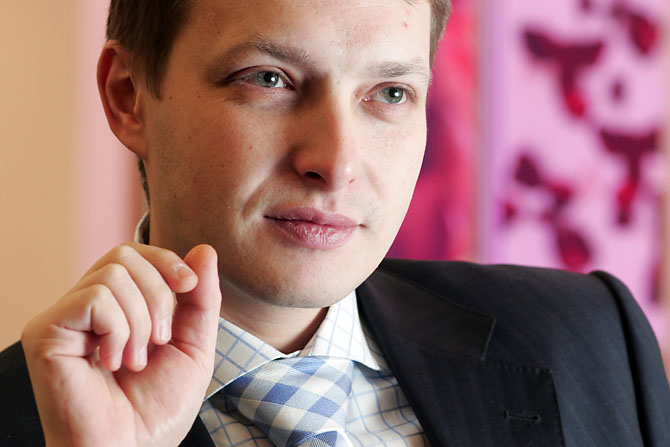
Leonid Bershidsky set himself a three with a minus for the “elephant”.
Photo: Sostav.ru
- Starting from that characteristic about the main Russian media -startup. You have not been working in the media since this week. Which, of course, is a bad sign for the people of our profession. It turns out that little interesting will happen here. Nothing new is foreseen if the main shooter leaves. So?
- The concept of “media” is wider than the concept of “media”. I have been working in the book business, in fact, since May last year.
Well, then I am not the main shooter, of course. I am just a participant in a number of large projects, more or less controversial. I think that not everything new in this market can be connected with my person.
-This is not an answer to the question about whether it is worth waiting for something new?
- The market is definitely worth it. There is now a revolution. And from me - let's see.
-I will try more clearly: there were 20 years of growth, multiplication due to Western technologies, their own incidents like “Kommersant” or “Life”. Last year, something like a correction began: for example, the Russian Newsvik died.
- “Newsvik” died with the “mother” [American publication of Newsweek], in fact, during this revolution: old formats are being revised, there is a search for new ones associated with a change in the methods of consumption of content. But, by the way, the American “mother” of Newsvik can now come to life magically. Tina Brown, the former editor -in -chief of the New Yorker and Vanity Fair, is now steering to her. Soon she will show what she came up with, and, perhaps, will set some new direction to the entire weekly format.

The most famous Russian media -startup is 39 years old. He considers himself a dinosaur.
Photo: Sostav.ru
- But in general, the revolution, what is it?
- Until recently, Huffington Post has sold more than $ 300 million. This is also a piece of revolution, and it is a very clear format and a clear development path. I just started when some newspapers used a hot set, and I am already a dinosaur at 39. And the market is developing. How not to wait for a new one?
-Do you think that this revolution will somehow be seriously manifested in Russia? With its somewhat specific media market? What is there - "somewhat." Everything that is not a big TV or a conditional “life” no one needs. Of course, you know these talk about the fact that all other Russian newspapers and magazines are read by journalists themselves plus their loved ones.
“I know these conversations and I consider them garbage.” I worked in a bank, now I work in a book publishing house, I saw and see people who read magazines and newspapers (though now my friends read newspapers only on the Internet).
I also do not think that “nobody needs” everything except the TV and “life”. If this is true, then at the moment, an uncertain person takes an interview from another of the same for the publication, which no one needs.
- Exactly so.
- And then we need to stop jerking off and getting down to business right now.
- If you believe the hypothesis.
- If we believe her, we must finish on this. If we do not believe, we can continue. Of course, the revolution is global - why would Russia suddenly have immunity? We happened the other way around: in Russia there is a revolution, but nowhere else.
- What will happen with the previous form of life based on the results of the revolution? Here, for example, with those publications about which a table of actual and declared circulations was published a couple of days ago. There, for example, the D-Shatrich magazine, all of us, is a desperately beloved (in quotation marks), actually prints at times less than the declared.
- Yes, I saw this table. Well, there are solid circulations of actually, which could not be overestimated.
“And yet, Huffington Post is not dealing with such circulations.”
-Another thing is that the circulation of Kommersant-Weekend leads to sad thoughts about the circulation of the Kommersant itself, in which this application is invested. But this is precisely the consequence of the revolution. I do not know anyone who would read newspapers on paper. But the demand for their information remained. Hundreds of thousands of people go to the sites of Kommersant and Vedomosti.
And the glossy magazine, which is sold hundreds of thousands of copies, is an excellent business, I will tell you. Despite the revolution. And some of these magazines are very advanced in terms of new forms. Look at the Russian Cosmo and Men's Health - they have beautiful, cunningly made versions for iPad. At the level of the best foreign samples.

The work requires the Berschid ability to understand the breeds of horses and journalists.
Photo from the archive of Leonid Berschid
- Agree. Although in any case, all this is not a “revolution”, but rather a “coup”. Where is the expected penetration of the service? You, again, are sure, you understand what I mean: the Internet is a thing where you can’t just make a newspaper. Let it be operational. That is, it is deprived of paper deficiencies. On the Internet, it is rather not just information, but information plus service. In Russia, in addition to the Afisha website, something is not possible to immediately remember anything.
- Well, I don't know. What service does The Wall Street Journal provide on the Internet? Or Murdokovskaya The Daily for the same iPad? Demand has not gone to the information, it just needs to be dissected differently. What is the service of the same Huffpost? Yes, no, just differently packed and chopped information.
-That is, a picture of the future: in Russia, someone copies the Haffington Post technology or-linearly, as with the “Vedomovy”-will buy it and try to instill it on the grounding soil? Such a prospect?
- “Vedomosti” did not buy a technology for a draw, but built their own from scratch. Most likely, the Huffington Post Russian will be arranged internally differently than the American one. It is ridiculous that when my colleagues and I invented the Elephant, we did not see Huffpost. Just everywhere the same ideas are in the air. Someone is getting better, someone is much worse.
- And how did you do it? On the Haffington scale?
-There are some kind of main routes of development, and Huffpost is a pointer to one of these ways. The Daily - on the second ... Well, there are still many different ones. How did we get? Three with a minus.
- Why?
- We are Russians, it explains a lot. Seriously, I just did not have enough brains to do as well.
- The brains are profitable. That is, now the average portrait of a journalist (take federal publications) is something like: a professional girl with a humanitarian higher.
-Do I look like a professional girl with a humanitarian higher? By the way, about different paths. While we are talking here, this one gets out. Everyone is trying, even quite amazing.
- About the girl. I'm not talking about managers, but about work horses.
- Well, how can you averaged, and Vladislav?
- The profession is this: exaggerate.
- Non -working horses are not paid anywhere now. And there are all kinds of workers. Both girls and former captains of the Soviet Army.

The journalist Bershidsky laughed over the book of Nikolai Up. Publisher Bershid - enjoys.
Photo: Sostav.ru
“But there are not enough brains.” Here we come to one of the whales (elephants) of Russian media - the narrowness of the market. There is nothing to pay for those who helped.
- Well, yes, the money goes from the paper, but they crawl well to the network. This is not enough than to pay. There is such a problem, I do not argue. But so far, not as acute as, for example, for metranpage and chimney sweeps. However, the reporters certainly never promised that it would be easy, they never went to this profession for money.
-Another whale: dead socio-political life. On the one hand, there is nothing to write about. On the other hand, as soon as the media becomes really influential, the deputy of one administration calls. This is the time to exclaim about the “this country”, in which everything is in vain.
- Well, they call. But in fact, the media do not even close even for strict opposition. You are unlikely to call at least one example.
Some The New Times does not complain that he has nothing to write about. He writes to himself, does not even have time about everything he would like. There is a problem with self -censorship, it is in the head. There is no problem with the lack of material. Navalny does not complain either.
- Agreed. Since the revolution, who will be the first to be swept away. Otherwise: to which of the paper media do you want to die before the rest? The death of "RBC Daily", I remember, you were glad.
- I will be consistent and repeat this wish. RBC is still the wrong thing. And so I especially do not want death to anyone, all sorts of ridiculous bubbles will be blown away without it.
- The last question: how did it happen that Nikolai (sorry Lord) Uskov foresaw your departure? I mean when I sent you curses in response to your review about his fresh art work.
- Yes, it seems he did not foresee anything, he just saw a quote from his book, read, and he felt ill. He decided to take his emotions on me. The joke is that I work in Eksmo, which published Up, and now I am happy to observe the good sales of his terribly cynical book.