
Translated material
The victims of Stanislavsky
Ksenia Larina - about how the theater waved to his deity
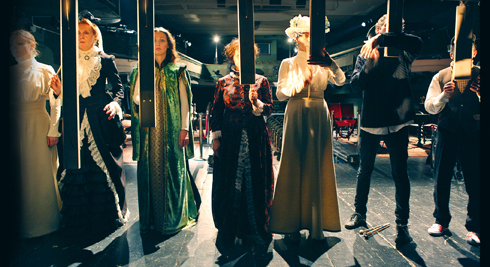
ABC of acting, the basics of the "Stanislavsky system" actors play before our eyes
The victims of art. If the theater is a temple, then we were allowed to the holy of holies, where a mere mortal was ordered, we were allowed into the altar. In the Drama Theater. K.S. Stanislavsky was transferred to the stage theatrical “Bible” - the work of the founder of the “School of Stanislavsky” “My Life in Art”. The play “I do not believe” turned out to be cheerful and terrible. Fun - because the theater is generally a funny occupation, but scary - because art really requires sacrifice
The audience goes to the “altar” through the hall, climb the ramp on the stage, pass through the improvised museum, in which the action will take place. The museum is the decoration of several rooms. Table, chairs, sofa, ancient photos on the walls, in the rooms of mannequins in theatrical costumes. Black boards scenes faintly creak underfoot. Spectators pass through the “fourth wall” - pass the line of the curtain and remain in behind the grinder, alone with a naked theater machinery, deaf brick walls, black picket fants, iron rods and props, placed in the corners of the curtains. Following the viewer, artists rise from the audience and remain to live in museum rooms. So the theater begins.
The second reality
The playwright Mikhail Durnenkov and director Marat Gatsalov wrote their stage essay on a free topic. To hope that the artist in the costume and make -up of Stanislavsky will come to the forefront and, taking away the monocles from the eye, will say thoughtfully into the hall: “I was born in Moscow in 1863 at the turn of two eras” - it would be ridiculous. Stanislavsky is Kostya (actor Alexander Userdin), a young man of the 21st century, a middle -sized businessman who hated the words “supplier” and “customer” and having a completely different passion in his soul - a high illness called “theater”. The path of Kostya from the reality of the household to the “second reality” of the theater is a mirror reflection of the fate of his great double from the 19th century-Konstantin Sergeyevich Alekseev-Stanislavsky. Entrepreneur and genius, Salieri and Mozart in one person who has set the acting nature above human nature. To remind you that actors are not quite people.
Composing their performance, the authors and heroes persistently seek drama in the successful fate of Stanislavsky, realizing that without a drama, without an internal conflict, this whole undertaking will become another boring byopic. The drama of the great reformer was in the palm of his hand - the fake artificial world of the theater overshadowed the real world for him. The hero of the performance is a person who voluntarily abandoned love, compassion, from family, from fatherhood, from morality, from conscience.
In this conscious choice there is no Nietzscanism: Stanislavsky, following Salieri, dreamed of putting “craft with an art”, but unlike the Pushkin genius of evil, he did not blow music, like a corpse, having previously died off sounds, but on the contrary, he became a sound. The highest meaning of creativity - sounding life - before our eyes becomes unifying secret. So in the hands of the actors any object turns into a living creature. The glasses are sung when the artist’s hand touches them, they sing stones, sing cutlery, sing rattles, sing iron bowls and porcelain plates. And even the annoying sound of iron through the glass becomes music, if you have this hidden hearing, the divine gift of art that encourages you from the world and at the same time making you part of it. 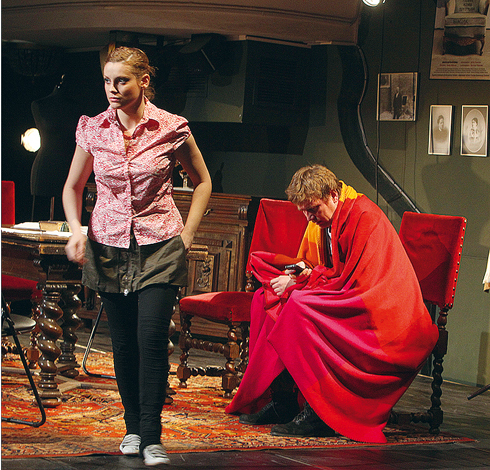
Holy
The secret brotherhood of dedicated to the theater is just a game, and this delightfully simple and clear image becomes the main driving force of the whole performance. When one game is replaced by another, third, fifth and so to infinity, not allowing the viewer to come to his senses, preventing him from finding the origins of this game, its first level.
The artists play the alphabet of acting, the basics of the classic “System of Stanislavsky” before our eyes. All creative cuisine is presented as a fascinating gambling search for the highest truth. Spectators will not recognize, but they will see what a sketch method is, what is the grain of role and its super -task, what an action is and the background, the internal monologues will hear and feel the magical power of the expression “if”.
The priesthood is adjacent to children's enthusiasm, the shamanism of the clairvoyant - with the excitement of the card player. And with each scene, the line between art and life will melt, disappear, wash - either from skill, or from the power of imagination, or from the degree of faith in the proposed circumstances. The key "I do not believe!" It will become the main code of the secret of creativity.
In the scenery of the century
Here everything is true and not true at the same time. As they played to Stanislavsky, they will show us in detail and hilariously funny. Knightly armor, pale beauties with artificial hair, covered with white leggings legs, invisible eyes and fake "die!" With the equally false "I am dying!" Cranberry juice, sung by a block in the "Balaganer", here will become a symbol of theatrical hypocrisy and quackery. The nervous Kostya will desperately demand the truth - the truth of life, the truth of faith, the truth of being at the cost of abandoning the truth of life. And then in real life an inspired genius turns into a finished soulless egoist - while fate will collapse around him, pregnant women and unborn children will sob, father will die, wars will be struck, revolutions will rage, people will die and cripple. For the great Constantine, the entire XX century and people in it are only cardboard scenery, props, cranberry juice. And this is the same drama that he does not find out about and which will appear to be a cruel farce in the Bulgakov “Theater Roman”.
“I do not believe” - a performance that ends with the opening of the curtain. Before he reveals, the actors will listen to their idol right at our feet, his tantrums will witness (documentary fact!), Then the bell will hit - and the curtain will open. And we, together with the artists in the grave silence, look into the blackness of the auditorium. And with them we will survive the last seconds before going on the stage. In these last seconds - horror and delight.