
Translated material
Paper forested
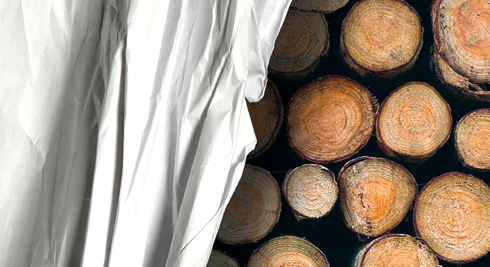
Bureaucratic forestry. So far, from high stands they talk about the creation of “electronic Russia”, enterprises are exhausted under the weight of paperwork. In a strange way, the number of certificates and reports multiplies, although, it would seem, in the era of digital technology it should be exactly the opposite. The phenomenon studied The New Times
 |
The editors of The New Times spend about 20 packs of office paper per month - 500 sheets each. Not at the whim of the editorial office - by the will of officials. Almost all departments require documents on paper media: banks, funds, inspection. For example, the data to the Pension Fund is sent by e -mail, but a paper copy of 30-50 pages is necessarily printed, and each page is necessarily on the front side. A paper copy is placed in the archive - this is the requirement of any verification instance, including tax. And so with almost any document, although the company has an electronic signature certified in all necessary instances. Cause? This is the requirement of Law No. 129-ФЗ “On Accounting” * * Article 13, clause 6 “Accounting reporting is compiled, stored and provided to users of financial statements in the established form on paper media”. .
Crying on trees
In Greenpeace Russia, damage from bureaucratic addiction to paper has long been calculated. “One ton of paper, or 400 packs of office paper, is 20 felled trees, or 5 cubic meters of wood,” says Vladimir Chuprov, head of the Greenpeace Russia energy department. It turns out that the individual version of The New Times is forced to destroy 8–9 pines per year. What can we say about large organizations with their giant paper turnover?
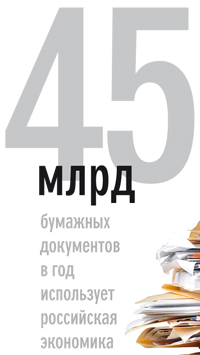
In 2002, the Federal Tax Service (Federal Tax Service) estimated the number of invoices, which is drawn up per year in the country, in 12 billion copies. “According to our estimates, now this amount has increased to 15 billion,” says Grigory Povarov, deputy general director of SKB Contour. - And if you calculate all other documents that the company exchange with each other, acts, overhead, agreements - this will be another 30 billion. The Russian economy operates using 45 billion paper documents a year. ” If we calculate the costs of printing, delivering, driving, data into the program and processing them, it turns out that out of 100 million working people, about 2 million people are engaged exclusively with shifting, printing and entering information from these documents, the expert calculated. In other words, out of every 100 employees, two are engaged in excess work.
“If you summarize all the costs of printing, the delivery of documents, their processing and the fact that the accounts are not paid on time, since everyone is waiting for the documents to get from point A to point B, it turns out the amount of about 500 billion rubles a year,” summarizes Grigory Povarov. - This is 1.3 % of GDP. So the Russian economy is very ineffective, including because of a large number of papers. ”
"
The rule of good tone in electronic correspondence was the phrase at the end of the letter: “Before you print the document, think about nature”
"The authorities seemed to understand the problem, otherwise why are they calling for the transition to electronic media in full swing? The IT-business does not sleep either: there are a large number of interesting development systems of document management automation, which companies and departments are diligently introducing. But the number of certificates and copies is only growing." Paradox, but when introducing automated systems, the volume of parallel document circulation increases by about four times, it increases by four times, it increases by four times. -states Mikhail Larin, the director of the All-Russian Research Institute of Documentation and Archival Affairs, is explainable: it is impossible to refuse paper immediately, because, firstly, there is a tradition, and secondly, there is no official recognition of an electronic document as a legally significant, similar to paperwork in the federal executive bodies. survey, is at least 20% per year. ”
According to Larin, until there is the legitimacy of the electronic document in Russia, there will be a paper confirmation, signature and seal everywhere: “People clearly understand that an electronic document is not appropriate for the case and it is impossible to find a specific executor if there is no person’s signature.”
 |
I don't understand mine
Electronic paper chaos reigns in the authorities themselves. As the New Times reported in the press service of the Ministry of Communications, today the paper is the main method of communications between departments, and electronic documents are only being introduced into separate state bodies. But even in the highest echelons of power there is no single information space. As a result, one program often does not understand another. “Two years ago, the presidential apparatus at the level of the automated office work system could not communicate with the government apparatus,” says Sergey Afanasyev, executive director of the Guild of Management Documentation. “Now this problem is overcome with great difficulty, but far far away, since there are no uniform standards of electronic document management.”
Due to the covers in concepts and standards, most departments prefer to insure and at any time may require partners paper copies of electronic documents. Moreover, state bodies have the right to freely create new types of reports. “Departments have no restrictions on creating new types of documents,” says Mikhail Larin. -Suppose I wanted to create a new type of certificate or change the frequency of reporting in accounting-without problems. No controlling authority in the state regulates this issue. ”
“Honestly, I'm just horrified,” says Marina V., chief accountant of the capital's small enterprise. - The volume of paper work from year to year grows catastrophically, especially taking into account the introduction of an automated accounting system. In the payment alone, the number of details increased several times. ” Even technological progress in individual departments often turns into a headache for taxpayers. “Recently sent reports to the tax inspectorate in electronic form,” says Marina. - Everything was handed over on time. But a few days later, the Federal Tax Service blocked the company's account. It turned out that our reports simply did not receive our reports. ”
Dense thickets
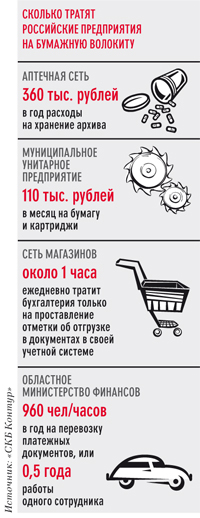 |
In the Federal Tax Service itself, they do not reopen from their sins, but they ask to celebrate merits. The press service of the department said: today 62% of taxpayers who submit tax reports do this in electronic form without duplication on paper. But at the same time, tax authorities can request reports in paper form - just in case. And there are really any cases: the accountant Marina V. recalls how she paid for the technical problems of the Federal Tax Service: in 2008, when changing one automated system to another in the main tax department, the electronic archive with reporting disappeared. “As a result, I spent a year and a half to hang out and submit re -reporting in 9 years,” Marina sighs.
“The former mayor of Moscow Yuri Luzhkov supported our idea of saving paper due to the bilateral printing of documents,” says Vladimir Chuprov from Greenpeace. “But Sergei Sobyanin canceled this order: now in the city hall the documents need to be printed only on one side of the sheet.” And again, the problem is in archaic legislation: the law obliges to conduct paper archiving of all state documents. “This makes electronic document management meaningless, because it is still necessary to make a paper copy of each document, otherwise it has no legal force,” says State Duma deputy Ilya Ponomarev. “And the corresponding amendment to the law has not yet been adopted, since there is no understanding of the problem from individual departments, including the government.” A similar problem is accompanied by an electronic digital signature (EDS): someone recognizes it, but most do not trust. According to deputy Ponomarev, the EDS law has long been outdated, and its new edition, which will endow the electronic signature with greater legal force, was only the first reading in the State Duma.
 |
Another sample of the absurdity is the order of the Ministry of Education of the RSFSR, dated to the mid-80s, which is still valid and orders all the Russian schools to keep paper cool magazines, although I have long been switching to electronic ones all over the world: “Now I’ve been sitting at home and watching the Internet estimate of my 9-year-old son,” Andres Valme, a resident of Narva, told The New Times. “The teacher put the four in the first lesson, and I already see her.” Estonia today occupies one of the first places in Europe in the effectiveness of document management: the population and organizations have long switched to universal electronic cards with which payments, changes in documents, requests to state bodies, even voting are made.
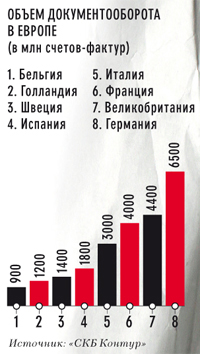
The electronic document management market in Europe, according to SKB Contour, in monetary terms is € 2.5 billion and increases annually by 40% per year. Already 2.5 million European companies (out of 23 million) use electronic documents when working with counterparties and customers. And in a number of countries, for example in Finland, the share of electronic invoices exceeds 70%. The rule of good tone in electronic correspondence was the phrase at the end of the letter: “Before you print the document, think about nature.”
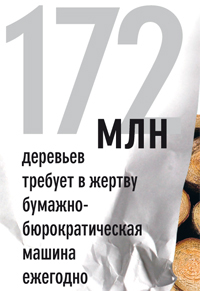
Well, in Russia, meanwhile, according to Greenpeace estimates, annually 43 million cubic meters of forest are cut down only for the needs of the pulp and paper industry. Thus, the paper-bureaucratic machine annually requires 172 million trees.